
AI Commerce Visibility
Shows online retailers how AI assistants rank, describe, and trust their products.
Key Takeaways
- What it is
- Shows online retailers how AI assistants rank, describe, and trust their products.
- Pricing
- Freemium
- Best for
- AI shopping assistant monitoring
- E commerce centric prompt engine
- Product and attribute level analytics
- Rating
- 4.3/5
What is AI Commerce Visibility?
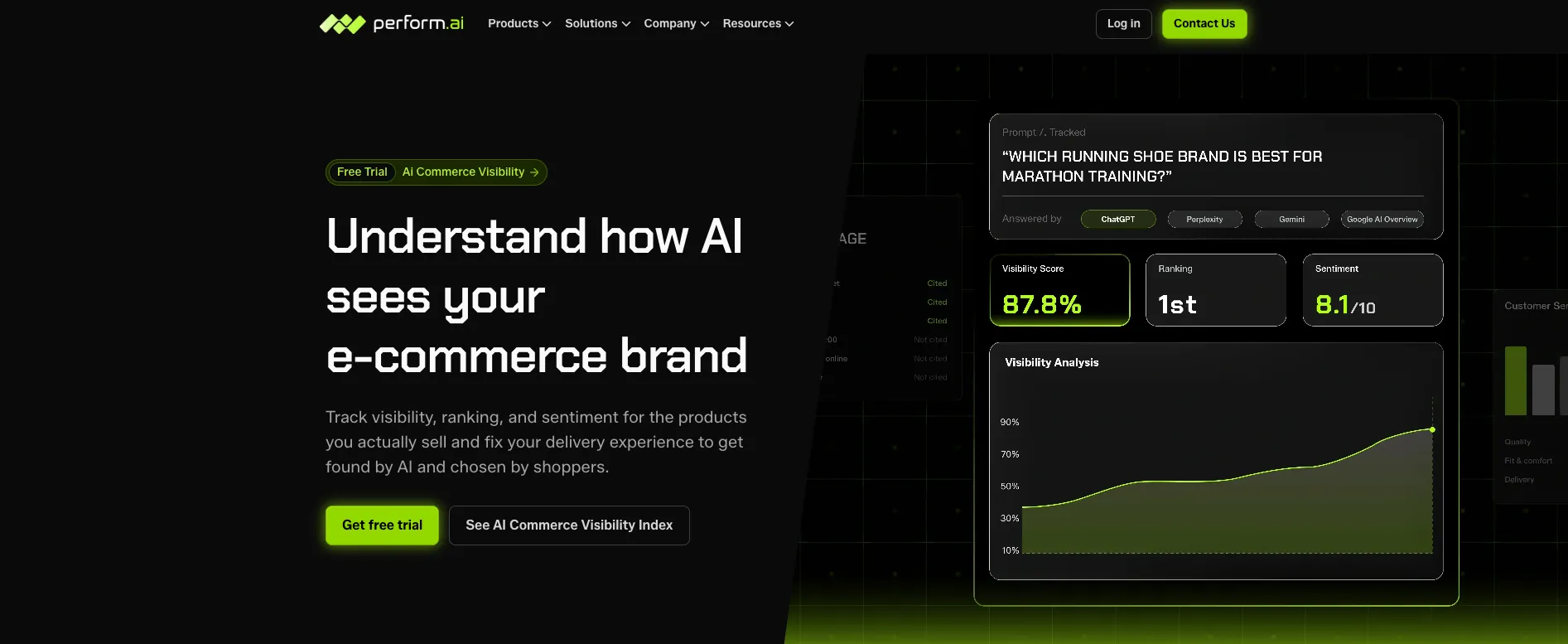
AI Commerce Visibility from Parcel Perform measures how e commerce brands, products, and channels show up in AI shopping assistants. It turns real AI conversations from tools like ChatGPT, Gemini, Perplexity, and Claude into visibility, ranking, and sentiment signals that marketers and operators can act on.
AI Commerce Visibility focuses squarely on how AI agents behave as shopping assistants, not generic search engines. It tracks concrete, high intent questions such as product comparisons, price and policy checks, and purchase recommendations, then connects those answers to category, attribute, channel, and operational performance. The AI Visibility Index adds a public benchmark across brands, while deep citation analysis shows exactly which articles and experiences are shaping AI narratives, giving teams a very direct playbook for changing how AI talks about them.
AI Commerce Visibility gives e commerce brands a focused way to see, in plain terms, whether AI assistants are recommending their products, which competitors are beating them, and why. By tying AI rankings to both content signals and delivery experience, it suits teams that want practical levers instead of abstract AI dashboards. For retailers and brands that treat AI shopping traffic as the next major acquisition channel, it offers a targeted, data driven route to claim more of the AI “shelf” before competitors do.
Who is Using AI Commerce Visibility?
Direct to consumer brands
Consumer electronics, beauty, fashion, and home brands that want to appear in “best of” and “where to buy” AI queries.
Retailers and marketplaces
Multi brand retailers tracking which product lines and partners AI assistants recommend across their assortments.
E commerce marketing and growth teams
Specialists responsible for AEO, content strategy, and brand share inside AI driven shopping journeys.
Logistics and operations leaders
Teams aligning delivery speed, reliability, and returns flows with AI trust signals and recommendation likelihood.
Uncommon Use Cases
Brand owners that sell mainly through retail partners but want to understand AI treatment of their SKUs; agencies and consultancies running AI visibility audits and competitive benchmarks on behalf of clients.
Key Features
Rating Breakdown
Pricing Plans
Free Trial
Free
- Includes automated website scanning to identify product categories, attributes, markets, and competitors, plus generation of 200+ tailored prompts to begin tracking your e-commerce visibility score
AI Commerce Visibility Use Cases
Track product-category visibility
Monitor how specific product categories and models appear in AI shopping recommendations.
Outcome: Teams identify where their products rank against competitors.
Monitor shopper prompts
Use automatically generated and custom prompts covering discovery, comparison, purchase, delivery, and returns questions.
Outcome: Teams see the questions influencing AI recommendations.
Benchmark competitors
Compare visibility, rankings, sentiment, product features, markets, and channels against selected competitors.
Outcome: Teams find specific product and market battles where they can improve.
Find citation and content gaps
Review the sources AI uses, identify where competitors are cited but the brand is absent, and audit sentiment in cited articles.
Outcome: Teams receive opportunities for content and public-relations improvements.
Improve operational trust signals
Connect delivery, estimated delivery date, tracking, and returns performance to recommendations for improving AI visibility.
Outcome: Teams can address operational factors that may affect AI rankings.
Workflow Ideas with AI Commerce Visibility
Set up a visibility baseline
- 1Provide the e-commerce website URL
- 2Review automatically generated product categories, attributes, markets, and competitors
- 3Run the initial prompts and record visibility, ranking, and sentiment
Run a weekly competitor-monitoring cycle
- 1Schedule weekly prompt runs for priority product categories
- 2Compare rankings and sentiment against selected competitors
- 3Review citation sources and identify new visibility gaps
Turn operational gaps into actions
- 1Connect logistics and delivery-performance data
- 2Review recommendations involving EDD, tracking, delivery, and returns
- 3Prioritize operational and content changes, then manually rerun prompts to check progress
How AI Commerce Visibility fits into your stack
Browser
Used through the Parcel Perform portal to configure e-commerce products, markets, competitors, prompts, and AI visibility tracking.
Pros
- +Built for e commerce teams: Mirrors how merchandisers think, using product categories, attributes, markets, and competitors rather than abstract keyword lists.
- +Bridges marketing and operations: Links content, delivery performance, returns, and policy clarity directly to AI recommendation strength instead of treating AI visibility as only a content problem.
- +Fast initial setup: Scans a merchant’s site to auto detect categories, attributes, markets, and competitors, reducing manual prompt and taxonomy work.
- +Transparent usage model: Credits based billing focused on prompts run, with access to all supported AI platforms and regions from day one.
Cons
- −Best for data rich brands: Smaller sellers with limited product depth or logistics data may not fully use the analytical depth.
- −E commerce focused scope: Less suited to non retail verticals that want generic AI search visibility rather than commerce specific questions.
- −Credit usage planning required: Heavy experimenters need to watch prompt volume so visibility tracking does not outpace budget.
Limitations & when to consider alternatives
Known limitations
- Usage-based pricing. Pricing is based on credits and prompts run rather than fixed monthly feature tiers; users can pause tracking or top up credits.
- Weekly default refresh. Visibility data is refreshed weekly, although users can manually trigger a prompt run.
- Limited public AI-platform coverage. The product page specifically highlights ChatGPT, Gemini, Perplexity, and Claude, while additional platform coverage is described as forthcoming.
- Industry coverage is still expanding. The site states that more industries are coming soon.
- Enterprise-oriented positioning. Parcel Perform describes the solution as an enterprise beta designed for enterprise and mid-market retailers.
How to Use AI Commerce Visibility
- 1
Start the trial
Submit your e-commerce website URL so Parcel Perform can scan the site and generate an initial tracking configuration.
- 2
Validate the configuration
Review and adjust product categories, attributes, markets, competitors, prompts, and tracking parameters.
- 3
Run visibility monitoring
Use scheduled weekly runs or manually trigger prompt checks to measure visibility, ranking, and sentiment.
- 4
Analyze product and channel performance
Compare product models, product features, sales channels, and competitors to identify priority gaps.
- 5
Review citations and recommendations
Inspect the sources AI uses and follow recommendations involving content, delivery experience, estimated delivery dates, tracking, and returns.
- 6
Scale prompt coverage
Add unlimited prompts for real shopper questions and increase usage credits when more monitoring is needed.
Who is AI Commerce Visibility For?
E-commerce businesses
The product is designed to track brand, product, channel, and delivery visibility in AI shopping recommendations.
Enterprise and mid-market retailers
Parcel Perform introduced AI Commerce Visibility for enterprise and mid-market retailers seeking access to its AI visibility capabilities.
SEO and growth agencies
Agencies can track client products in AI recommendations, explain operational ranking factors, and use one workspace with unlimited seats.
E-commerce marketing teams
Marketing teams can monitor share of voice, citations, sentiment, competitor visibility, and content opportunities.
Logistics and operations teams
Operations teams can connect delivery performance, estimated delivery dates, tracking, and returns signals to AI visibility.
Frequently Asked Questions
What is AI Commerce Visibility?
It tracks how visible e-commerce brands and products are on AI shopping assistants and analyzes shopper questions by product category.
Where does AI Commerce Visibility get its data?
It analyzes responses from large language models such as Gemini, ChatGPT, and Perplexity using Parcel Perform’s proprietary engine.
What metrics does it track?
It tracks visibility score, ranking, and sentiment, including market share relative to competitors and the emotional tone used to describe a brand.
How does it differ from traditional SEO tools?
Instead of focusing on Google keywords and rankings, it tracks real shopping questions asked to AI platforms from discovery through purchase.
How often is the data refreshed?
Prompts and visibility data refresh weekly, and users can manually trigger a prompt run through the Parcel Perform portal.
How do I get started?
Start a free trial and provide a website URL. Parcel Perform scans it to identify product categories, attributes, markets, competitors, and tailored prompts.
Community reviews
Be the first to share your experience.
Sign in to leave a review for AI Commerce Visibility.
AI Commerce Visibility Alternatives
Looking for alternatives to AI Commerce Visibility? Here are similar tools in the same category:
Learn to Master AI Commerce Visibility
With Skill Leap courses
Get in-depth training on AI Commerce Visibility and 50+ other AI tools with our expert-led video courses.
Start 7-Day Free Trial