
AI MSL
Turns plain-language requests into production branches.
Key Takeaways
- What it is
- Turns plain-language requests into production branches.
- Best for
- AppGraph System Intelligence
- AI-Assisted Product Management
- Governed Code Delivery
Who is Using AI MSL?
Product Managers
Plan software changes with system-impact visibility, complexity estimates, dependency analysis, and validated requirements.
Engineering Leads
Use living architecture and dependency maps, engineering history, modernization analysis, and AI-ready system context.
Business and Engineering Teams
Initiate and track software changes through a self-service workspace without coordinating day-to-day engineering activities.
Organizations Modernizing Legacy Software
Identify modernization opportunities, technical debt, risks, dependencies, priorities, and implementation effort.
Organizations Replacing or Expanding Engineering Teams
Capture institutional knowledge and create structured onboarding assets for new engineers or service providers.
Key Features
Pricing Plans
AI-MSL Core
- Full lifecycle from product definition to production-ready code
- AppGraph system intelligence
- Automated requirement expansion
- Edge-case discovery
- Impact analysis on architecture
- Requirements to specifications to code lifecycle
- AI-driven development with gates
- Test-first implementation
- Architecture-aware delivery
- Documentation auto-updates
Operate
- AI-powered production operations
- Includes PM + Development
- Kubernetes operations
- AI-powered monitoring
- Cost optimization
- Issue detection
- Production feedback into lifecycle
Enterprise
- Deep integration with internal engineering processes and governance
- Enterprise integration
- Internal CI/CD integration
- Engineering leadership collaboration
- Enterprise security alignment
- Partial client operational control
- Custom AI models and governance
Which AI MSL plan should you pick?
Start with Essential for system understanding, add Modernization or Software TCO when planning broader investment decisions, then move to AI-MSL Core for governed development and Operate for production operations.
Essential
Good for organizations that need a system knowledge base, architecture and dependency mapping, quality assessment, and maintenance baseline.
Modernization
Good for teams that need technical-debt analysis, modernization opportunities, implementation priorities, and a roadmap.
Software TCO
Good for leaders who need total-cost-of-ownership, maintenance-cost, team-dependency, and investment analysis.
AI-MSL Core
Good for organizations that need the full lifecycle from product definition through production-ready code.
Operate
Good for customers that also need AI-powered production operations, monitoring, cost optimization, and issue detection.
Enterprise
Good for large engineering organizations needing deep integration with internal engineering processes and governance.
AI MSL Use Cases
Modernize Legacy Software
Evaluate modernization opportunities, dependencies, risks, implementation effort, and roadmap priorities.
Outcome: A prioritized modernization roadmap before investment.
Build Major New Features
Assess system impact, estimate complexity, and validate requirements before development begins.
Outcome: More predictable feature scope, timing, and cost.
Adopt AI-Powered Development
Create AppGraph as the foundation for AI-assisted requirements, specifications, code generation, testing, and evolution.
Outcome: AI development grounded in system context.
Expand or Replace Engineering Teams
Capture organizational knowledge and create structured onboarding assets for new engineers or service providers.
Outcome: Reduced dependency on individual developers.
Evaluate Software Investment
Assess quality, maintainability, technical debt, future maintenance costs, and long-term investment requirements.
Outcome: Clearer software investment decisions.
Workflow Ideas with AI MSL
Assess and map a software system
- 1Connect GitHub, GitLab, or Bitbucket repositories or upload a zip
- 2Upload optional diagrams, documentation, API specifications, infrastructure definitions, and SOPs
- 3Launch the assessment and review AppGraph, quality metrics, risks, and recommendations
Turn a product idea into a governed change
- 1Submit a high-level feature request in the AI-MSL Workspace
- 2Review the refined PRD, edge cases, system impact, timeline, and DevCredit estimate
- 3Approve the scope and submit it for specification, implementation, testing, and review
Deliver a production-ready software change
- 1Generate detailed specifications and implementation work items
- 2Run architecture validation, code generation, automated testing, and documentation updates
- 3Review the governed delivery package and merge the production-ready branch
How AI MSL fits into your stack
Browser
Used through the AI-MSL self-service workspace to create, track, review, and govern software changes.
Knowledge and files
AppGraph organizes repositories, architecture diagrams, API and data schemas, infrastructure configuration, SOPs, tickets, and other engineering assets.
Source control and repositories
Connects GitHub, GitLab, or Bitbucket repositories, or accepts uploaded zip files for assessment and lifecycle execution.
Automation and APIs
Indexes API specifications and data schemas, performs automated impact analysis, and executes requirements-to-code-to-testing lifecycle workflows.
Pros
- +End-to-end requirements-to-production lifecycle
- +System-wide AppGraph context and dependency mapping
- +Expert-supervised quality and governance gates
- +Supports GitHub, GitLab, and Bitbucket repositories
- +Enterprise deployment and customer-environment options
Cons
- −Not a self-serve-only product; it is delivered as a platform plus managed service
- −Pricing is assessment-based rather than publicly stated by plan
- −Monthly Continuous Software Readiness DevCredits expire at the end of each billing period
- −New feature delivery uses separate DevCredit estimates and charges
- −No documented native mobile, desktop, or browser-extension application
Limitations & when to consider alternatives
Known limitations
- Not fully self-serve. AI-MSL is delivered as a platform plus managed service, with AI Lifecycle Manager and AI Lifecycle Engineer supervision.
- Pricing is assessment-based. The initial automated assessment determines system complexity, maintenance scope, and expected future feature-development costs.
- Standard hosting uses CloudGeometry infrastructure. Customer VPC or environment deployment is described for enterprise deployments; standard packages use CloudGeometry-managed infrastructure.
- Continuous-readiness credits expire. DevCredits allocated to the monthly maintenance package are replenished monthly and expire at the end of each billing period.
How to Use AI MSL
- 1
Create the workspace
Set up the organization profile and invite team members so stakeholders can access the shared MSL Workspace.
- 2
Connect software assets
Connect GitHub, GitLab, or Bitbucket repositories or upload a zip, then add optional diagrams, documents, API specifications, infrastructure definitions, SOPs, and test documentation.
- 3
Launch the assessment
Run the assessment to build AppGraph and evaluate architecture, quality, maintainability, dependencies, risks, and modernization opportunities.
- 4
Submit a change
Describe a feature, maintenance item, modernization idea, or operational improvement in plain English.
- 5
Review and approve the PRD
Review refined requirements, edge cases, impact analysis, delivery timing, and DevCredit estimates before authorizing implementation.
- 6
Review the governed delivery
Inspect generated specifications, implementation, tests, documentation updates, review gates, and the production-ready branch before merging.
Who is AI MSL For?
Business Leaders
Evaluate system health, business risk, maintenance costs, modernization priorities, and software investment decisions.
Product Managers
Plan changes with impact analysis, feature complexity estimates, validated requirements, and continuously aligned product knowledge.
Engineering Leads
Use living architecture and dependency maps, trace implementation history, identify technical debt, and prepare AI-ready context.
Frequently Asked Questions
What is AI-MSL?
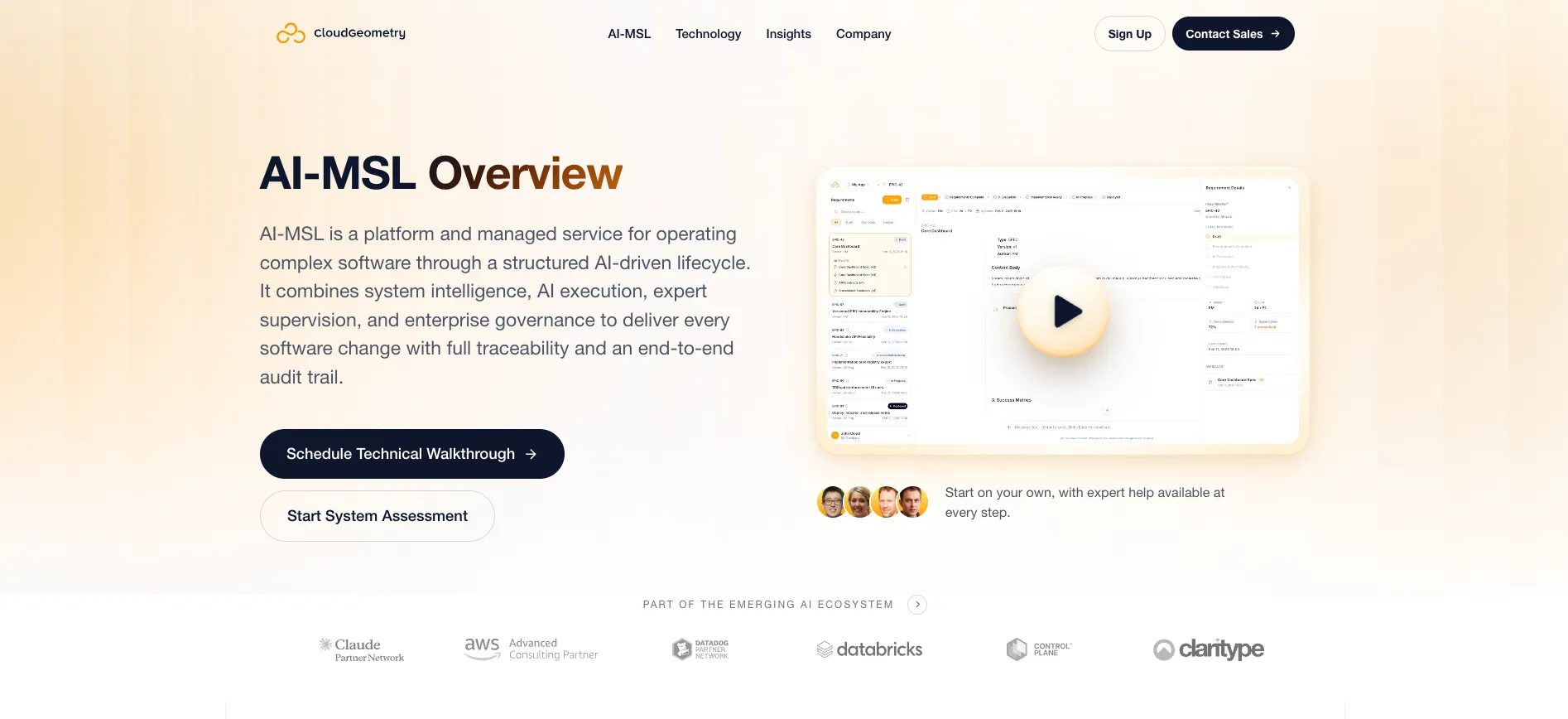
AI-MSL is a platform and managed service for operating software through a structured AI-driven lifecycle with expert supervision and governance.
How does AI-MSL pricing work?
Pricing separates ongoing Continuous Software Readiness from pay-per-change delivery. New changes receive independent DevCredit estimates before implementation.
What do I need to provide to get started?
You need access to your system and the ability to describe your goals. AI-MSL builds understanding from existing repositories and engineering assets.
Can AI-MSL run in my own VPC or environment?
Yes. Enterprise deployments can run in a customer VPC or environment configured for security and compliance requirements.
Is AI-MSL self-serve?
AI-MSL provides direct workspace visibility and interaction, but is delivered as a platform plus managed service with AI Lifecycle Manager and Engineer support.
What happens if I stop using AI-MSL?
You retain your codebase, generated assets, improved documentation, structured system understanding, and modernization opportunities.
Community reviews
Be the first to share your experience.
Sign in to leave a review for AI MSL.
AI MSL Alternatives
Looking for alternatives to AI MSL? Here are similar tools in the same category:
Learn to Master AI MSL
With Skill Leap courses
Get in-depth training on AI MSL and 50+ other AI tools with our expert-led video courses.
Start 7-Day Free Trial