
Applied Intuition
Streamline autonomous system development, testing, and deployment.
Key Takeaways
- What it is
- Streamline autonomous system development, testing, and deployment.
- Best for
- ADAS and AD Development Platform
- Vehicle Software Platform
- Off-road Autonomy Stack
- Rating
- 4.5/5
What is Applied Intuition?
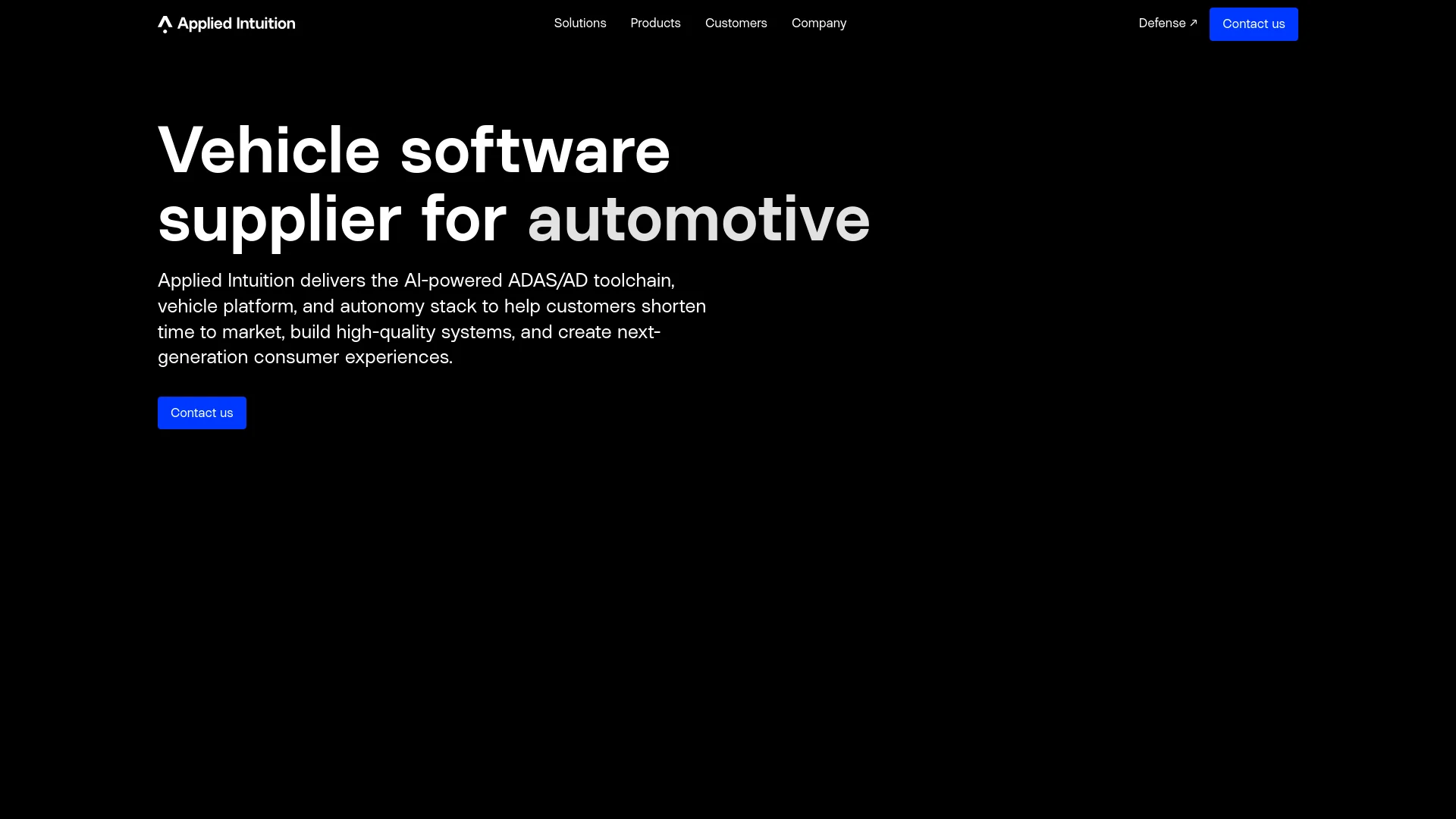
In the rapidly evolving landscape of autonomous technology, Applied Intuition emerges as a beacon, offering cutting-edge solutions to streamline the development, testing, and deployment of automated driving systems and vehicle software. With a focus on both on-road and off-road applications, this platform is engineered to bolster the capabilities of industries ranging from automotive to defense, ensuring they not only keep up with technological advancements but also lead the charge in innovation.
What truly sets Applied Intuition apart is its comprehensive suite of tools that cater to a broad spectrum of industries with varied needs in autonomous technology. From simulating complex driving environments to providing a platform for the complete lifecycle of vehicle software development, Applied Intuition ensures that all bases are covered. Its proactive AI Copilot feature enhances user experience, making complex processes more manageable and intuitive.
Applied Intuition excels in revolutionizing the development and deployment of autonomous systems across various industries. With its robust ADAS and AD development platform, comprehensive vehicle software capabilities, and innovative off-road autonomy stack, it provides essential tools for advancing safety, efficiency, and technological prowess. Its unique integration of AI and simulation technologies sets it apart, offering unmatched advantages in accelerating the adoption of intelligent, autonomous systems worldwide.
Who is Using Applied Intuition?
Automotive Manufacturers
Employing the platform to innovate and enhance the safety and efficiency of vehicle systems.
Defense Contractors
Utilizing the off-road autonomy stack for developing autonomous systems in defense applications.
Agriculture Sector
Leveraging technology to automate and optimize machinery used in farming and agricultural processes.
Mining and Construction Companies
Applying autonomous technology to improve safety and efficiency in harsh, unpredictable environments.
Uncommon Use Cases
Academic institutions use Applied Intuition for research and development in autonomous technologies; Tech startups integrate it for rapid prototyping and testing of new vehicle technologies.
Key Features
Rating Breakdown
Pricing Plans
Custom Pricing Model
- Applied Intuition offers tailored pricing based on specific industry needs and scale of deployment
Applied Intuition Use Cases
Autonomy development
Build, simulate, validate, and improve autonomous-driving and physical-AI systems.
Outcome: Faster development and safer deployment.
Fleet operations
Deploy, coordinate, monitor, and optimize fleets of autonomous vehicles, robots, and industrial equipment.
Outcome: Scaled autonomous operations.
Scenario creation and simulation
Create virtual scenarios and test autonomy software across diverse conditions.
Outcome: Earlier detection of safety issues and regressions.
Sensor-data curation
Ingest, filter, label, and prepare real-world sensor data for training, simulation, and evaluation.
Outcome: A reusable data flywheel for model and system improvement.
Software-defined vehicle development
Connect requirements, architecture, code, simulation, validation, debugging, and deployment.
Outcome: Shorter vehicle software development cycles.
Workflow Ideas with Applied Intuition
Convert fleet data into validation scenarios
- 1Ingest and curate real-world sensor data
- 2Identify anomalies, events of interest, or coverage gaps
- 3Turn findings into simulation test cases
Develop and validate a vehicle feature
- 1Read and evaluate requirements
- 2Implement the feature in a reproducible cloud environment
- 3Validate it through software-in-the-loop and hardware-in-the-loop testing
Run a continuous autonomy data flywheel
- 1Collect and process real-world and synthetic data
- 2Train, simulate, and evaluate autonomy models
- 3Use metrics and failure analysis to guide the next iteration
How Applied Intuition fits into your stack
Industry-wide Compatibility
Adapts to various sectors including automotive, defense, and agriculture.
Extensive API Access
Offers robust API for custom integrations, enhancing flexibility across systems.
Hardware-in-the-Loop Simulation
Supports HIL simulation for real-time testing and validation.
Data Integration Capabilities
Facilitates seamless integration with existing data systems for enhanced data analysis and application.
Pros
- +End-to-end platform for developing, testing, validating, and deploying physical AI
- +Supports cloud, on-premises, and air-gapped environments
- +API and SDK access for custom applications and embedded interfaces
- +Integrates with Slack and Jira
- +Strong encryption for data at rest and in transit
Cons
- −Complexity of Tools: The advanced nature of the tools may require a steep learning curve for new users.
- −High Dependency on Tech Infrastructure: Optimal performance relies heavily on existing technological setups, which might be a barrier for smaller enterprises.
- −Cost Implications: While offering immense value, the initial investment and ongoing costs could be significant, particularly for small to mid-sized companies.
Limitations & when to consider alternatives
Known limitations
- Enterprise-oriented access. The public site directs prospective users to request product information or a demo rather than offering self-serve public pricing.
- Limited early access for Dana. Applied Intuition says Dana initially had limited, early access for select customers.
- Safety-critical domain complexity. The platform is designed for complex, safety-critical machines and requires specialized engineering workflows.
- Browser-based tooling. Applied Intuition describes its product suite as browser-based rather than as a downloadable desktop application.
Look elsewhere when
- You need a native desktop application.
- You need publicly listed pricing and plans.
- You need a general-purpose document or coding assistant.
How to Use Applied Intuition
- 1
Explore a range of tutorials from basic setup to advanced functionalities directly on the Applied Intuition platform, designed to help users maximize the tool’s capabilities.
Who is Applied Intuition For?
Developers
Dana provides APIs, SDKs, code-first workflows, and tools for building physical AI applications.
Engineers
Engineering teams can develop, test, validate, and deploy autonomy and vehicle software.
Operators
Operators can deploy, coordinate, monitor, and optimize autonomous fleets.
Automotive manufacturers
Applied Intuition supports ADAS, autonomous driving, software-defined vehicles, and intelligent cabin experiences.
Defense and industrial organizations
The platform targets defense, trucking, construction, mining, agriculture, and robotics use cases.
Frequently Asked Questions
What is Dana?
Dana is Applied Intuition's agentic platform for building, testing, deploying, and operating physical AI systems.
Who is Dana for?
Dana is built for developers, engineers, and operators who build, deploy, and run physical AI.
How does Dana speed up development?
Dana replaces fragmented tools and manual handoffs with agentic workflows that orchestrate the platform.
What can I do with Dana?
Users can access reference applications, workflows, and agent skills for autonomy development, fleet operations, and operating-system development.
Do I need to replace my existing tools?
No. Dana is designed to connect existing stacks, data, and workflows rather than replace them.
How do developers access Dana?
Developers can access Dana through natural language, APIs, SDKs, custom applications, and embedded interfaces.
Community reviews
Be the first to share your experience.
Sign in to leave a review for Applied Intuition.
Applied Intuition Alternatives
Looking for alternatives to Applied Intuition? Here are similar tools in the same category:
Learn to Master Applied Intuition
With Skill Leap courses
Get in-depth training on Applied Intuition and 50+ other AI tools with our expert-led video courses.
Start 7-Day Free Trial