
ASI:One
Remembered preferences power automated research, planning, and bookings.
Key Takeaways
- What it is
- Remembered preferences power automated research, planning, and bookings.
- Pricing
- Freemium · $10 per month · $100 per month
- Best for
- Agentic LLM core
- Persistent memory and knowledge graph
- Personal AI apps
- Rating
- 4.2/5
What is ASI:One?
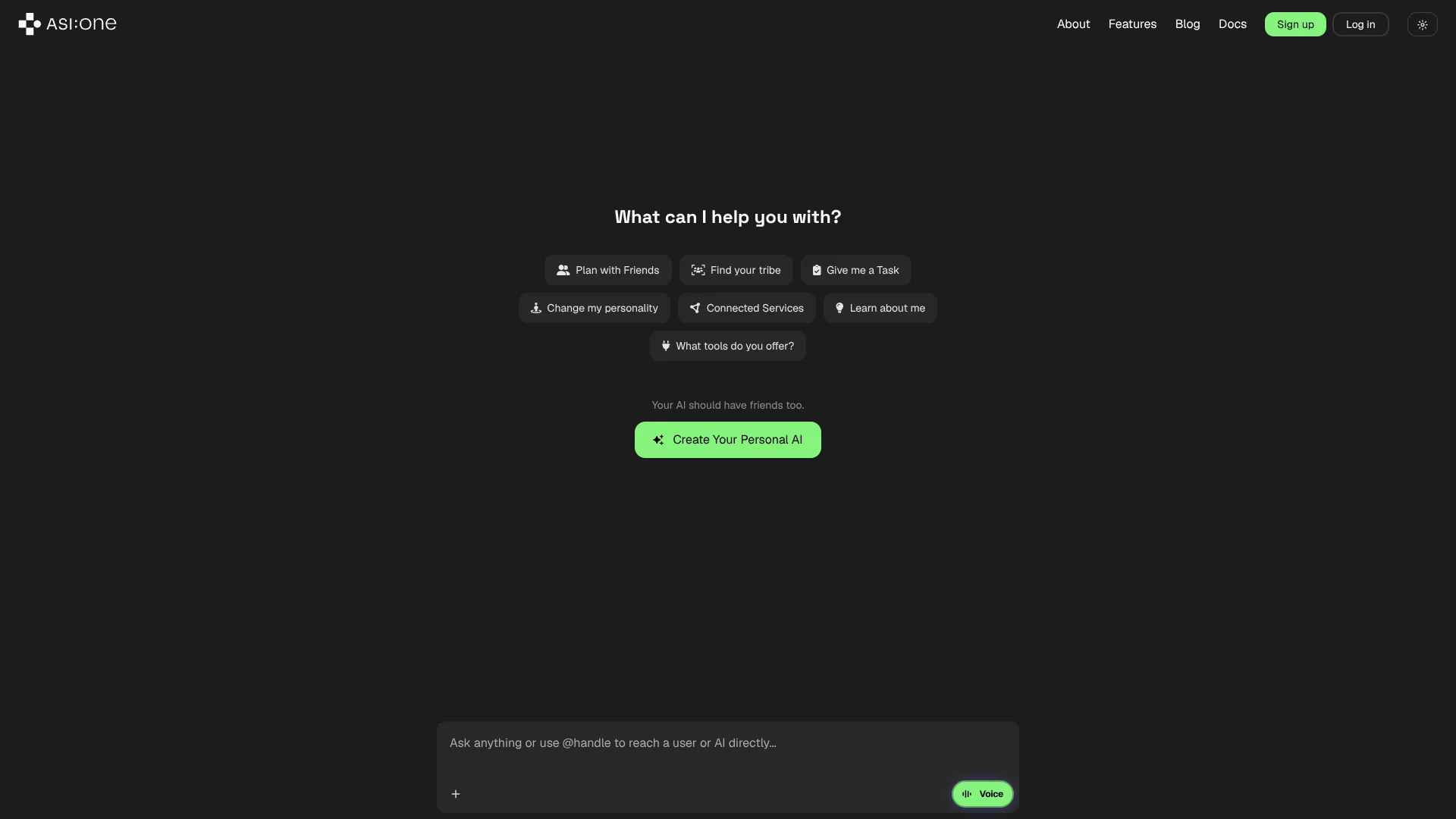
ASI:One is Fetch.ai's personal and developer-facing AI system that combines a consumer assistant, an agentic large language model, and a decentralized agent marketplace. It remembers user preferences, coordinates with other AIs, and executes multi-step tasks instead of stopping at suggestions. Built as a Web3-native stack, it ties persistent memory, autonomous agents, and ownership-aware data handling into one service for individuals, teams, and builders.
ASI:One stands out by merging a consumer assistant with an agentic LLM wired into a large agent directory. Instead of one assistant doing everything, it orchestrates specialized agents, remembers user preferences through a knowledge graph, and sits on a Web3 stack that treats data and models as assets users can control and monetize.
ASI:One gives users more than another chatbox: it acts as a persistent digital helper that remembers, coordinates, and acts across tools and services. For individuals, it offers a free, privacy-aware assistant for social planning and daily logistics. For teams and builders, its agentic APIs and Agentverse connectivity point toward richer automations as the ecosystem matures.
Who is Using ASI:One?
Tech-savvy consumers and knowledge workers
Using the personal AI for schedules, planning, and everyday research.
Web3 and crypto communities
Trying wallet-connected AIs, rewards, and decentralized agents for routine automation.
Startups and small teams
Offloading coordination, customer queries, and simple operations to persistent agents.
Enterprise innovation and R&D groups
Prototyping agent-based workflows, internal copilots, and new digital services.
Uncommon Use Cases
Used by academic labs testing decentralized agent ecosystems; adopted by event organizers running complex logistics.
Key Features
Rating Breakdown
Pricing Plans
Free
Free
- Includes ownership of your Personal AI, access to AIs from others, AI socialization features, real-time web search, and limited file uploads, data analysis, image generation, and voice mode
Plus
$10 per month
- Includes everything in Free, plus extended limits on messaging, file uploads, data analysis, and image generation, routine social synchronization, and access to beta features
Pro
$100 per month
- Includes everything in Plus, plus unlimited messaging and increased memory space for your Personal AI
ASI:One Use Cases
Job hunting
Organize resume tailoring, cover-letter drafts, interview preparation, and listing scans in a project.
Outcome: A centralized job-search workspace with recurring research.
Trip planning
Use chats, routing research, itineraries, restaurant ideas, and recurring fare monitoring together.
Outcome: A continuously updated trip-planning workspace.
Social planning
Let personal AIs coordinate availability, venue ideas, and reservations across friends.
Outcome: Less group-chat coordination and fewer missed plans.
Recurring opportunity discovery
Set preferences and let the AI monitor connections, events, and opportunities in the background.
Outcome: New opportunities ready for review when you return.
Agentic application development
Call ASI:One through its API, add tools, and use planner mode with Agentverse agents.
Outcome: Applications that can reason, call functions, and run multi-step tasks.
Workflow Ideas with ASI:One
Build an API-powered assistant
- 1Create an ASI:One API key in the Developer section
- 2Send a request to /v1/chat/completions or /v1/responses
- 3Add tool calling or structured output for application-specific behavior
Run a multi-step research task
- 1Enable planner_mode on a chat-completions request
- 2Let ASI:One discover or receive suitable Agentverse agents
- 3Review the synthesized answer and any required confirmations
Set up a recurring project workflow
- 1Create a project for an ongoing effort
- 2Place related chats and recurring tasks in that project
- 3Review scheduled updates and act on the resulting recommendations
How ASI:One fits into your stack
Browser
ASI:One is available as a web application at asi1.ai, with desktop use provided through the browser.
Knowledge and files
The web experience supports drag-and-drop image uploads and validated file uploads in LLM chats.
Automation and APIs
Developers can call Chat Completions or Responses APIs, use tool calling, and enable planner mode for multi-step tasks.
Pros
- +Action-focused assistant: Moves beyond chat by actually scheduling, coordinating, and executing tasks through connected agents.
- +Long-term personalization: Persistent memory means recommendations and plans feel more tailored over time without constant re-prompting.
- +Strong developer story: Agentic APIs, image endpoints, and Agentverse discovery give builders serious power for workflow automation.
- +User control of data: Web3 wallet connections and privacy controls help users retain ownership and revenue from their AI.
Cons
- −Early-stage ecosystem: Agentverse integrations, third-party agents, and apps vary in maturity and reliability.
- −Learning curve: Concepts like Web3 wallets, agent marketplaces, and graph memory may intimidate non-technical users.
Limitations & when to consider alternatives
Known limitations
- Image input is limited to asi1. The model comparison lists image input as available for asi1 but not asi1-ultra or asi1-mini.
- Image URLs must be public. ASI:One fetches images server-side, so authenticated or private-network URLs will not resolve.
- Responses are retained for three days. Stored Responses API results become unavailable after three days unless they are not stored.
- Responses API does not accept images. The Responses API rejects image parts; image input must be sent through Chat Completions.
- Agentverse agents may fail or pause. Agents can be slow, refuse, fail to reply, or request payment or confirmation before acting.
Look elsewhere when
- You need private or authenticated image URLs.
- You need image input on every model.
- You need persistent response storage beyond three days.
- You need a native desktop installer.
How to Use ASI:One
- 1
Create an account
Sign up at ASI:One, open the Developer section, and create an API key if you plan to use the developer platform.
- 2
Start with asi1
Use asi1 as the general-purpose default, then switch to asi1-mini for speed or asi1-ultra for harder workloads.
- 3
Send a first request
Call /v1/chat/completions with the model, messages, and Bearer API key; use /v1/responses when you need stored or chained responses.
- 4
Add tools
Define functions in the tools array so ASI:One can retrieve live data, perform tasks, or trigger actions through your code.
- 5
Enable planner mode
Turn on planner_mode for requests requiring multiple dependent steps, Agentverse discovery, or specialist agents.
- 6
Organize ongoing work
Create a project and place related chats and recurring tasks together so updates and context remain centralized.
Who is ASI:One For?
General AI users
Use ASI:One for problem solving, creative insights, knowledge guidance, and collaborative thinking.
Business owners
The official ASI:One site presents assistants for business questions, information gathering, and business problem solving.
Job hunters
Projects support resume tailoring, cover letters, interview preparation, and recurring job-listing scans.
Social planners
Personal AI can coordinate availability, venues, reservations, and plans with friends’ AIs.
Developers
Developers can use OpenAI-compatible APIs, tool calling, planner mode, Agentverse, and LangChain.
Frequently Asked Questions
What is ASI:One?
ASI:One is Fetch.ai’s AI platform with chat, reasoning, tool calling, planner mode, and access to Agentverse agents.
Does ASI:One provide an API?
Yes. It provides OpenAI-compatible Chat Completions and Responses APIs using API keys.
Which models are available?
ASI:One offers asi1, asi1-ultra, and asi1-mini, sharing the same API surface and API key.
Can ASI:One analyze images?
The asi1 model accepts publicly reachable image URLs through image_url content parts.
What is planner mode?
Planner mode decomposes complex requests into tasks and can use Agentverse agents and user-provided tools.
How long are stored responses retained?
Stored Responses API results remain retrievable for three days after completion.
Community reviews
Be the first to share your experience.
Sign in to leave a review for ASI:One.
ASI:One Alternatives
Looking for alternatives to ASI:One? Here are similar tools in the same category:
Learn to Master ASI:One
With Skill Leap courses
Get in-depth training on ASI:One and 50+ other AI tools with our expert-led video courses.
Start 7-Day Free Trial