
Athena
AI-driven decision support for defense, enhancing situational awareness.
Key Takeaways
- What it is
- AI-driven decision support for defense, enhancing situational awareness.
- Best for
- AI-Enhanced Callsign
- Hierarchical Neural Networks
- Terrain and Thermal Analysis
- Rating
- 4.4/5
What is Athena?
Athena, available at Athena Defence, is an innovative AI decision support system designed to enhance decision-making processes in defense and tactical operations. By integrating advanced computer vision and AI-enabled features, Athena simplifies complex decision-making with high accuracy and speed, while ensuring legal and ethical considerations are met in high-stress environments.
Athena is distinguished by its AI-enhanced callsign, which is particularly beneficial for tactical operations. Its integration of legal and ethical guidance into decision-making processes makes it a critical tool for defense and emergency response teams.
Athena excels in providing enhanced situational awareness and decision support, making it an essential tool for defense and emergency response teams. Its unique features, such as the AI-enhanced callsign and legal/ethical guidance integration, offer significant advantages in high-stress environments.
Who is Using Athena?
Military and Defense Organizations
Enhancing decision support and situational awareness.
Law Enforcement Agencies
Supporting tactical operations and real-time decisions.
Emergency Response Teams
Facilitating rapid and accurate situational assessments.
Security Firms
Using advanced surveillance and threat detection capabilities.
Uncommon Use Cases
Adopted by wildlife conservationists for monitoring poaching; used by disaster management agencies for crisis response.
Key Features
Rating Breakdown
Pricing Plans
Custom Pricing
- Plans are tailored based on specific use cases and organizational needs
Athena Use Cases
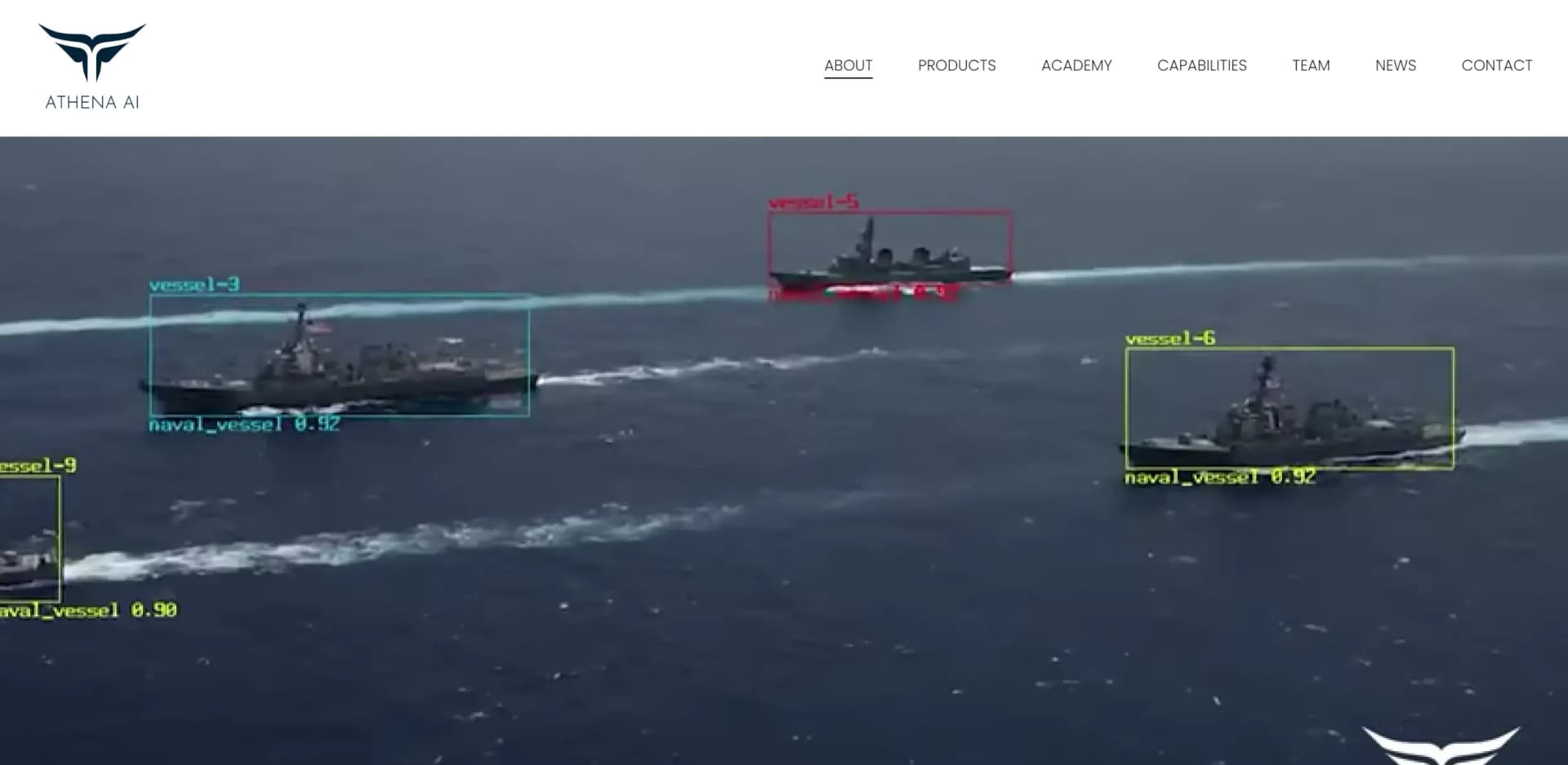
Aided target recognition
Detect, classify, and track people, vehicles, vessels, drones, and other objects in video feeds.
Outcome: Faster and more informed tactical decisions.
Geospatial mission planning
Analyze terrain, identify obstacles, find mobility corridors, and plan routes for tactical assets.
Outcome: Improved mission planning and autonomous navigation.
Counter-UAS operations
Track multiple fast-moving aerial objects and provide real-time classification and prioritization.
Outcome: Improved situational awareness against drone threats.
Precision geolocation
Combine onboard video processing with geolocation and TAK integration.
Outcome: Actionable location data for mission and targeting workflows.
Mission-specific model adaptation
Refine existing Athena models using operational imagery, new target classes, sensors, and environments.
Outcome: Deployment-ready AI tailored to mission requirements.
Workflow Ideas with Athena
Terrain-to-route planning
- 1Ingest satellite or geospatial data
- 2Analyze terrain, obstacles, mobility corridors, and concealment
- 3Generate and task optimal routes for tactical assets
Real-time target recognition
- 1Process live EO or IR video onboard
- 2Detect and classify people, vehicles, vessels, or drones
- 3Send geolocation and guidance outputs to mission systems
Mission-specific AI adaptation
- 1Collect operational imagery and sensor-specific inputs
- 2Refine existing Athena models and add target classes
- 3Deploy optimized models to Sightline software or hardware
How Athena fits into your stack
Satellite Data Integration
Supports terrain analysis via satellite data.
Thermal Imaging Compatibility
Works seamlessly with thermal imaging devices.
Custom API
Offers API access for tailored integrations.
User Interface Integration
Provides a user-friendly interface for real-time AI information display.
Pros
- +Enhanced Situational Awareness: Improves real-time awareness and tactical edge.
- +Legal and Ethical Guidance: Incorporates legal and ethical considerations into decision-making.
- +High Operational Tempo: Maintains performance in fast-paced environments.
- +Customizable Neural Networks: Tailored to specific decision support needs.
Cons
- −Complex Initial Setup: Requires detailed configuration for optimal performance.
- −Limited Use Cases: Primarily focused on defense and tactical operations.
Limitations & when to consider alternatives
Known limitations
- Defense-focused rather than general-purpose. Sightline explicitly describes the technology as specialized, edge-optimized battlefield vision rather than general-purpose computer vision.
- Edge and embedded deployment emphasis. The platform is designed for low-size, weight, and power environments and onboard processing.
- Commercial pricing is not public. The product pages direct prospective customers to connect with sales rather than displaying self-service pricing.
- Integration-oriented deployment. Documentation and product materials emphasize hardware, processor, protocol, and platform integration.
Look elsewhere when
- You need a general-purpose AI assistant or productivity chatbot.
- You need a consumer-facing mobile or browser application.
- You need a self-service SaaS product with published pricing.
How to Use Athena
- 1
Explore comprehensive tutorials on YouTube, covering everything from basic setup to advanced features to help users maximize the tool's capabilities.
Who is Athena For?
SOCOM and U.S. Army organizations
AiTR is designed for low-size, weight, and power environments supporting SOCOM, the U.S. Army, JSOC, and related missions.
Defense OEMs and integrators
Sightline provides onboard video processing, AI detection, classification, tracking, and integration support for defense platforms.
ISR operators
The technology helps ISR teams detect, classify, track, geolocate, and interpret objects in real time.
Counter-UAS teams
Athena-enabled capabilities support detection, classification, prioritization, and tracking of drones and other aerial threats.
Autonomous-platform developers
Athena Geo and AiTR support autonomous tasking, route planning, platform coordination, and edge-native AI deployment.
Frequently Asked Questions
What is Athena AI?
Athena AI is a defense-focused AI capability specializing in computer vision, decision support, situational awareness, and autonomous mission applications.
What happened to Athena Defence?
SightLine Applications acquired Athena AI in March 2025 and now operates the combined business as Sightline Intelligence.
What does Athena AI process?
Its technology processes video, imagery, terrain data, sensor inputs, and other operational data for detection, classification, tracking, and planning.
Can Athena AI support autonomous systems?
Yes. Athena Geo supports autonomous tasking, asset placement, route planning, and coordination across platforms.
Can Athena AI models be customized?
Sightline's AI Training Tools let customers refine Athena models with mission data, sensors, target classes, and operational environments.
Where can Athena AI run?
The technology can run on Sightline hardware, onboard processors, ground stations, or as a lightweight software library on NVIDIA processors.
Community reviews
Be the first to share your experience.
Sign in to leave a review for Athena.
Athena Alternatives
Looking for alternatives to Athena? Here are similar tools in the same category:
Learn to Master Athena
With Skill Leap courses
Get in-depth training on Athena and 50+ other AI tools with our expert-led video courses.
Start 7-Day Free Trial