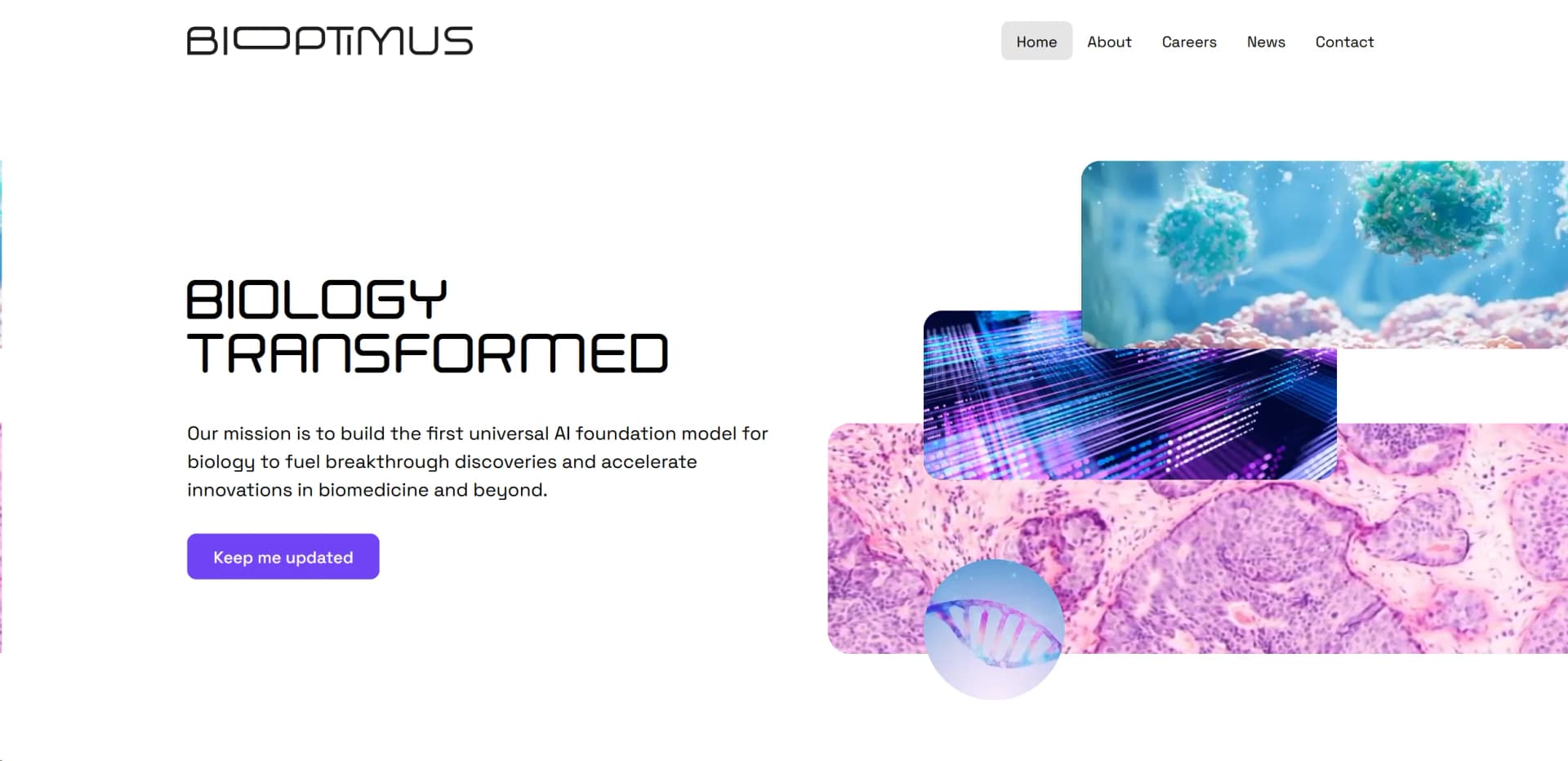
Bioptimus
AI-driven tool accelerating biological research with predictive analytics.
Key Takeaways
- What it is
- AI-driven tool accelerating biological research with predictive analytics.
- Pricing
- Freemium · $299 per month
- Best for
- Foundation Model for Biology
- Accelerated Discoveries
- Data Integration
- Rating
- 4.5/5
What is Bioptimus?
Bioptimus is a pioneering AI tool designed to revolutionize the field of biology and biomedicine. At its core, Bioptimus aims to build the first universal AI foundation model specifically tailored for biological applications. This tool is crafted to fuel breakthrough discoveries and accelerate innovations, making it an invaluable asset for researchers, scientists, and professionals in the biomedical sector and beyond. By integrating advanced artificial intelligence with biological data, Bioptimus simplifies complex analyses and enhances the predictive capabilities of biological research.
Bioptimus stands out with its specialized focus on biological data, a rarity in the field of universal AI models. Its ability to integrate and analyze complex biological datasets sets it apart, providing users with unprecedented tools for prediction and research in biomedicine.
Bioptimus excels in transforming the landscape of biological research and biomedicine, making it an essential tool for professionals aiming to push the boundaries of what's possible in these fields. Its unique foundation model for biology, coupled with powerful predictive analytics, offers an unmatched advantage in accelerating discoveries and innovations.
Who is Using Bioptimus?
Biomedical Researchers
Employing the tool to enhance drug discovery and development processes.
Academic Institutions
Utilized in teaching and research to provide students with cutting-edge technology experience.
Pharmaceutical Companies
Leveraging the tool to streamline research and reduce time-to-market for new therapies.
Geneticists
Using the tool for genetic research and manipulation.
Uncommon Use Cases
Adopted by agricultural scientists for crop and livestock improvement; used by environmental scientists for ecosystem modeling.
Key Features
Rating Breakdown
Pricing Plans
Free Tier
Free
- Explore Bioptimus capabilities with a limited free trial
Professional Tier
$299 per month
Bioptimus Use Cases
Biomarker discovery and patient stratification
Analyze histopathology and molecular features to identify predictive biomarkers and stratify clinical-trial participants.
Outcome: Improved selection of patients and biomarker-defined cohorts.
Drug discovery and preclinical validation
Analyze drug-tissue interactions and predict efficacy across cancer subtypes.
Outcome: Earlier insight into drug response and reduced early-stage attrition.
Clinical trial design
Use multimodal biomarker signatures to distinguish responders from non-responders in trial cohorts.
Outcome: Better-informed trial endpoints and patient-selection strategies.
Spatial biology analysis
Integrate histology, spatial transcriptomics, and genomics or predict spatial gene expression from H&E slides.
Outcome: Molecular and spatial insights without requiring a new spatial assay in every workflow.
Digital pathology analysis
Automate annotation and analysis of whole-slide images using foundation-model embeddings and downstream models.
Outcome: Reduced manual workload and more consistent pathology image analysis.
Workflow Ideas with Bioptimus
Whole-slide embedding workflow
- 1Deploy H-Optimus through AWS SageMaker or an on-premise container
- 2Connect the Bioptimus SDK to the model endpoint
- 3Tile slides, mask tissue, generate embeddings, and write results
Custom downstream prediction workflow
- 1Prepare H&E whole-slide images and extract H-Optimus embeddings
- 2Train a task-specific downstream model such as a classification or MIL head
- 3Validate the custom pipeline on retrospective local cohorts
Spatial gene-expression workflow
- 1Deploy M-Optimus and provide H&E tiles with optional bulk RNA information
- 2Run tile-level prediction through the SDK
- 3Visualize predicted spatial gene-expression outputs across the slide
How Bioptimus fits into your stack
Cloud-Based Platforms
Fully compatible with major cloud services to enhance computational power.
Data Formats
Supports a wide range of biological data formats for seamless integration.
API Access
Offers APIs for custom integration with existing research tools.
Collaborative Features
Enables sharing and collaboration across institutional and geographic boundaries.
Pros
- +Enhanced Research Efficiency: Drastically reduces the time required for biological research and discovery.
- +Precision and Accuracy: Increases the reliability of predictions in biological experiments.
- +Scalability: Adapts to various scales of biological data, from molecular to ecosystem level.
- +User-Friendly: Despite its complex capabilities, it maintains an intuitive interface for ease of use.
Cons
- −Specialized Requirements: Primarily designed for users with a background in biology or biomedicine.
- −High Resource Intensity: Requires significant computational power for maximum efficiency.
- −Initial Setup Complexity: New users may face a steep learning curve due to the advanced nature of the technology.
Limitations & when to consider alternatives
Known limitations
- Research use rather than approved diagnosis. Bioptimus states that its models are for research use and are not approved medical devices or currently cleared companion diagnostics.
- H-Optimus-1 licensing restrictions. H-Optimus-1 is available for non-commercial academic research; commercial use requires a separate licensing agreement.
- H&E pretraining limitation. H-Optimus was pretrained exclusively on H&E whole-slide images, so non-H&E applications require rigorous validation.
- Infrastructure requirements. Deployment requires AWS SageMaker, an on-premise container, or compatible local hardware and GPU infrastructure.
- Local validation is required. Bioptimus recommends validating custom downstream pipelines on local retrospective cohorts because scanner and staining variability can affect results.
Look elsewhere when
- You need a native mobile application.
- You need a browser extension or desktop installer.
- Your use case requires built-in SSO or enterprise identity management.
- Your procurement requires documented encryption controls.
How to Use Bioptimus
- 1
Explore detailed tutorials and resources on the official website to master Bioptimus, covering everything from basic setup to advanced predictive modeling.
Who is Bioptimus For?
Pharmaceutical companies
Bioptimus targets pharma teams using foundation models for biomarker discovery, indication expansion, trial design, and drug development.
Biotech companies
Biotech teams can use the models to analyze pathology and multimodal biological data for translational research.
Universities and research institutions
Academic organizations can request non-commercial research access and use eligible models through Hugging Face.
Clinical research organizations
Clinical research teams can apply the models to patient stratification, treatment-response analysis, and exploratory clinical development.
Data scientists and ML engineers
The documentation provides SDK, deployment, inference, cohort, and visualization workflows for technical users.
Frequently Asked Questions
What is H-Optimus?
H-Optimus is a vision foundation model for histology that extracts tile-level feature vectors from H&E whole-slide images.
What is M-Optimus?
M-Optimus is a multimodal, multi-scale model that predicts spatial gene expression from routine H&E images, optionally informed by bulk RNA.
How can Bioptimus models be deployed?
Models can be deployed through AWS SageMaker, an on-premise container, or Hugging Face for eligible academic access.
What does the Bioptimus SDK do?
The Python SDK handles whole-slide reading, tiling, tissue masking, model dispatch, bulk-RNA alignment, and output generation.
Can H-Optimus be used for academic research?
Yes. H-Optimus models are available through Hugging Face for academic research, with model-specific licensing restrictions.
Is H-Optimus an approved diagnostic device?
No. Bioptimus documents H-Optimus as a research and analytical tool rather than a currently cleared regulated diagnostic or companion diagnostic.
Community reviews
Be the first to share your experience.
Sign in to leave a review for Bioptimus.
Bioptimus Alternatives
Looking for alternatives to Bioptimus? Here are similar tools in the same category: