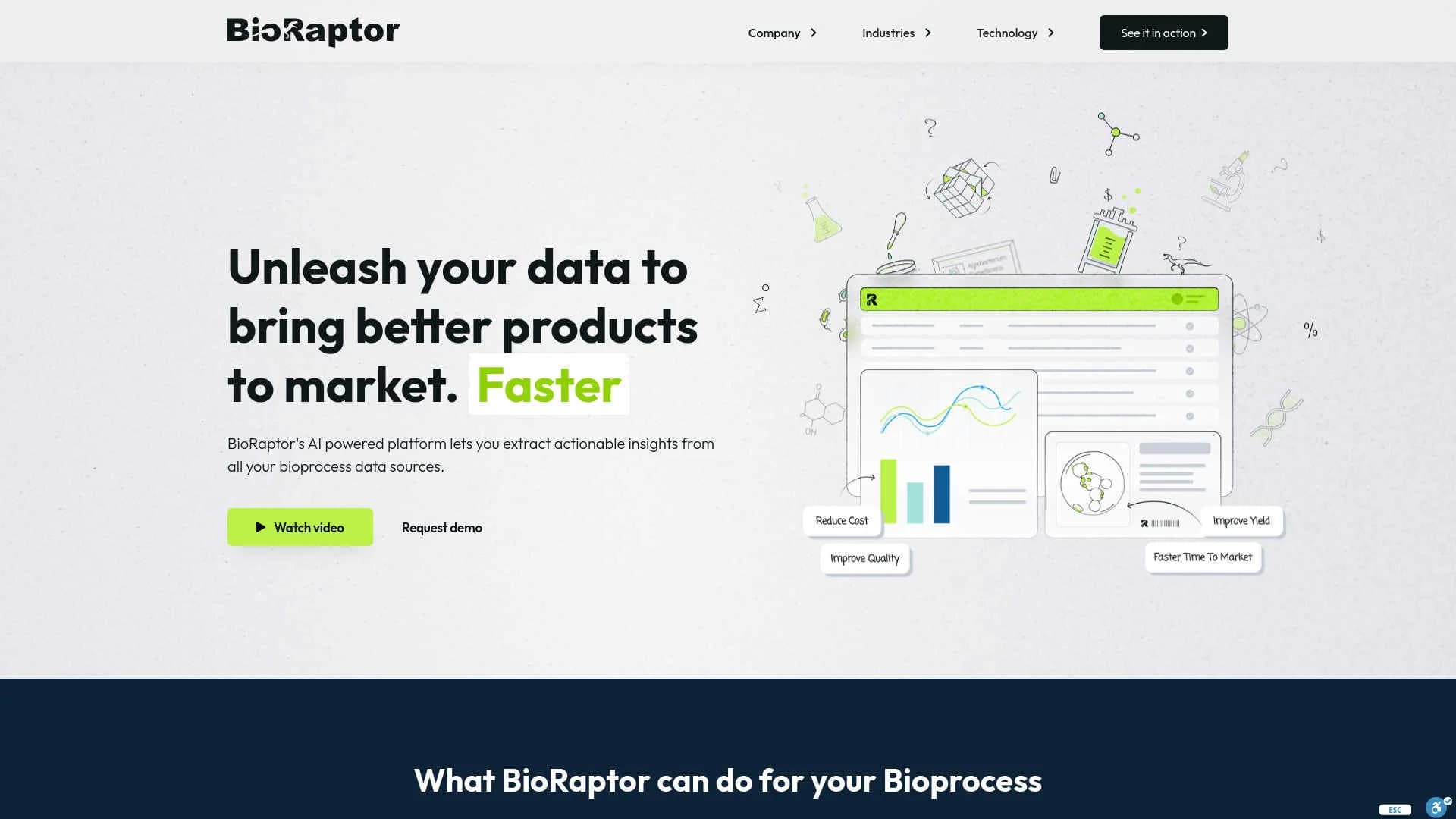
BioRaptor
AI-driven platform optimizing bioprocess data for enhanced productivity.
Key Takeaways
- What it is
- AI-driven platform optimizing bioprocess data for enhanced productivity.
- Pricing
- $500 per month
- Best for
- Precision Fermentation and Cell Culture Optimization
- Real-Time Anomaly Detection
- Digital Twin Simulations
- Rating
- 4.4/5
What is BioRaptor?
BioRaptor is a cutting-edge AI-powered platform designed to transform the way bioprocess data is utilized across various industries, including biopharma, food tech, and biotech. Its primary aim is to help organizations streamline their data analysis, enhance collaboration, and speed up the time to market for new products. By integrating advanced machine learning algorithms, BioRaptor enables users to extract actionable insights from complex bioprocess data, optimize operations, and ultimately bring better products to market faster.
BioRaptor sets itself apart by combining robust data handling with advanced AI tools to not only manage but actively enhance bioprocesses. Its unique selling point lies in its ability to integrate complex bioprocess data into actionable insights rapidly, which is crucial for industries where speed to market is critical.
BioRaptor excels in empowering biotech industries to harness the full potential of their bioprocess data. Its robust analytics, combined with real-time monitoring and digital twin capabilities, make it an indispensable tool for organizations aiming to innovate and enhance their product development cycles efficiently. With its strong focus on data integration and actionable insights, BioRaptor is not just a data management tool but a gateway to accelerated biotechnological advancement.
Who is Using BioRaptor?
Biopharmaceutical Companies
Enhancing drug development processes from discovery through to production.
Food Technology Firms
Optimizing strains and processes in the production of alternative proteins.
Biotechnological Innovators
From bio-cosmetics to bio-textiles, streamlining product development.
Research and Development Teams
Employing AI to leapfrog stages in product innovation.
Uncommon Use Cases
Used by academic institutions for educational purposes; utilized in small-scale boutique fermentation projects.
Key Features
Rating Breakdown
Pricing Plans
Free Trial
- Access all features of BioRaptor with a one-month free trial
Subscription Plans
$500 per month
- Smaller teams
Which BioRaptor plan should you pick?
Start with BioRaptor Starter for a small team seeking self-serve bioprocess visibility, then contact BioRaptor for a broader deployment.
BioRaptor Starter
Good for small bioprocessing teams that need a lightweight, self-serve way to visualize, analyze, and share online, at-line, and offline data.
BioRaptor Use Cases
Bioprocess R&D
Teams centralize runs, compare experiments, test hypotheses, and identify parameters affecting outcomes.
Outcome: Faster learning, improved yields, and reduced experimental repetition.
Precision fermentation
Teams analyze fermentation data, monitor runs, and use soft sensors to estimate biological metrics.
Outcome: Better process control, consistency, and optimization.
Downstream processing
Engineers compare filtration, centrifugation, buffer, flow-rate, and other downstream parameters.
Outcome: Higher purity, faster recovery, and reduced variability.
Real-time monitoring
Users monitor running experiments, detect anomalies, and receive alerts during bioreactor processes.
Outcome: Earlier intervention and fewer run failures.
Automated reporting
Teams generate end-of-run summaries, graphs, dashboards, and reusable report templates.
Outcome: Less manual reporting work and clearer team decision-making.
Workflow Ideas with BioRaptor
Import and analyze offline bioprocess data
- 1Import data from devices, batch records, or CDMO collaborators
- 2Align process data from different machines and sampling frequencies
- 3Compare runs and identify factors affecting variability
Monitor a live bioreactor run
- 1Connect bioprocess equipment through online connectivity
- 2View running experiments and sensor signals in real time
- 3Receive anomaly alerts and intervene before failures
Create an automated end-of-run report
- 1Generate an end-of-run summary
- 2Customize graphs, dashboards, or report templates
- 3Share the resulting analysis with the team
How BioRaptor fits into your stack
API for Custom Integrations
Ensures that BioRaptor can seamlessly connect with existing systems.
Support for Multiple Data Formats
Allows easy data import from diverse sources.
Cloud-Based Infrastructure
Facilitates remote access and collaboration.
Pros
- +Enhanced Productivity: Reduces the time required for data analysis and experiment planning.
- +Cost Reduction: Minimizes the need for physical experiments and reduces resource wastage.
- +Improved Collaboration: Facilitates better teamwork through easy sharing and reporting features.
- +Scalability: Scales effortlessly with growing data needs and expanding team sizes.
Cons
- −Complexity for Beginners: Might be challenging for users with limited technical or data science background.
- −Integration Dependencies: Requires integration with existing systems, which might be a hurdle for some setups.
- −High Initial Investment: Potentially high upfront costs for full deployment and training.
Limitations & when to consider alternatives
Known limitations
- Not a LIMS or ELN. BioRaptor explicitly says it is neither a Laboratory Information Management System nor an Electronic Lab Notebook.
- Implementation takes several weeks. The site says typical onboarding takes a few weeks and describes implementation as taking two to four weeks.
- Designed for bioprocess data. The platform is purpose-built for biological and bioprocess measurements rather than general-purpose analytics.
- No documented public developer API. BioRaptor references APIs in a brochure but does not publish developer documentation, API keys, or endpoint specifications.
How to Use BioRaptor
- 1
Explore a range of tutorials on the BioRaptor website, covering everything from basic setup to advanced features.
Who is BioRaptor For?
Bioprocess scientists
BioRaptor provides cross-run analysis, hypothesis-free analysis, calculations, and process insights without requiring advanced data-science knowledge.
Bioprocessing leadership
The platform provides dashboards, automated reports, visibility across runs, and decision-support metrics.
Biotech companies
BioRaptor supports biotechnology teams working across development, scale-up, and production.
Biopharma companies
BioRaptor targets biologics and cell-and-gene-therapy organizations with bioprocess analytics and monitoring.
Food-tech companies
BioRaptor supports alt-protein, cellular-agriculture, and related biological production workflows.
Frequently Asked Questions
Is BioRaptor a LIMS or an ELN?
No. BioRaptor describes itself as a bioprocess data analytics platform that integrates with existing LIMS and ELN systems.
Can BioRaptor integrate with existing data infrastructure?
Yes. BioRaptor says it integrates with LIMS, SCADA, historians, cloud services, and third-party analytical tools.
How does BioRaptor get data from devices and instruments?
It connects through encrypted transmission channels such as secure VPN tunnels or cloud gateways.
How secure is data on BioRaptor?
BioRaptor lists encryption, role-based access control, audit trails, and secure cloud infrastructure.
Does BioRaptor use customer data to train models?
BioRaptor says customer data remains theirs and is not used to train anyone else’s models.
Does BioRaptor include machine learning?
Yes. Users can build software-based sensors and predictive models using algorithms ranging from linear regression to XGBoost.
Community reviews
Be the first to share your experience.
Sign in to leave a review for BioRaptor.
BioRaptor Alternatives
Looking for alternatives to BioRaptor? Here are similar tools in the same category: