
Causa
Unlock causal ML insights for strategic, data-driven decisions.
Key Takeaways
- What it is
- Unlock causal ML insights for strategic, data-driven decisions.
- Best for
- CausaDB
- Cloud-Native Infrastructure
- SDK Integration
- Rating
- 4.5/5
What is Causa?
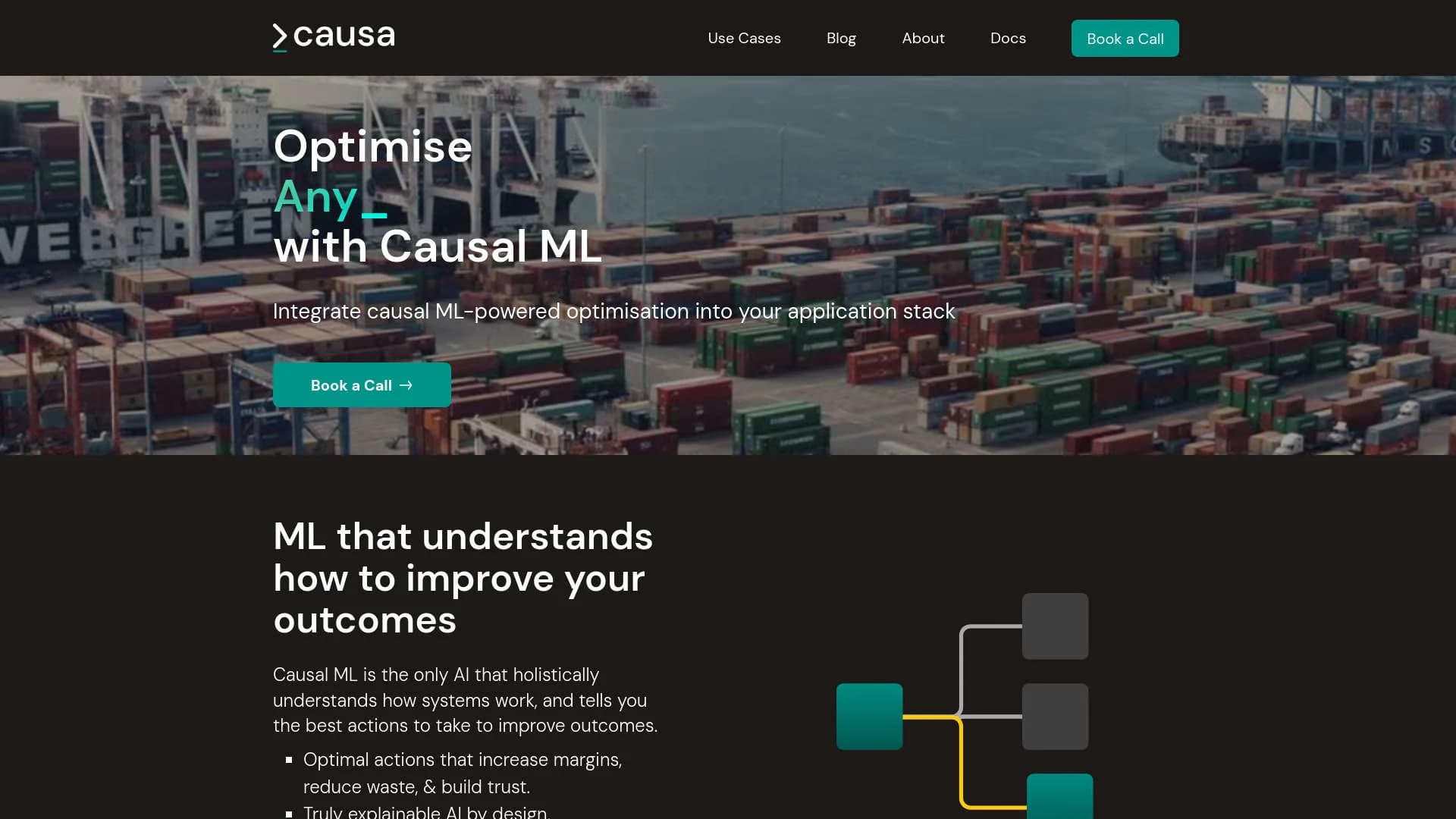
Causa is an advanced platform dedicated to harnessing the power of causal machine learning (ML) to optimize business operations across various industries. It provides a comprehensive ecosystem for data analysis, enabling organizations to make data-driven decisions that drive efficiency, reduce waste, and boost profitability. Causa integrates seamlessly into existing applications, offering robust analytics and actionable intelligence through an intuitive and scalable cloud-native solution.
Causa's specialization in causal ML sets it apart from general ML platforms. By focusing on understanding the 'why' behind data, rather than just the 'what,' Causa provides deeper insights and more strategic decision-making capabilities. This niche focus offers businesses clarity and precision in optimizing operations and achieving desired outcomes.
Causa stands out for its advanced causal ML capabilities, making it an invaluable tool for businesses aiming to optimize their operations. Its focus on providing actionable insights and recommendations helps organizations drive efficiency and profitability. With its user-friendly design and powerful features, Causa is a top choice for businesses looking to leverage causal analysis for strategic decision-making.
Who is Using Causa?
Manufacturing Companies
Optimizing production processes to improve yield and reduce waste.
Healthcare Providers
Enhancing patient outcomes and operational efficiency in clinical settings.
Energy Companies
Managing and predicting energy demands to minimize costs and waste.
Supply Chain Managers
Improving resilience and efficiency in supply chain operations.
Uncommon Use Cases
Academics using Causa for research in causal relationships; financial analysts employing it for risk assessment and mitigation strategies.
Causa's versatility makes it a valuable tool across various sectors
Key Features
Rating Breakdown
Pricing Plans
Cloud Package
- Offers a base plan scalable according to business size and needs. For detailed pricing
- Contact Causa directly
Enterprise Solutions
- Custom pricing available for large organizations
- Including comprehensive support and integration services
Causa Use Cases
Pricing strategy
Build a causal pricing model to understand willingness-to-pay across customer segments.
Outcome: Inform tier restructuring and value-based pricing.
Promotion and discount analysis
Isolate the incremental impact of promotions from seasonality, pull-forward, and cannibalisation.
Outcome: Improve promotional strategy and revenue performance.
Dynamic provisioning
Use Bayesian demand forecasting to optimise cloud infrastructure provisioning.
Outcome: Balance cost efficiency with strict uptime requirements.
Causal inference
Use DAGs and modern causal methods to identify what actually drives business outcomes.
Outcome: Enable interventions that work.
Decision modelling
Frame a decision, model uncertainty, and translate complex analysis into actionable insights.
Outcome: Help decision-makers act with a clearer view of risk and upside.
Workflow Ideas with Causa
Causal decision analysis
- 1Understand the decision that needs to be made
- 2Encode domain knowledge into causal maps and constraints
- 3Quantify uncertainty and deliver actionable clarity
Causal model development
- 1Define cause-and-effect relationships
- 2Stress-test conclusions against hidden factors and alternative explanations
- 3Run what-if simulations before committing to a decision
Embedded capability building
- 1Work alongside the client team as an extension
- 2Build causal modelling capability in-house
- 3Deliver results for complex or ongoing problems
How Causa fits into your stack
Flexible SDK & API
Facilitates integration into existing tech stacks with ease.
Cloud Compatibility
Operates fully in cloud environments, supporting remote and distributed teams.
Third-Party Tools
Compatible with various third-party applications, enhancing its functionality and versatility.
Pros
- +Efficient Implementation: Quick and easy integration of advanced ML models, reducing deployment time and technical expertise requirements.
- +Scalable: Cloud-native features ensure seamless scalability as business needs grow.
- +Data Optimization: Provides insights and recommendations to maximize ROI by identifying and acting on the most impactful actions.
- +User-Friendly: Despite its advanced capabilities, Causa is designed with a simple, intuitive interface accessible to users without extensive technical knowledge.
Cons
- −Niche Application: Most beneficial for companies with specific needs for causal analysis and optimization, which may not apply to all industries.
- −Learning Curve: New users may need time to understand and fully utilize causal ML's potential applications and benefits.
- −Integration Limitations: Potential challenges in integrating with legacy systems that are not compatible with modern APIs.
Limitations & when to consider alternatives
Known limitations
- Fixed-scope projects typically take 4+ weeks. The site lists a typical timeline of four or more weeks for pricing, attribution, and forecasting projects.
- No open-ended retainers. Fixed-scope projects are scoped upfront with an agreed question and deliverable; the site explicitly says there are no open-ended retainers.
- Workshops are scheduled engagements. Workshops and training are listed as one-to-three-day sessions tailored to the client's domain and data.
- Embedded partnerships require longer commitments. Embedded partnerships are listed with typical durations of three to twelve months.
Look elsewhere when
- You need a self-serve software product with a free plan.
- You need a documented developer API or browser-based automation platform.
How to Use Causa
- 1
Visit Causa's official documentation page for a variety of tutorials, ranging from basic setup to advanced features, designed to help users maximize the platform’s capabilities.
Who is Causa For?
Commercial leaders
Causa helps commercial leaders understand the cause-and-effect relationships driving revenue and growth.
Data teams
Workshops and training are tailored for data teams learning Bayesian thinking, causal reasoning, and decision modelling.
Leadership
Hands-on sessions help leadership teams apply Bayesian thinking and causal reasoning to business decisions.
Strategy teams
Embedded partnerships support complex or ongoing strategic problems.
R&D and product teams
Embedded partnerships build internal capability while delivering results for R&D and product organizations.
Frequently Asked Questions
What does Causa do?
Causa helps commercial leaders understand cause-and-effect relationships that drive revenue and growth using causal modelling.
What methods does Causa use?
Its services include causal inference, Bayesian modelling, and decision science.
What is Kairos?
Kairos is Causa’s proprietary causal reasoning engine for building, validating, and deploying causal models.
What types of work does Causa undertake?
Causa offers fixed-scope projects, workshops and training, and embedded partnerships.
How long do engagements typically last?
Fixed-scope projects typically take four or more weeks; embedded partnerships typically last three to twelve months.
Does Causa provide training?
Yes. Causa offers hands-on workshops and training in Bayesian thinking, causal reasoning, and decision modelling.
Community reviews
Be the first to share your experience.
Sign in to leave a review for Causa.
Causa Alternatives
Looking for alternatives to Causa? Here are similar tools in the same category:
Learn to Master Causa
With Skill Leap courses
Get in-depth training on Causa and 50+ other AI tools with our expert-led video courses.
Start 7-Day Free Trial