
Consensus
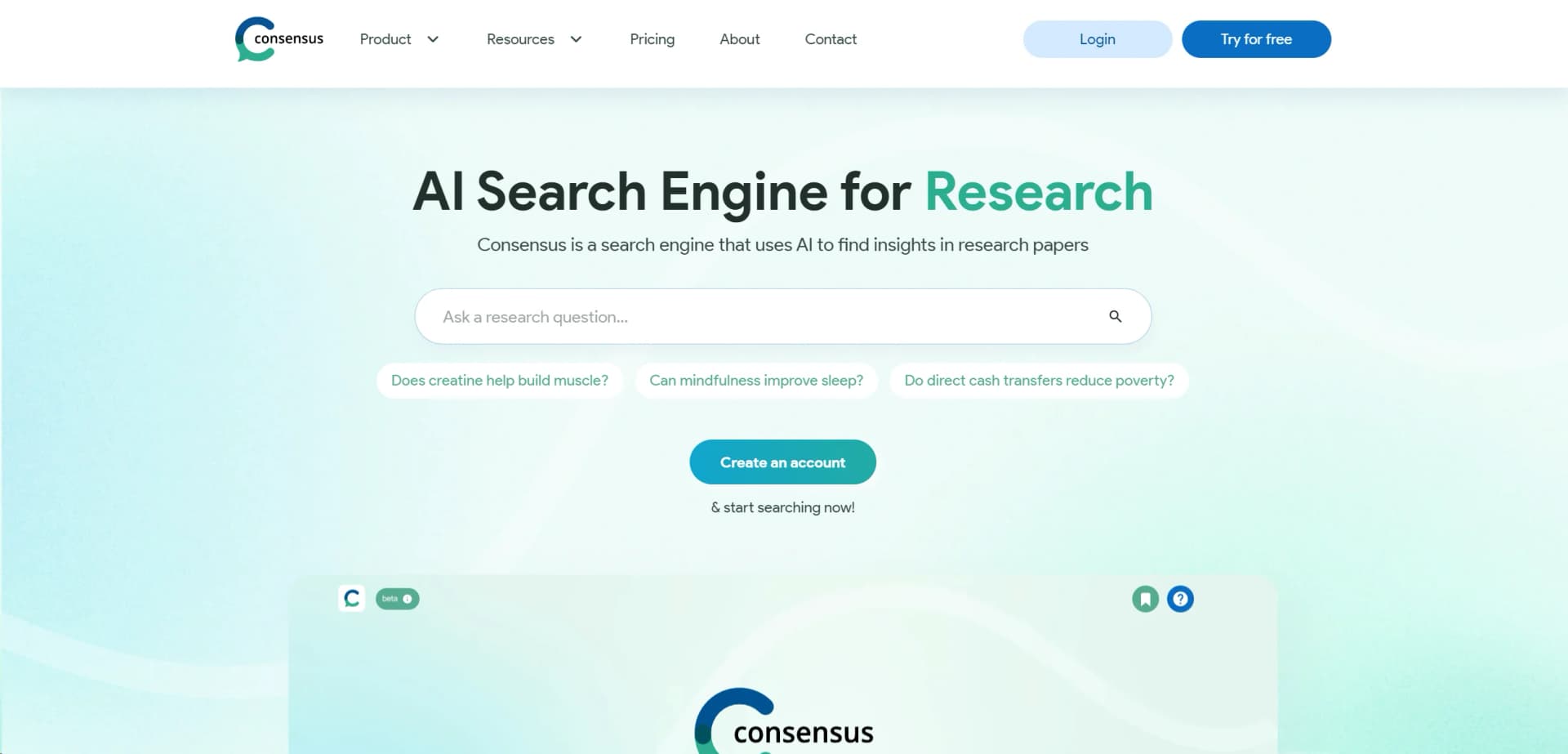
Unlock expert knowledge: AI-powered, ad-free research from 200M+ scientific papers.
Key Takeaways
- What it is
- Unlock expert knowledge: AI-powered, ad-free research from 200M+ scientific papers.
- Pricing
- Freemium
- Best for
- Extensive Coverage
- Results You Can Trust
- Instant Analysis
- Rating
- 4.6/5
What is Consensus?
In the ever-evolving landscape of digital tools aimed at enhancing our ability to gather, process, and understand vast amounts of information, Consensus emerges as a beacon for researchers, students, professionals, and anyone in pursuit of knowledge. At its core, Consensus is an AI-powered search engine designed specifically for research purposes. Unlike traditional search engines that often return a barrage of loosely related information, Consensus zeroes in on delivering insights from over 200 million scientific papers. Its mission is straightforward yet profound: to democratize access to expert knowledge by enabling users to conduct efficient, reliable research without the clutter of ads or the necessity of keyword matching.
Consensus sets itself apart by focusing solely on aiding effective research. Unlike general-purpose AI like ChatGPT, which is built for conversation, Consensus is designed to pull results directly from peer-reviewed studies, ensuring that users have access to credible and reliable information. This distinction is crucial for users who rely on the accuracy and validity of scientific research for their work, studies, or personal interest.
Consensus excels in streamlining the research process, making it an indispensable tool for anyone in need of quick, reliable access to scientific papers and studies. Its unique approach to leveraging AI for summarizing and analyzing research content offers an unmatched advantage in the realm of academic and professional research. With its user-friendly interface, extensive database, and commitment to credibility, Consensus is poised to transform how we approach the search for knowledge.
Who is Using Consensus?
Researchers
Consensus is designed to help researchers search, synthesize, organize, and review scientific literature faster.
Clinicians
The Deep plan is described as suitable for researchers and clinicians conducting frequent literature reviews and evidence-based research.
Students
Consensus names students among its users and provides tutorials and guides for academic research.
Research groups, labs, and academic departments
The Teams plan provides centralized billing, individual logins, account management, and shared research access for organized teams.
Biotech and healthcare organizations
Consensus says it equips teams across biotech, healthcare, and related sectors with tools for finding and consuming external scientific literature.
Key Features
Rating Breakdown
Pricing Plans
Free Tier
Free
- Consensus offers a free trial
- Encouraging users to explore its features and capabilities without immediate commitment
Subscription Plans
- While specific pricing details were not available
- Consensus likely offers tiered subscription plans tailored to the needs of individual users and institutions
Which Consensus plan should you pick?
Start with Free to explore academic search; upgrade to Pro for regular AI analysis, Deep for intensive reviews, Teams for shared research groups, or Enterprise for large institutions.
Free Tier
Good for users starting with Consensus who need basic paper searches and limited AI research features.
Pro Subscription
Good for individual researchers who need unlimited Pro messages, 15 Deep reviews monthly, and unlimited Study Snapshots.
Deep Plan
Good for power users, researchers, and clinicians who need up to 200 Deep reviews monthly.
Teams Plan
Good for research groups, labs, and academic departments that need individual logins, shared management, and centralized billing.
Enterprise Plan
Good for large organizations, universities, and institutes needing thousands of users, library integrations, and account management.
Consensus Use Cases
Literature reviews
Run Deep Review to break a research question into sub-questions, search broadly, and synthesize findings.
Outcome: A structured literature review with introduction, methods, results, discussion, and citations.
Study comparison
Use Research Agent to compare studies and build tables across methods, populations, sample sizes, and outcomes.
Outcome: A side-by-side comparison of relevant research.
Evidence checking
Ask yes-or-no research questions and inspect the Consensus Meter’s Yes, No, Possibly, or Mixed classifications.
Outcome: A quick view of how the relevant literature aligns or disagrees.
Document analysis
Upload manuscripts, protocols, reports, or PDFs and ask questions across those documents.
Outcome: Answers grounded in the user’s uploaded research materials.
Citation discovery
Use Citation Graph to start from trusted papers and discover cited, co-cited, and bibliographically coupled research.
Outcome: A visual map of related, foundational, and follow-up studies.
Workflow Ideas with Consensus
Build a literature review
- 1Enter a focused research question in Consensus
- 2Switch to Deep mode
- 3Export the structured report with citations
Analyze a private research library
- 1Upload PDFs or import a Zotero library
- 2Organize papers into My Library Collections
- 3Ask questions or compare studies across the Collection
Trace a research field
- 1Open Citation Graph from a trusted paper
- 2Add seed papers and adjust graph density
- 3Promote results, exclude papers, and inspect connected research
How Consensus fits into your stack
Research Platforms Compatibility
Seamless integration with academic databases and libraries enhances its utility.
Browser Extension
Offers a browser extension for easier access and research workflow integration.
Mobile Accessibility
Ensures that users can conduct research on-the-go through mobile-friendly access.
Collaboration Tools Integration
While specific tools were not mentioned, the ability to share findings and collaborate on research projects is implied.
Pros
- +Time Efficiency: Significantly reduces the time spent on literature reviews and research by providing summarized results and direct access to scientific papers.
- +Credibility: By linking directly to peer-reviewed studies, Consensus ensures the information's reliability and credibility.
- +User-Friendly Interface: Designed with the user in mind, Consensus offers an intuitive experience that simplifies the research process.
- +Innovative Technology: The integration of GPT-4 for instant analysis of research papers is a game-changer, offering insights that might otherwise take hours to uncover.
Cons
- −Learning Curve: New users may need time to familiarize themselves with the platform's capabilities and how best to utilize its features for their research needs.
- −Specialized Focus: While its specialization in academic and scientific research is a strength, it may not cater to those looking for broader types of information.
- −Availability of Papers: Access to certain papers may be limited based on the user's institutional affiliations or the paper's availability online.
- −Researchers: For conducting thorough literature reviews and staying up-to-date with recent studies.
- −Students: To find supporting evidence for papers or to explore topics for academic assignments.
- −Doctors and Clinicians: For quickly answering patient questions with evidence-based information.
- −Analysts and Content Creators: To source expert quotes and peer-reviewed insights for reports, presentations, and blog posts.
- −Health and Fitness Enthusiasts: Checking the effectiveness and viability of supplements and fitness routines.
- −Uncommon Use Cases: Journalists using it to back their stories with scientific evidence; Policy makers leveraging it for data-driven decision making.
Limitations & when to consider alternatives
Known limitations
- Consensus Meter is not a complete view of all science. The Meter uses only the five to twenty most relevant results for a query and may not reflect the full body of research.
- Full-text access varies. Consensus can analyze full text only when it is available through publisher partnerships or open-access sources; otherwise it relies on metadata, abstracts, or indexed information.
- Uploaded files must be text-based PDFs. Image-based or scanned PDFs may not process, and uploads have a 50 MB size limit.
- Zotero import is one-way. Changes made in Consensus are not reflected in Zotero, and new Zotero items require periodic re-importing.
- Citation Graphs are not saved in beta. Refreshing or closing the Citation Graph page clears the graph.
Look elsewhere when
- You need a complete, exhaustive representation of all research on a topic.
- You need to analyze scanned or image-based PDFs.
- You need changes to synchronize bidirectionally with Zotero.
- You need a native desktop application.
How to Use Consensus
- 1
Ask a research question
Open Consensus, enter a focused question or topic, and choose Paper Search, Pro, or Deep mode based on the depth of analysis needed.
- 2
Choose the research corpus
Use All, Medical mode, or My Library to control whether Consensus searches its full index, biomedical literature, or your saved and uploaded papers.
- 3
Refine the evidence
Apply filters such as study type, publication date, sample size, journal quality, population, or citation count.
- 4
Review the synthesis
Read cited summaries, inspect Study Snapshots, use the Consensus Meter for yes-or-no questions, or run Deep Review for a structured report.
- 5
Organize research
Save papers and searches into My Library Collections, import Zotero materials, or share Collections with Viewers and Editors.
- 6
Export results
Export reports as PDF or copy formatted text, and export citations as CSV, RIS, BibTeX, or other supported citation styles.
Who is Consensus For?
Researchers
Consensus helps researchers search, evaluate, compare, and synthesize peer-reviewed literature.
Clinicians
Clinicians can check evidence, use medical search filters, and review clinical research before decisions.
Students
Students can explore unfamiliar topics, conduct literature reviews, and verify evidence behind academic arguments.
Faculty
Faculty can use Consensus for evidence-based research and access student and academic discounts.
Librarians
Consensus provides a LibGuide and research workflows designed for librarians supporting academic users.
Frequently Asked Questions
Can I use Consensus for free?
Yes. Consensus offers a free tier with unlimited Paper searches, limited Pro messages, three Deep reviews, ten Study Snapshots, and 30 API or MCP calls monthly.
What does Consensus search?
Consensus searches more than 220 million peer-reviewed research papers, with a separate medical dataset containing approximately 8 million papers and 50,000 clinical guidelines.
Can I upload my own documents?
Yes. Users can upload published papers, drafts, manuscripts, dissertations, clinical protocols, private research reports, and other research-related PDFs.
Can I collaborate with other people?
Yes. Collections can be shared by email or invite link with Viewer or Editor access.
Does Consensus train AI models on my data?
No. Consensus says it does not use user data to train its own or third-party AI models.
Can Consensus integrate with other research tools?
Consensus integrates with Zotero and supports citation workflows using formats compatible with EndNote, Mendeley, Paperpile, RefWorks, Citavi, and Papers.
Community reviews
2 reviews from people who use Consensus.
Sign in to leave a review for Consensus.
Cornelia Tschichold
Emir Osmanov
Consensus Alternatives
Looking for alternatives to Consensus? Here are similar tools in the same category:
Learn to Master Consensus
With Skill Leap courses
Get in-depth training on Consensus and 50+ other AI tools with our expert-led video courses.
Start 7-Day Free Trial