Dedoctive
Auditable AI for defensible decisions.
Key Takeaways
- What it is
- Auditable AI for defensible decisions.
- Pricing
- Freemium
- Best for
- Auditable AI Workflows
- Curated Knowledge Models
- Granular Source Provenance
- Rating
- 4.2/5
What is Dedoctive?
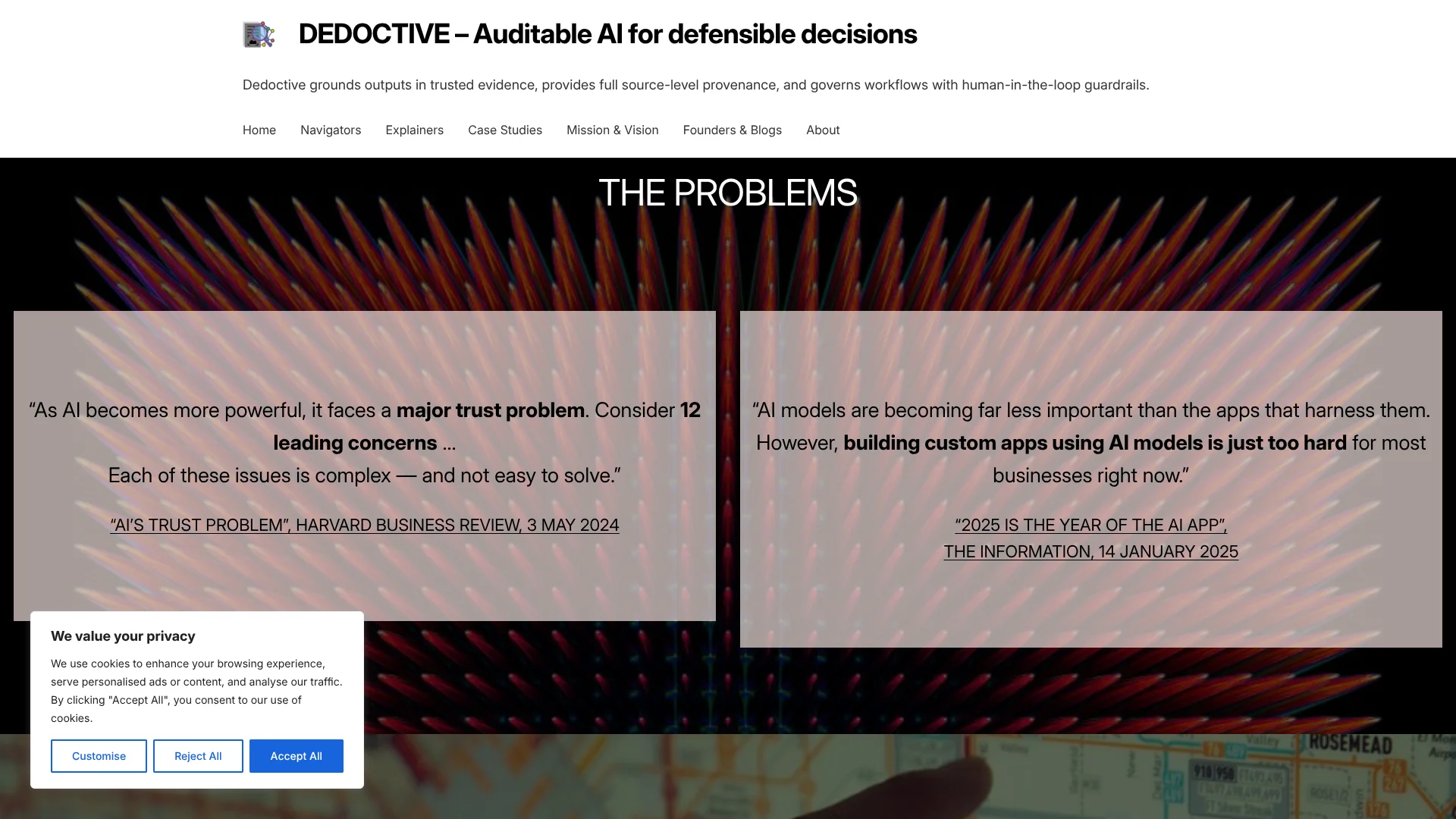
Dedoctive focuses on auditable AI for defensible decisions. It wraps large language models inside transparent, governed workflows so that every output is grounded in trusted evidence, fully traceable to its sources, and open to human review. Instead of acting as a black-box chatbot, it behaves like a cautious analyst that always shows its working.
Dedoctive is unusual in how strongly it prioritizes evidence and traceability over raw generative flair. Its curated knowledge models, strict provenance, and refusal to answer without adequate evidence create a system that behaves more like a cautious expert panel than a free-form chatbot. By combining BPMN-modeled workflows, human checkpoints, and fine-grained source links, it gives organisations a practical way to apply large language models where every decision must be explainable and defensible, not just impressive in a demo.
Dedoctive suits organizations that care less about flashy conversational tricks and more about whether an AI-assisted decision can be defended to regulators, courts, boards, or the public. Its auditable workflows, curated knowledge, and granular provenance make it a strong fit for public sector, financial, legal, healthcare, and engineering teams that need AI to act like a meticulous analyst, not an improviser.
Who is Using Dedoctive?
Public Sector Bodies
Supporting policy, procurement, compliance, and regulatory decisions that must stand up to scrutiny.
Financial and Legal Services
Assisting risk, compliance, and legal teams where every recommendation must be sourced and auditable.
Healthcare and Life Sciences
Aiding evidence reviews, clinical policy interpretation, and research assessments backed by transparent citations.
Engineering and Critical Industries
Helping subject matter experts reach, validate, and defend critical decisions on safety, compliance, and risk management.
Large Enterprises and Consultancies
Standardising how AI-driven analyses are produced, checked, and documented across complex organisations.
Uncommon Use Cases
Used by research teams to map and visualise complex argument chains across documents; adopted by internal audit groups to test, document, and challenge AI-assisted decision processes.
Key Features
Rating Breakdown
Pricing Plans
Free Services
Free
- Includes public website content, demonstrations, workshops, downloadable materials, evaluation tools, and developer editions
Paid Services
- Governed by a quotation
- Order form
- Statement of work
- Subscription agreement
- Purchase order
- Or other written confirmation
Trial/Beta/Evaluation Access
Free
- Provided for assessment purposes only and not intended for production or high-impact decision-making use unless expressly agreed in writing
Dedoctive Use Cases
Safety and compliance assessment
Use Safety Navigator to extract safety arguments, create bowtie diagrams, and assess compliance from complex documentation and data.
Outcome: Visual outputs with potential weaknesses highlighted.
Emergency routing
Use RouteMAIT to support routing for debris clearance, casualty transportation, wildfire suppression, search and rescue, and relief aid distribution.
Outcome: Swift and effective disaster-response routing.
Home retrofit planning
Use Retrofit Navigator to provide homeowners, advisors, architects, and builders with designs, plans, and local costs.
Outcome: Practical construction projects for warmer, more comfortable, sustainable buildings.
Healthcare recommendation review
Use Healthcare Navigator to summarise relevant health-record information and analyse implications for a proposed diagnosis, prognosis, or treatment plan.
Outcome: A governable framework for clinical recommendation review.
Climate adaptation and placemaking
Use Adaptation Navigator or Place Navigator to provide customised climate-adaptation pathways or review planning applications against best practices and regulations.
Outcome: More informed community participation and decision-making.
Workflow Ideas with Dedoctive
Create a source-linked document analysis workflow
- 1Index documents, tables, data, and images into a structured Knowledge Model
- 2Design a hybrid BPMN and AI workflow with controlled reasoning
- 3Return answers and reports with granular links back to supporting evidence
Run a governed safety review
- 1Provide the relevant safety documentation and data
- 2Use Safety Navigator to extract arguments and generate bowtie diagrams
- 3Have a human reviewer inspect highlighted weaknesses and approve or modify the result
Build and deploy a custom Navigator
- 1Index domain documents into a structured Knowledge Model
- 2Design workflows in DedoctiveDesigner using tasks, agents, and tools
- 3Deploy the workflow as an agent and iterate using Dynamic Debugging
How Dedoctive fits into your stack
Browser
Dedoctive provides browser-based access to auditable AI workflows and source-linked decision-support outputs.
Knowledge and files
It ingests documents, data, tables, and images into verified knowledge models with granular provenance.
Automation and APIs
Visual BPMN workflows combine deterministic process steps, AI reasoning, human tasks, and deployable agents.
Pros
- +High Trust Outputs: The system draws only on verified sources and will say when evidence is missing, which sharply reduces hallucinations.
- +Transparent Reasoning: Multi-step reasoning paths and supporting documents can be inspected, helping reviewers understand how a conclusion was reached.
- +Model Agnostic: Because it wraps external models, teams can choose or switch language models without rethinking their governance approach.
- +Governance Friendly: Human-in-the-loop guardrails, audit trails, and evidence traceability match the needs of regulated or high-risk decision processes.
Cons
- −Setup Effort: Building curated knowledge models and workflows demands more upfront effort than using a generic out-of-the-box chatbot.
- −Technical Skill Requirement: The Developer Edition assumes comfort with BPMN concepts and basic software engineering practices.
- −Niche Focus: Best suited to evidence-heavy, regulated work; smaller teams running informal experiments may find it more structured than they need.
Limitations & when to consider alternatives
Known limitations
- Free, beta, trial, and developer access is not for high-impact production decisions. The terms prohibit using these access types for production, regulated, safety-critical, clinical, financial, legal, operational, or other high-impact decisions unless expressly agreed.
- Human review remains required. Dedoctive supports human judgement rather than replacing it; users must review, validate, and approve outputs before relying on them.
- Outputs are not guaranteed to be error-free. The terms state that outputs may not always be complete, accurate, current, suitable, or free from error.
- Sensitive data has restrictions in public and evaluation environments. Highly sensitive, classified, patient-identifiable, special-category, and other restricted data must not be submitted to public, free, trial, workshop, beta, or developer environments unless safeguards are agreed.
- Input quality affects output quality. Poor, incomplete, outdated, inconsistent, or unauthorised input data may affect Dedoctive outputs.
Look elsewhere when
- You need model fine-tuning or training jobs
- You need a native mobile application
- You need a documented public developer API
- You need explicit at-rest or in-transit encryption guarantees
How to Use Dedoctive
- 1
Choose a document-heavy decision process
Start with a process where evidence quality, traceability, and defensibility matter; the vendor offers a free micro-pilot around one such process.
- 2
Provide the source material
Bring relevant documents, tables, data, spreadsheets, diagrams, websites, or images for ingestion into a verified knowledge model.
- 3
Design the governed workflow
Use BPMN and AI workflow components to specify allowed tasks, sources, rules, review points, escalation conditions, and audit records.
- 4
Query the knowledge model
Ask questions in natural language and retrieve answers assembled from structured and unstructured information.
- 5
Inspect provenance and visual outputs
Follow source links, explore Response Maps, and review reports, diagrams, arguments, classifications, or recommendations.
- 6
Apply human approval before use
Review, validate, approve, reject, or modify the result before sharing it or using it in a decision.
Who is Dedoctive For?
Assurance and compliance teams
They can use source-linked workflows and verified evidence to make decisions traceable, reviewable, and defensible.
Safety and risk teams
They can extract safety arguments, create bowtie diagrams, and assess compliance from complex documentation and data.
Digital transformation and enterprise AI teams
They can build governed AI workflows and domain-specific Navigators without requiring model training.
Public-sector decision-makers
They can apply auditable AI to document-heavy decisions where governance, accountability, and evidence quality matter.
Developers and enterprise architects
They can index documents, design hybrid BPMN and AI workflows, deploy agents, and debug workflows.
Frequently Asked Questions
What is Dedoctive?
Dedoctive is a neuro-symbolic AI platform for auditable, source-linked decisions. It combines curated knowledge models, governed workflows, provenance links, and human review.
What types of information can Dedoctive process?
Dedoctive processes documents, data, tables, spreadsheets, databases, diagrams, websites, and images, converting them into a unified knowledge model.
Can Dedoctive work with existing large language models?
Yes. The platform can use large language models without requiring model training and is designed to avoid dependence on proprietary software.
Does Dedoctive provide source traceability?
Yes. Answers include granular provenance links that can lead to source paragraphs, table cells, or background text within images.
Does Dedoctive require human review?
Yes. Its workflows include human-in-the-loop guardrails, approval, rejection, modification, escalation, and audit points.
How can an organisation get started?
Organisations can request a free micro-pilot using one document-heavy decision process, or explore enterprise deployments and partner-led projects.
Community reviews
Be the first to share your experience.
Sign in to leave a review for Dedoctive.
Dedoctive Alternatives
Looking for alternatives to Dedoctive? Here are similar tools in the same category:
Learn to Master Dedoctive
With Skill Leap courses
Get in-depth training on Dedoctive and 50+ other AI tools with our expert-led video courses.
Start 7-Day Free Trial