
DeepSeek
Scales efficient language processing with open-source accessibility.
Key Takeaways
- What it is
- Scales efficient language processing with open-source accessibility.
- Pricing
- $0.07 (cache hit) · $0.14 (cache hit)
- Best for
- Mixture-of-Experts (MoE) Architecture
- High Parameter Count with Efficient Activation
- Extended Context Length
- Rating
- 4.7/5
What is DeepSeek?
DeepSeek is a Chinese artificial intelligence company specializing in developing open-source large language models (LLMs). Founded in 2023, DeepSeek has rapidly emerged as a formidable competitor in the AI landscape, offering advanced models that rival leading Western counterparts. The company's flagship model, DeepSeek-V3, exemplifies its commitment to innovation and efficiency in AI development.
DeepSeek distinguishes itself through its commitment to open-source development and efficient AI model training. The company's ability to deliver high-performance models with reduced computational resources challenges the traditional paradigm of AI development, making advanced AI more accessible and sustainable.
DeepSeek has rapidly established itself as a leader in the AI industry by delivering high-performance, open-source models that are both cost-effective and efficient. Its innovative approach to AI development makes it a compelling choice for organizations seeking advanced language models without the prohibitive costs typically associated with such technology.
Who is Using DeepSeek?
Academic Researchers
Leveraging DeepSeek's open-source models for studies in natural language processing and AI development.
Technology Startups
Integrating DeepSeek's models to enhance product offerings with advanced language understanding capabilities.
Financial Institutions
Utilizing DeepSeek's AI for algorithmic trading and financial analysis, benefiting from its efficient processing capabilities.
Healthcare Providers
Applying the models in medical data analysis and patient communication tools to improve service delivery.
Uncommon Use Cases
Adopted by environmental organizations for analyzing large datasets related to climate change; employed by legal firms to assist in document review and case analysis.
Key Features
Rating Breakdown
Pricing Plans
deepseek-chat
$0.07 (cache hit)
- $0.27 (cache miss)
- $0.28 (output)
deepseek-reasoner
$0.14 (cache hit)
- $0.55 (cache miss)
- $2.19 (output)
DeepSeek Use Cases
Code completion
Provide a prefix and optional suffix for fill-in-the-middle completion, including programming functions.
Outcome: Generated code fills the missing section.
Image analysis
Submit an image and ask DeepSeek to describe it, read screenshot text, or analyze a chart.
Outcome: The model returns a text interpretation of the image.
Tool-assisted applications
Define external functions such as weather lookup and let the model call them during a conversation.
Outcome: Applications can combine model reasoning with external tools.
Structured data processing
Ask DeepSeek to transform unstructured content into JSON output.
Outcome: The application receives machine-readable structured results.
AI agent and coding assistant backends
Configure Claude Code, GitHub Copilot, OpenCode, or Codex to use DeepSeek models through the API.
Outcome: DeepSeek models power supported agent or coding workflows.
Workflow Ideas with DeepSeek
Analyze an uploaded image
- 1Upload a JPEG, PNG, GIF, or WebP image through the Files API
- 2Reference the returned file ID in a vision-model request
- 3Ask DeepSeek to describe, transcribe, or analyze the image
Build a tool-assisted assistant
- 1Define external functions in the API request
- 2Send the user conversation to a DeepSeek model
- 3Execute returned tool calls and send the results back for a final answer
Generate structured application data
- 1Provide source text and a JSON-output instruction
- 2Request a response using JSON mode or a JSON schema
- 3Parse the returned structured response in the application
How DeepSeek fits into your stack
Browser
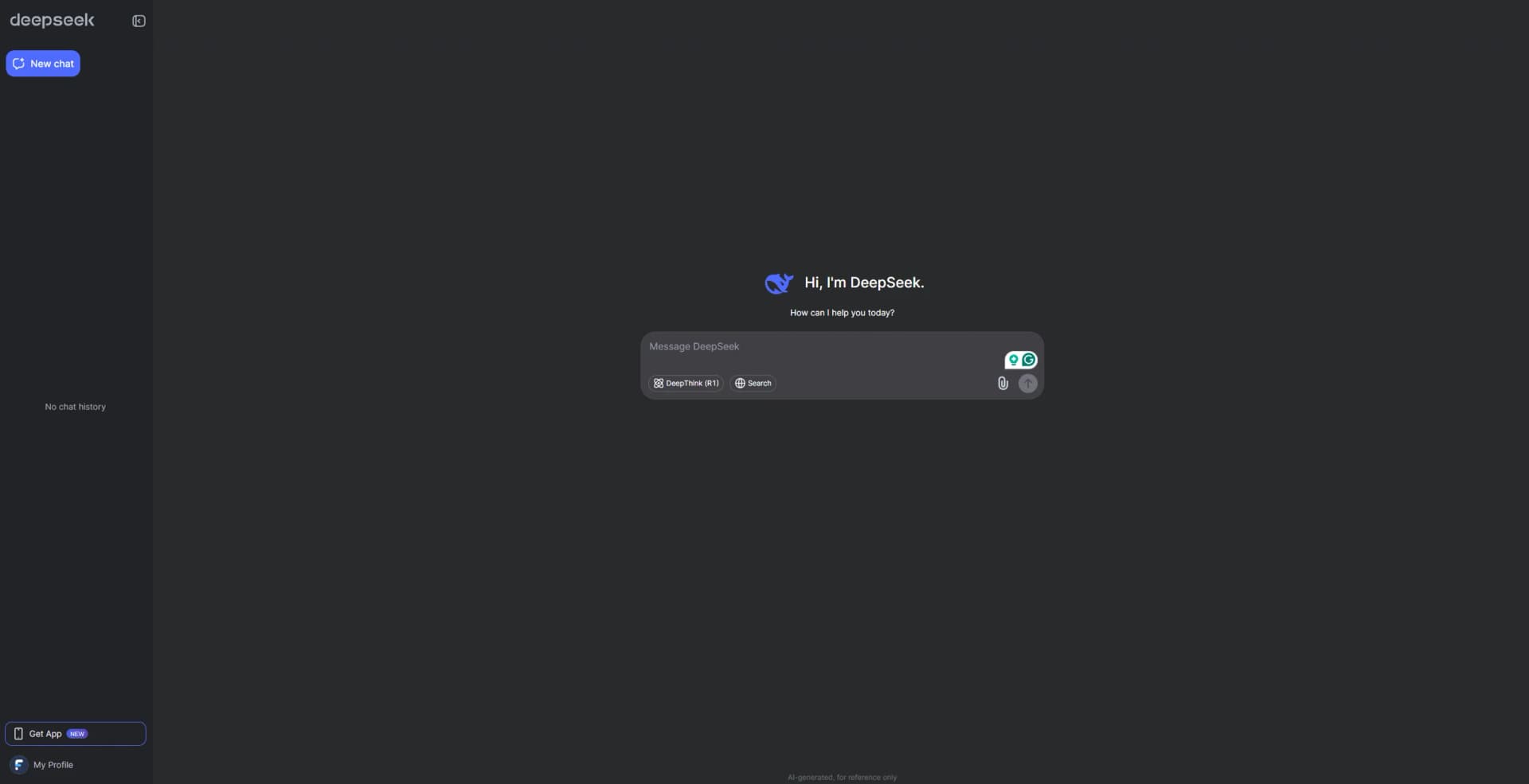
DeepSeek Web provides browser-based chat access, including free access to its current models.
Automation and APIs
The documented API exposes OpenAI-compatible, Anthropic-compatible, Responses, Files, vision, and tool-calling interfaces.
Desktop / IDE
DeepSeek Harness runs locally as an extensible coding-agent environment; DeepSeek models can also be configured in Codex and coding tools.
Knowledge and files
The Files API stores uploaded images for reuse, while vision models can inspect screenshots, charts, and other images.
Pros
- +Cost-Effective Development: DeepSeek's models have been developed at a fraction of the cost compared to competitors, demonstrating that high-performance AI can be achieved with efficient resource utilization.
- +Rapid Training Time: The company has achieved significant reductions in training time, enabling faster deployment of models and quicker iteration cycles.
- +Competitive Performance: Benchmark tests indicate that DeepSeek-V3 outperforms models like Llama 3.1 and Qwen 2.5, and matches the capabilities of GPT-4o and Claude 3.5 Sonnet in various tasks.
- +Energy Efficiency: The Mixture-of-Experts architecture contributes to lower energy consumption during inference, making it a more sustainable option for large-scale AI applications.
Cons
- −Limited Global Recognition: Despite its advancements, DeepSeek is still gaining recognition outside of China, which may affect its adoption in international markets.
- −Potential Censorship Concerns: As a Chinese company, there may be concerns regarding content moderation and censorship, particularly in applications involving sensitive topics.
Limitations & when to consider alternatives
Known limitations
- API responses are stateless. The Responses API does not store conversations; applications must resend the complete conversation history.
- Vision is model-specific. Only the documented vision model processes images; other models return an unsupported-image error or treat image input as a placeholder.
- Image formats are limited. The Files API documents JPEG, PNG, GIF, and WebP uploads rather than general office-document uploads.
- API usage is metered. API charges are calculated from input and output tokens and deducted from account balance.
- Concurrency limits apply. Documented concurrency limits vary by model, and exceeding them produces HTTP 429 errors.
How to Use DeepSeek
- 1
Start with the web or mobile app
Open DeepSeek’s web experience or install the official mobile app to begin free conversations.
- 2
Choose a model mode
Use the available standard or reasoning-oriented experience depending on whether you need faster responses or deeper reasoning.
- 3
Use the API for applications
Create an API key, set the DeepSeek base URL, select a model, and call the chat or responses endpoint.
- 4
Add vision input when needed
Use the vision model with an image URL, base64 image, or uploaded file ID to analyze visual content.
- 5
Connect tools or coding assistants
Configure function tools or supported coding and agent integrations such as Codex, Claude Code, GitHub Copilot, or OpenCode.
Who is DeepSeek For?
AI agent and harness developers
DeepSeek Harness is explicitly positioned for developers building extensible agent runtimes and harnesses.
Developers
The API platform provides documented endpoints, API keys, model configuration, and coding-agent integrations.
Coding professionals
DeepSeek supports coding agents, code generation, file editing, shell tools, and integrations with developer tools.
Frequently Asked Questions
Is DeepSeek free to use?
DeepSeek’s official website offers free conversations, while API usage is billed by token consumption.
Does DeepSeek provide an API?
Yes. The API supports OpenAI-compatible and Anthropic-compatible formats, API keys, chat completions, responses, tool calls, and vision.
Can DeepSeek analyze images?
Yes. The vision model accepts JPEG, PNG, GIF, and WebP images through URLs, base64 data, or uploaded file IDs.
Can DeepSeek generate code?
Yes. DeepSeek documents code-generation capabilities, coding models, FIM completion, and integrations with coding assistants.
Can DeepSeek upload files?
The Files API supports image uploads for later use with the vision model. The documented upload formats are JPEG, PNG, GIF, and WebP.
Does the API retain conversations?
The Responses API is stateless; clients must send the full conversation history for multi-turn requests.
Community reviews
1 review from people who use DeepSeek.
Sign in to leave a review for DeepSeek.
Jeffrey Munn
DeepSeek Alternatives
Looking for alternatives to DeepSeek? Here are similar tools in the same category:
Learn to Master DeepSeek
With Skill Leap courses
Get in-depth training on DeepSeek and 50+ other AI tools with our expert-led video courses.
Start 7-Day Free Trial