
Dhisana AI
Automate account research, outreach, meetings, and forecasting.
Key Takeaways
- What it is
- Automate account research, outreach, meetings, and forecasting.
- Pricing
- Freemium · $49 per month
- Best for
- Agentic Flows Cognitive Architecture
- Full-Funnel Revenue Automation
- Adaptive Outreach & Intent Intelligence
- Rating
- 4.5/5
What is Dhisana AI?
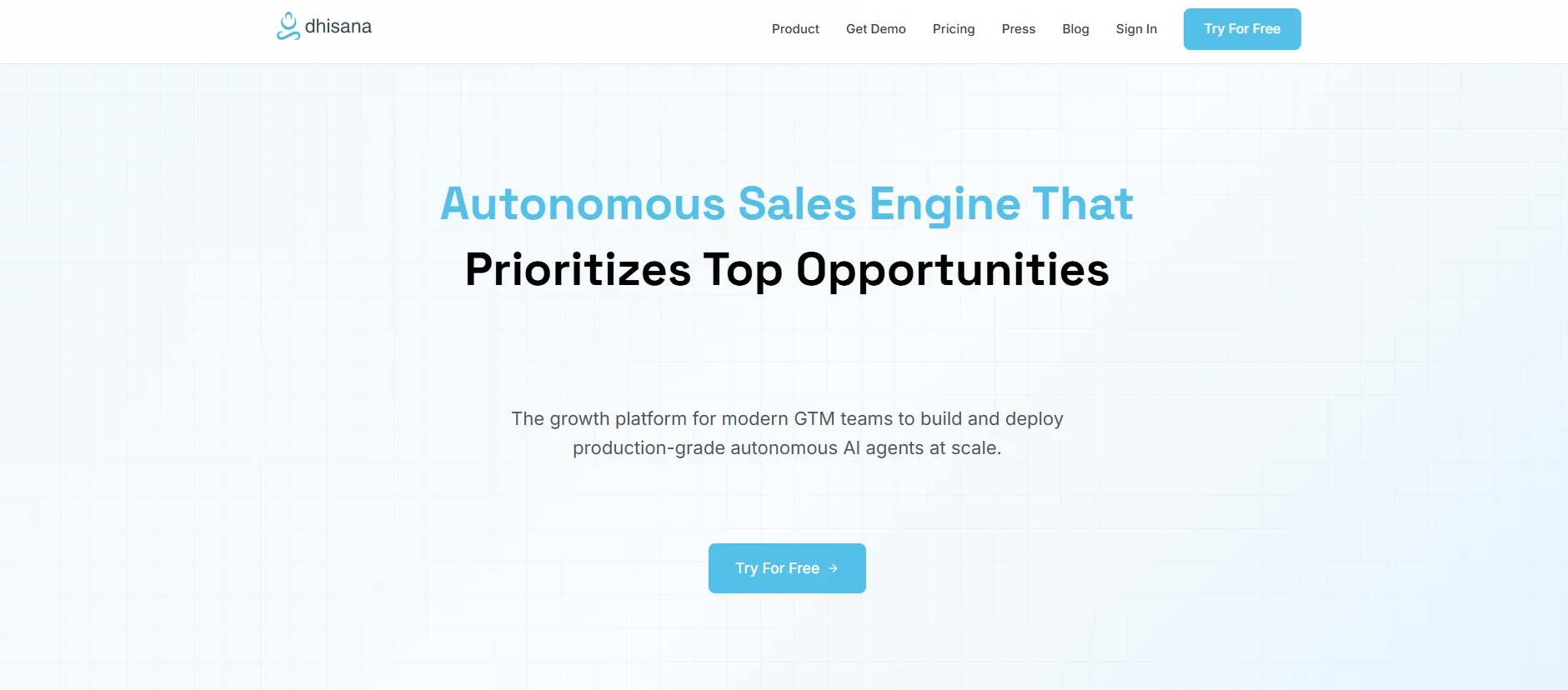
Dhisana AI is an autonomous sales engine focused on modern go-to-market teams. It combines large language models with a patent-pending cognitive architecture called Agentic Flows to automate account discovery, outreach, meeting prep, follow-up, and forecasting. Rather than acting as just another CRM add-on, it behaves like a 24/7 AI GTM team that drives pipeline, accelerates cycles, and supports revenue expansion across the entire funnel.
Dhisana AI stands out through its cognitive Agentic Flows architecture, which turns detailed GTM processes into reliable, self-running workflows instead of just generating text or simple triggers. It positions itself as a system of intelligence on top of existing systems of record, transforming CRM and product data into intent scores, next-best actions, and live coaching. The combination of full-funnel coverage, AI-native workflow design, usage-based pricing, and strong integration depth makes it unusually attractive for revenue teams that want autonomy without assembling a patchwork of point tools.
Dhisana AI offers a focused answer for revenue leaders who want autonomous execution, not just more dashboards. By combining production-grade AI agents, strong GTM-centric workflows, and a usage-based business model, it gives SDRs, AEs, managers, RevOps, and CS teams a powerful shared engine for pipeline creation and expansion revenue. Organizations that are ready to invest a bit of time in configuration and data access will likely find that Dhisana AI provides a notably efficient way to turn complex sales processes into always-on, AI-driven operations.
Who is Using Dhisana AI?
B2B SaaS Startups
Using autonomous agents to build predictable outbound programs without hiring large SDR teams.
Mid-Market GTM Teams
Coordinating SDR, AE, and CS motions inside one AI-driven revenue engine.
Enterprise Sales Organizations
Augmenting complex account-based selling with intent signals, call intelligence, and deal coaching.
RevOps and Sales Operations Teams
Automating enrichment, routing, and pipeline health monitoring while maintaining clean analytics.
Customer Success Teams
Watching usage, renewal risk, and upsell signals so CSMs can focus on strategic conversations.
Uncommon Use Cases
Private equity and VC firms tracking sales performance patterns across portfolios; product-led growth teams mining GTM insights to influence product and packaging decisions.
Key Features
Rating Breakdown
Pricing Plans
Starter
Free
- Managing up to 100 active leads per month, basic AI workflows, email and chat support, core CRM and email integrations, and a basic analytics dashboard
Professional
$49 per month
- Managing up to 1,000 active leads per month, unlimited seats, 500+ AI workflows across prospecting and sales processes, lead research and enrichment, email support, reporting, HubSpot integration, and pay-as-you-go expansion at $40 per additional 1,000 active leads per month
Enterprise
- Custom active lead volumes based on GTM needs, a dedicated Forward Deployed Engineer, custom integrations, advanced security and compliance, and Salesforce integration
Which Dhisana AI plan should you pick?
Start with the free option to validate one workflow, use Professional for initial production usage, upgrade to Business for shared multi-workflow teams, and choose Enterprise for custom deployment and governance.
Professional
Good for teams launching their first production revenue agents with 5,000 monthly Agent Work Units and unlimited seats.
Business
Good for teams running shared pipeline and customer workflows with 15,000 monthly Agent Work Units, shared workspaces, and cross-functional orchestration.
Enterprise
Good for organizations needing custom capacity, proprietary integrations, SSO, role-based access, audit controls, and dedicated deployment.
Dhisana AI Use Cases
Product-led growth orchestration
Connect product analytics events, aggregate usage, score leads, detect churn risk, and trigger CRM, Slack, or email actions.
Outcome: Automated lead scoring, routing, trial conversion, and retention workflows.
Champion tracking
Upload champion lists, monitor job changes, research new companies, score opportunities, and route contacts to CRM or outreach.
Outcome: Create warm pipeline from existing customers, power users, and advocates.
Custom signal monitoring
Define signals such as funding, hiring, technology changes, or expansion plans, then scrape sources and route findings.
Outcome: Automatically update CRM records, alert Slack, or trigger sequences.
Multi-channel engagement
Build conditional email and LinkedIn sequences with delays, branches, agent instructions, and follow-up actions.
Outcome: Run coordinated prospect engagement across multiple channels.
New-hire tracking
Monitor target-account hiring activity, filter relevant roles, research new decision makers, and alert account owners.
Outcome: Reach new stakeholders while they are evaluating priorities and vendors.
Workflow Ideas with Dhisana AI
Product usage to sales action
- 1Connect PostHog, Amplitude, Mixpanel, or another product analytics source
- 2Aggregate usage events and have agents score accounts or detect risks
- 3Update CRM records, alert Slack, or trigger personalized email sequences
Champion job-change pipeline
- 1Upload a list of champions, power users, or past buyers
- 2Monitor LinkedIn for job changes and research the new company
- 3Score and route the opportunity to Slack, CRM, or an outreach sequence
Custom signal routing
- 1Define the business signals to monitor in plain English
- 2Scrape specified websites, LinkedIn, job boards, or other sources
- 3Extract signals and route them to CRM, Slack, sequences, or another configured workflow
How Dhisana AI fits into your stack
Browser
Dhisana operates as a hosted AI agent platform for revenue teams, using browser-based research and a built-in Browser Use Operator for tasks such as LinkedIn engagement monitoring.
Automation and APIs
Agentic Flows coordinate multi-step revenue work, including webhooks or API-based event ingestion, lead scoring, routing, CRM updates, outreach, and follow-up automation.
Team chat and tickets
Dhisana can route alerts and workflow outcomes to Slack while coordinating CRM, email, calendar, and cross-functional revenue workflows.
Knowledge and files
The platform combines internal knowledge, proprietary business context, account lists, playbooks, customer data, and enterprise records to ground agent decisions and actions.
Pros
- +True GTM Coverage: Handles everything from prospecting to renewals, reducing the need for multiple point tools.
- +Meaningful Productivity Gains: Reported lifts in engagement and time saved weekly make it attractive for lean revenue teams.
- +AI-Native Design: Built around autonomous agents from day one, rather than bolt-on AI features retrofitted to legacy CRM.
- +High Integration Surface: 100+ integrations and API options help Dhisana AI slot into existing stacks.
- +Flexible Consumption Model: Usage-based pricing ties spend directly to how much AI work is performed.
Cons
- −Pricing Opacity: No public per-month or per-unit dollar figures, which can slow quick budget comparisons.
- −Complexity For Smaller Teams: The breadth of capabilities may feel heavy for very simple or early-stage sales motions.
- −Data Access Requirements: To unlock full value, Dhisana AI needs deep access to CRM and communication data, raising governance work for security-conscious organizations.
Limitations & when to consider alternatives
Known limitations
- Usage is metered. Professional includes 5,000 Agent Work Units monthly and Business includes 15,000. Additional demand may require more capacity or a higher plan.
- Lower-priority workflows may need to pause. When monthly Agent Work Units are exceeded, Dhisana lists pausing lower-priority workflows until capacity resets as an option.
- SSO is enterprise-oriented. SAML-based SSO is described as a capability for enterprise customers.
- Some deployment options require enterprise scope. Dedicated hosted or customer-cloud deployment, dedicated deployment support, and custom controls are listed under Enterprise.
Look elsewhere when
- You need native mobile apps.
- You need public developer API documentation.
- You need model fine-tuning on your own data.
- You need image-analysis capabilities.
How to Use Dhisana AI
- 1
Choose a priority workflow
Start with a measurable revenue outcome such as account intelligence, qualification, meeting preparation, or CRM updates.
- 2
Connect business context
Connect CRM, email, calendar, product data, enrichment sources, web signals, transcripts, and existing business rules.
- 3
Configure an Agentic Flow
Define approvals, routing, enrichment, engagement, CRM updates, escalation paths, and other operating rules.
- 4
Run with human oversight
Let agents execute the workflow while approval checkpoints and policy controls govern consequential actions.
- 5
Inspect outcomes
Review workflow, team, usage, pipeline, and execution visibility to identify improvements.
- 6
Scale capacity or scope
Add Agent Work Units, move from Professional to Business, or contact sales for an Enterprise deployment as workflows expand.
Who is Dhisana AI For?
Revenue operations teams
Centralize business rules, routing, approvals, CRM quality, workflow adoption, and cross-system coordination.
Frontline revenue teams
Get prioritized accounts, risks, opportunities, meeting preparation, and contextual follow-through.
Sales and marketing teams
Use account intelligence, prospecting, engagement, qualification, and automated revenue workflows.
Customer success teams
Monitor adoption, churn risk, renewals, expansion opportunities, and relationship changes.
Revenue leadership
Inspect workflow performance, pipeline creation, account coverage, execution gaps, and business outcomes.
Frequently Asked Questions
What is Dhisana AI?
Dhisana is an enterprise decision intelligence platform powered by governed AI agents. It combines enterprise data, business signals, and operating rules to support decisions and next-best actions.
How is Dhisana deployed and integrated?
Dhisana connects CRM, data warehouses, internal knowledge, engagement platforms, collaboration tools, and proprietary systems. It can be deployed in a customer cloud or dedicated hosted instance.
What does Dhisana support?
The platform supports account intelligence, qualification, meeting preparation, opportunity progression, stakeholder follow-through, CRM operations, renewals, expansion, and leadership visibility.
Can we start for free?
Yes. Dhisana says users can explore the platform for free before subscribing to the Professional or Business plan.
Does Dhisana support SSO?
Yes. SAML-based single sign-on is supported for enterprise customers.
Does Dhisana train AI models on customer data?
No. Dhisana states that customer data is not used to train, fine-tune, or improve its AI models.
Community reviews
Be the first to share your experience.
Sign in to leave a review for Dhisana AI.
Dhisana AI Alternatives
Looking for alternatives to Dhisana AI? Here are similar tools in the same category:
Learn to Master Dhisana AI
With Skill Leap courses
Get in-depth training on Dhisana AI and 50+ other AI tools with our expert-led video courses.
Start 7-Day Free Trial