
Fast.ai
Simplifies deep learning with accessible courses and tools.
Watch Fast.ai in Action
Key Takeaways
- What it is
- Simplifies deep learning with accessible courses and tools.
- Best for
- Comprehensive Courses
- Open-Source Software
- Innovative Educational Resources
- Rating
- 4.5/5
What is Fast.ai?
Fast.ai is a renowned platform dedicated to democratizing deep learning, making it accessible to a broader audience beyond the traditional tech elite. Through its comprehensive courses and open-source software, Fast.ai seeks to simplify the complexities of deep learning, allowing individuals from diverse backgrounds to harness the power of AI. The platform is particularly known for its hands-on, code-first approach to learning, which empowers users to apply AI techniques effectively in real-world scenarios. Whether you're a coder looking to delve into neural networks or a professional seeking to integrate AI into your field, Fast.ai provides the resources and guidance needed to simplify these advanced technologies.
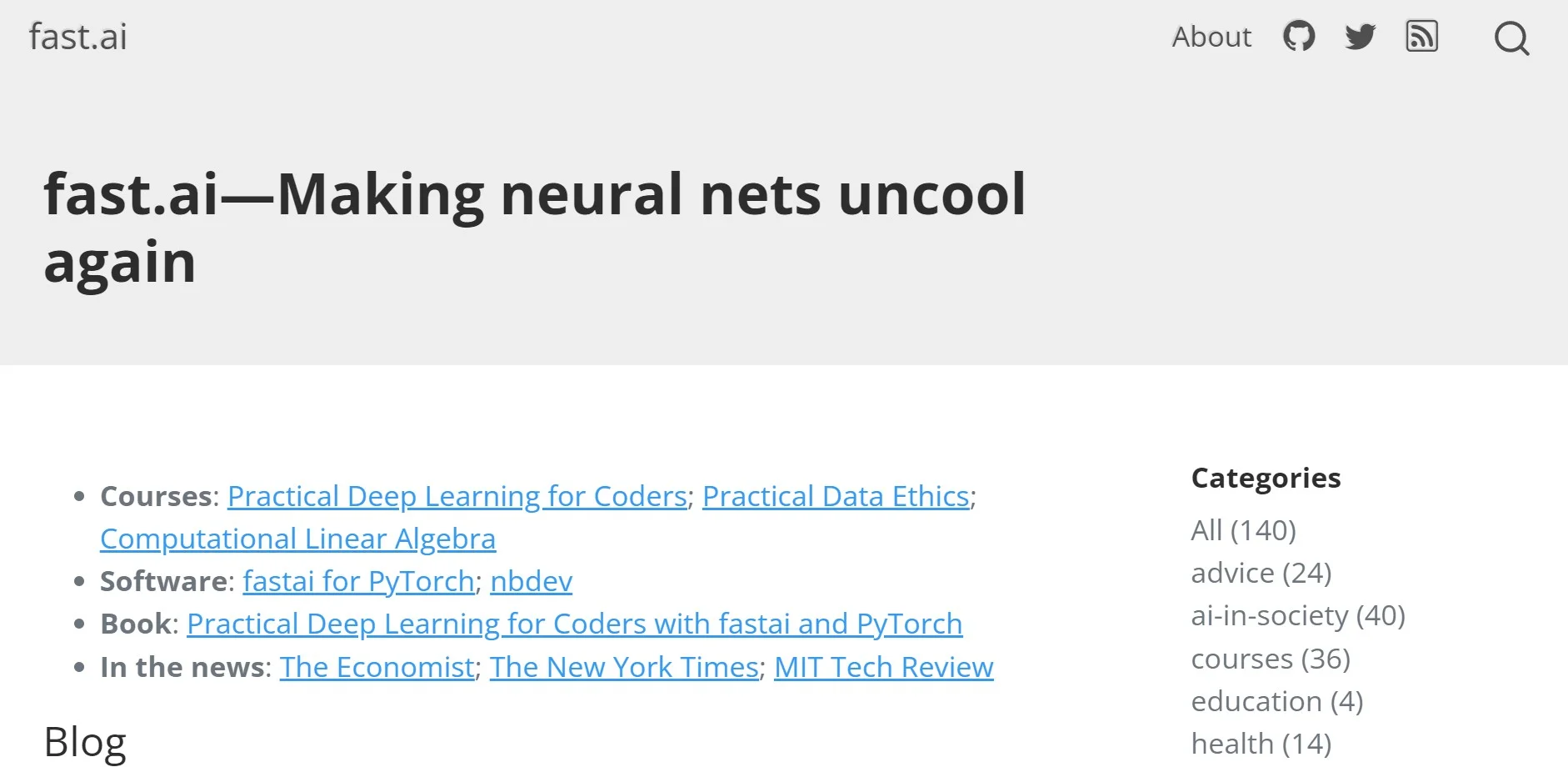
Fast.ai stands out with its mission to make neural networks "uncool" again, focusing on practical applications rather than academic exclusivity. Its unique approach to AI education, combining theory with hands-on practice, empowers users to implement AI in meaningful ways. The platform's open-source nature and community-driven ethos further distinguish it in the AI education landscape.
Fast.ai provides an invaluable resource for anyone looking to explore the world of deep learning and AI. Its commitment to accessibility and practical education makes it an excellent choice for learners and professionals alike. By breaking down complex concepts and offering robust community support, Fast.ai enables users to confidently apply AI technologies in diverse fields. Whether you're an aspiring data scientist or a seasoned developer, Fast.ai offers the tools and knowledge to elevate your understanding and application of AI.
Who is Using Fast.ai?
Data Scientists
Leveraging Fast.ai's resources to enhance their skills in machine learning and deep learning.
Educators
Incorporating Fast.ai's courses and materials into academic curricula to teach AI concepts.
AI Researchers
Utilizing the fastai library for developing and testing new AI models and algorithms.
Software Developers
Implementing AI solutions in their projects using Fast.ai's practical tools and libraries.
Uncommon Use Cases
Non-profit organizations using AI for social good initiatives; Artists exploring AI for creative projects.
Key Features
Rating Breakdown
Pricing Plans
Free Access
- Fast.ai provides free access to its courses and educational materials
- Making AI education accessible to all
Fast.ai Use Cases
Image classification
Train a model to classify images into categories such as dog and cat breeds.
Outcome: A model that predicts image labels and probabilities.
Image segmentation
Train a model that assigns labels to individual pixels in images.
Outcome: Color-coded segmentation results for image regions.
Text sentiment classification
Fine-tune a language model and train a classifier on labeled text.
Outcome: Predictions such as positive or negative sentiment.
Recommendation systems
Build collaborative-filtering models using user-item interaction data.
Tabular modeling
Train models on structured tabular datasets using fastai's tabular APIs.
Workflow Ideas with Fast.ai
Train an image classifier
- 1Organize or download an image dataset
- 2Create ImageDataLoaders and a vision Learner
- 3Fine-tune the model and run predictions
Build an image segmentation model
- 1Load image files and corresponding pixel labels
- 2Create SegmentationDataLoaders and a U-Net learner
- 3Fine-tune the model and visualize segmentation results
Share a trained model
- 1Train or load a fastai Learner
- 2Authenticate with the Hugging Face Hub
- 3Push the Learner and model card to the Hub
How Fast.ai fits into your stack
Browser
fastai documentation is available as interactive notebooks that can be opened in Google Colab for browser-based experimentation.
Desktop / IDE
Developers install fastai with pip, use Jupyter notebooks or Python scripts, and can perform editable source installations.
Knowledge and files
The library reads local or downloaded datasets, supports custom datasets, and trains models for vision, text, tabular, and collaborative-filtering tasks.
Automation and APIs
Its documented Python APIs assemble DataLoaders, Learners, training loops, predictions, and model-sharing workflows with Hugging Face Hub.
Pros
- +Accessibility: Offers free and open-access courses, lowering the barrier to entry for individuals interested in deep learning.
- +Practical Approach: Emphasizes a hands-on, code-first methodology, allowing learners to immediately apply what they learn in practical settings.
- +Community Engagement: Strong community support through forums and discussions enhances the learning experience.
- +Cutting-Edge Content: Continuously updated courses ensure learners are equipped with the latest AI advancements.
Cons
- −Initial Learning Curve: The depth of content may be overwhelming for complete beginners without a coding background.
- −Limited Personalization: Courses follow a structured curriculum, which may not cater to all individual learning preferences.
- −Dependency on Internet Access: Requires reliable internet access for optimal participation in online courses and community interactions.
Limitations & when to consider alternatives
Known limitations
- Windows multiprocessing limitation. In Jupyter on Windows, fastai resets DataLoader num_workers to zero to avoid hanging, which can make computer-vision tasks slower.
- Coding prerequisite. The course expects coding experience, preferably Python, plus at least high-school mathematics.
- GPU-dependent performance. The documentation recommends using a GPU runtime in Colab for faster execution and notes that CPU-based workflows can be slower.
Look elsewhere when
- You need a separate hosted notebook service for browser-based execution.
- You need another product for native mobile access.
- You need another product for managed team workspaces and user roles.
How to Use Fast.ai
- 1
Choose an execution environment
Use Google Colab for no-installation notebooks, or install fastai locally with pip.
- 2
Start with the quick start
Review the common DataLoaders, Learner, fit, and prediction pattern across vision, text, tabular, and recommendation tasks.
- 3
Prepare your dataset
Use built-in dataset helpers or organize your own files with the DataBlock and DataLoaders APIs.
- 4
Create a Learner
Select the appropriate application learner, such as a vision learner, U-Net learner, or text classifier.
- 5
Train and evaluate
Call a fit or fine-tuning method, inspect metrics and visualizations, and use predict for inference.
- 6
Share or deploy the model
Use the documented Hugging Face Hub integration to share and load fastai Learners.
Who is Fast.ai For?
Deep learning practitioners
fastai provides approachable high-level components for quickly training practical models.
Researchers
The library includes low-level components that can be mixed and matched to develop new approaches.
Coders
The free course is designed for people with coding experience who want to apply deep learning to practical problems.
Educators
fast.ai provides free courses, books, interactive notebooks, and documentation for teaching deep learning.
People from nontraditional backgrounds
fast.ai explicitly aims to make deep learning accessible to people from all backgrounds.
Frequently Asked Questions
What is fastai?
fastai is a deep learning library providing high-level components for practical neural-network training and lower-level components for research and customization.
Is fastai free?
The official course is free, and the fastai software library is openly available for installation and use.
How do I install fastai?
You can use fastai in Google Colab without local installation, or install it on your own machine with pip.
What can I build with fastai?
The quick start covers image classification, image segmentation, text sentiment models, recommendation systems, and tabular models.
What background is required for the course?
The course is designed for people with coding experience, preferably Python, and at least high-school mathematics.
Can I use my own datasets?
The documentation includes tutorials for training models on your own datasets and customizing data collection or training.
Community reviews
Be the first to share your experience.
Sign in to leave a review for Fast.ai.
Fast.ai Alternatives
Looking for alternatives to Fast.ai? Here are similar tools in the same category:
Learn to Master Fast.ai
With Skill Leap courses
Get in-depth training on Fast.ai and 50+ other AI tools with our expert-led video courses.
Start 7-Day Free Trial