
Geminus
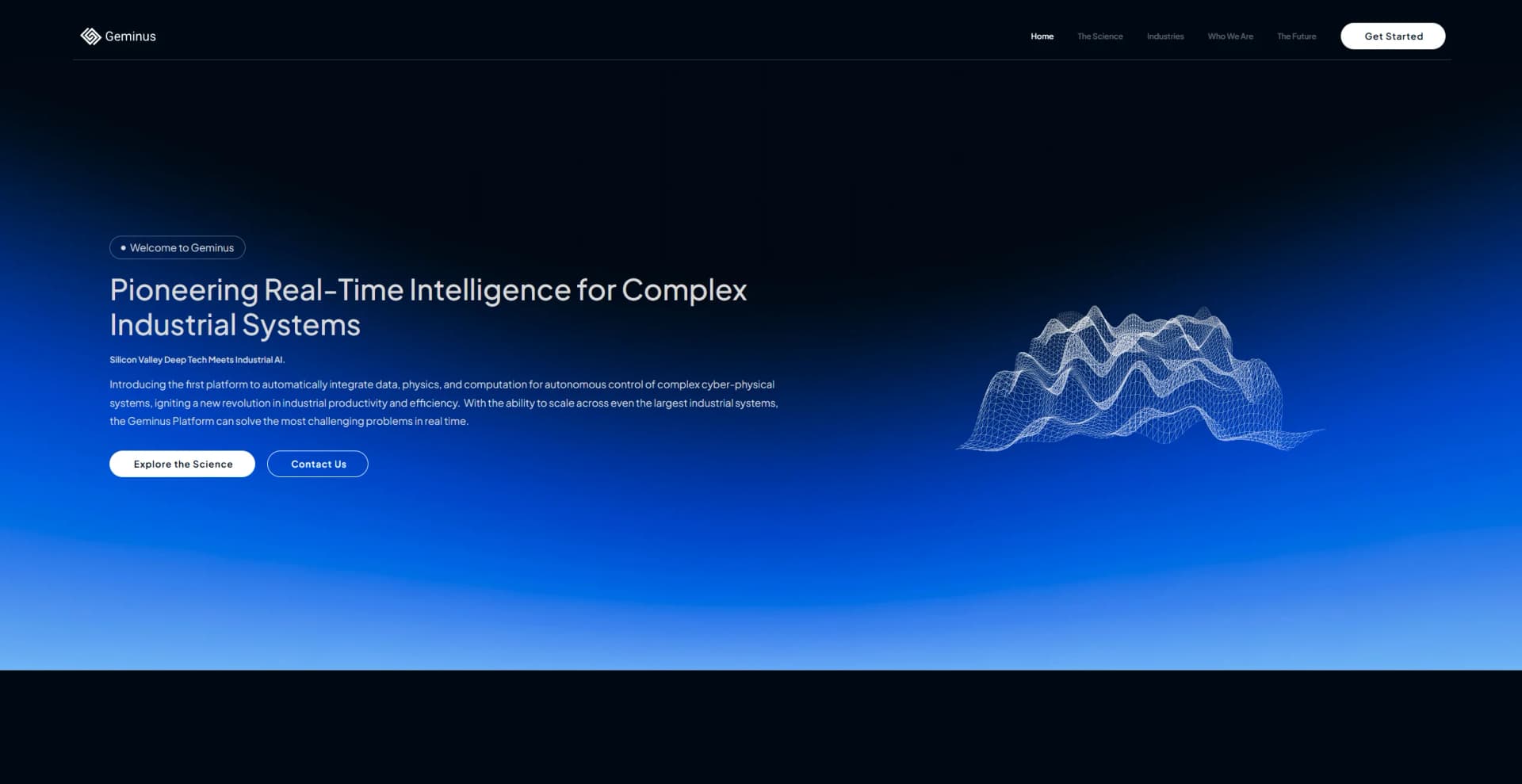
Pioneering Real-Time Intelligence for Complex Industrial Systems.
Key Takeaways
- What it is
- Pioneering Real-Time Intelligence for Complex Industrial Systems.
- Best for
- Generative Engineering Platform
- Real-Time Intelligence
- Scalability
- Rating
- 4.4/5
What is Geminus?
Geminus is pioneering the future of industrial AI by introducing the world’s first generative engineering platform. It revolutionizes real-time intelligence for complex industrial systems by seamlessly integrating data, physics, and computation. Designed for industries seeking to enhance productivity and efficiency, Geminus simplifies the autonomous control of cyber-physical systems, making it an essential tool for tackling some of the most challenging industrial problems in real-time.
Geminus stands out with its generative engineering platform, a true game-changer for industrial applications. Its ability to integrate data, physics, and computation for autonomous control of complex systems sets it apart. This unique approach not only enhances productivity but also ignites a revolution in industrial efficiency and innovation.
Geminus offers a transformative solution for industries looking to harness the power of AI for real-time intelligence and autonomous system control. With its unique generative engineering platform, it provides unparalleled scalability, accuracy, and efficiency, making it an indispensable tool for industries aiming to stay ahead in the rapidly evolving landscape of industrial AI. Whether you are in oil and gas, space, defense, or semiconductors, Geminus delivers innovative solutions that drive productivity and innovation.
Who is Using Geminus?
Oil and Gas Companies
Utilizing Geminus for optimizing exploration and production processes.
Space Agencies
Employing the platform for enhancing spacecraft engineering and control systems.
Defense Contractors
Leveraging Geminus for advanced defense system simulations and operations.
Semiconductor Manufacturers
Using the platform to improve design and manufacturing processes.
Uncommon Use Cases
Adopted by renewable energy companies for optimizing energy distribution; Utilized by utilities for predictive maintenance and operational efficiency.
Key Features
Rating Breakdown
Pricing Plans
Contact for Pricing
- Geminus offers tailored pricing based on team needs and company scale
- So contact their sales team to get started
Geminus Use Cases
Well and network optimization
Optimize wells, manifolds, compressors, facility dynamics, and network choke settings in real time.
Outcome: Increase production while reducing flaring and inefficiency.
Refinery unit optimization
Use surrogate models and optimizers to improve refinery-unit operations under changing conditions.
Outcome: Improve revenue, yield, and operating efficiency.
Data center cooling optimization
Continuously tune cooling and power conditions against live operating data.
Outcome: Lower energy use and cost while maintaining safe thermal limits.
Utility network balancing
Balance supply, demand, and system constraints across utility and electric-distribution networks.
Outcome: Improve efficiency and maintain stability.
Industrial surrogate modeling
Train and validate surrogate models using process data, simulations, and operational information.
Outcome: Create deployable engineering models faster than traditional workflows.
Workflow Ideas with Geminus
Build and deploy a surrogate optimizer
- 1Provide the problem description and relevant operational data
- 2Train and validate a surrogate model with Geminus workflows
- 3Wrap the surrogate and optimizer in an agent and share the interface with operations
Optimize a live industrial network
- 1Connect sensor, simulator, solver, or historian data
- 2Define operational and environmental constraints
- 3Generate real-time recommendations with confidence measures
Audit an engineering decision
- 1Review the data sources used by the workflow
- 2Inspect modeling and validation choices
- 3Verify the reasoning chain behind the recommendation
How Geminus fits into your stack
Browser
Geminus is presented as a self-service engineering platform with browser-based project dashboards, sessions, files, validation reports, and agent interfaces.
Knowledge and files
Teams provide problem information, process data, simulation data, sensor feeds, and unstructured data; the platform contextualizes these sources and exposes project files.
Automation and APIs
Geminus deploys skills, workflows, optimizers, and agents into operational environments, with REST API and OPC UA connectivity to DCS, SCADA, and historians.
Pros
- +Enhanced Productivity: Significantly boosts productivity by automating and optimizing complex industrial processes.
- +Scalable Solutions: Easily scales to meet the demands of large industrial systems, providing flexibility and adaptability.
- +Real-Time Problem Solving: Capable of solving intricate problems in real-time, which is crucial for industries requiring immediate solutions.
- +Innovative Partnerships: Collaborates with leading organizations to push boundaries and drive innovation in engineering.
Cons
- −Initial Setup Complexity: The initial setup and integration into existing systems may require significant time and expertise.
- −Industry-Specific Application: Primarily designed for industrial applications, limiting its use for general-purpose AI needs.
Limitations & when to consider alternatives
Known limitations
- Enterprise-oriented access. Geminus presents the platform as a customer deployment for industrial organizations and does not publish self-service consumer pricing.
- Industry-specific focus. The documented product is designed for high-consequence physical systems rather than general-purpose personal productivity.
- Deployment complexity. Available deployment models include dedicated cloud, customer cloud environments, and on-premises OpenShift, which may require enterprise infrastructure.
- Specialized data requirements. The platform is built around process data, simulations, real-time sensor feeds, operational context, and industrial system constraints.
Look elsewhere when
- You need a consumer-facing AI chat app with mobile and browser distribution.
- You need public self-service pricing and an individual free plan.
- Your work is unrelated to industrial infrastructure or physical-system optimization.
How to Use Geminus
- 1
Define the engineering problem
Describe the operational objective, constraints, assets, and context that Geminus should optimize.
- 2
Connect data and models
Bring together process data, simulations, solvers, real-time sensor feeds, historians, and operational context.
- 3
Create a surrogate model
Use the platform's code and training workflow to build a Geminus-quality surrogate.
- 4
Validate the model
Review automatically quality-checked training artifacts and validation diagnostics.
- 5
Wrap the optimizer in an agent
Turn the surrogate and optimizer into an agent and build an operational interface.
- 6
Deploy and monitor recommendations
Share the interface with operations or deliver recommendations to human operators and control systems.
Who is Geminus For?
Oil and gas organizations
Geminus optimizes production and delivery networks while balancing output, cost, and environmental constraints.
Data center operators
The platform tunes cooling and power conditions against live operating data while maintaining safe thermal limits.
Utilities and electric distribution operators
Geminus balances supply, demand, and system constraints across distributed infrastructure.
Space organizations
It supports system-state understanding, anomaly detection, and decision-making under uncertainty.
Defense organizations
Geminus supports real-time decision-making across complex defense operations with limited time, information, and resources.
Frequently Asked Questions
What is Geminus?
Geminus is an AI-generative engineering platform for mission-critical industrial infrastructure.
What does Geminus optimize?
It optimizes complex systems such as oil and gas networks, refineries, data centers, utilities, renewable energy systems, space systems, defense systems, and nuclear power.
How does Geminus make recommendations trustworthy?
Recommendations include calibrated confidence measures and auditable workflows tracing data sources, modeling choices, and validation steps.
Where can Geminus run?
Geminus can run in a dedicated Geminus Cloud instance, customer environments on Azure, AWS, or GCP, and on premises through OpenShift.
Can Geminus connect to existing industrial systems?
The platform supports REST API and OPC UA connections to DCS, SCADA, and historians.
Does Geminus train on customer data?
Geminus states that customers own their data and that the platform is not trained on it.
Community reviews
Be the first to share your experience.
Sign in to leave a review for Geminus.
Geminus Alternatives
Looking for alternatives to Geminus? Here are similar tools in the same category:
Learn to Master Geminus
With Skill Leap courses
Get in-depth training on Geminus and 50+ other AI tools with our expert-led video courses.
Start 7-Day Free Trial