
HAPPYROBOT
Revolutionizes logistics communication with AI-driven automation.
Key Takeaways
- What it is
- Revolutionizes logistics communication with AI-driven automation.
- Best for
- Intent Detection
- Call Monitoring
- Seamless Integration
- Rating
- 4.7/5
What is HAPPYROBOT?
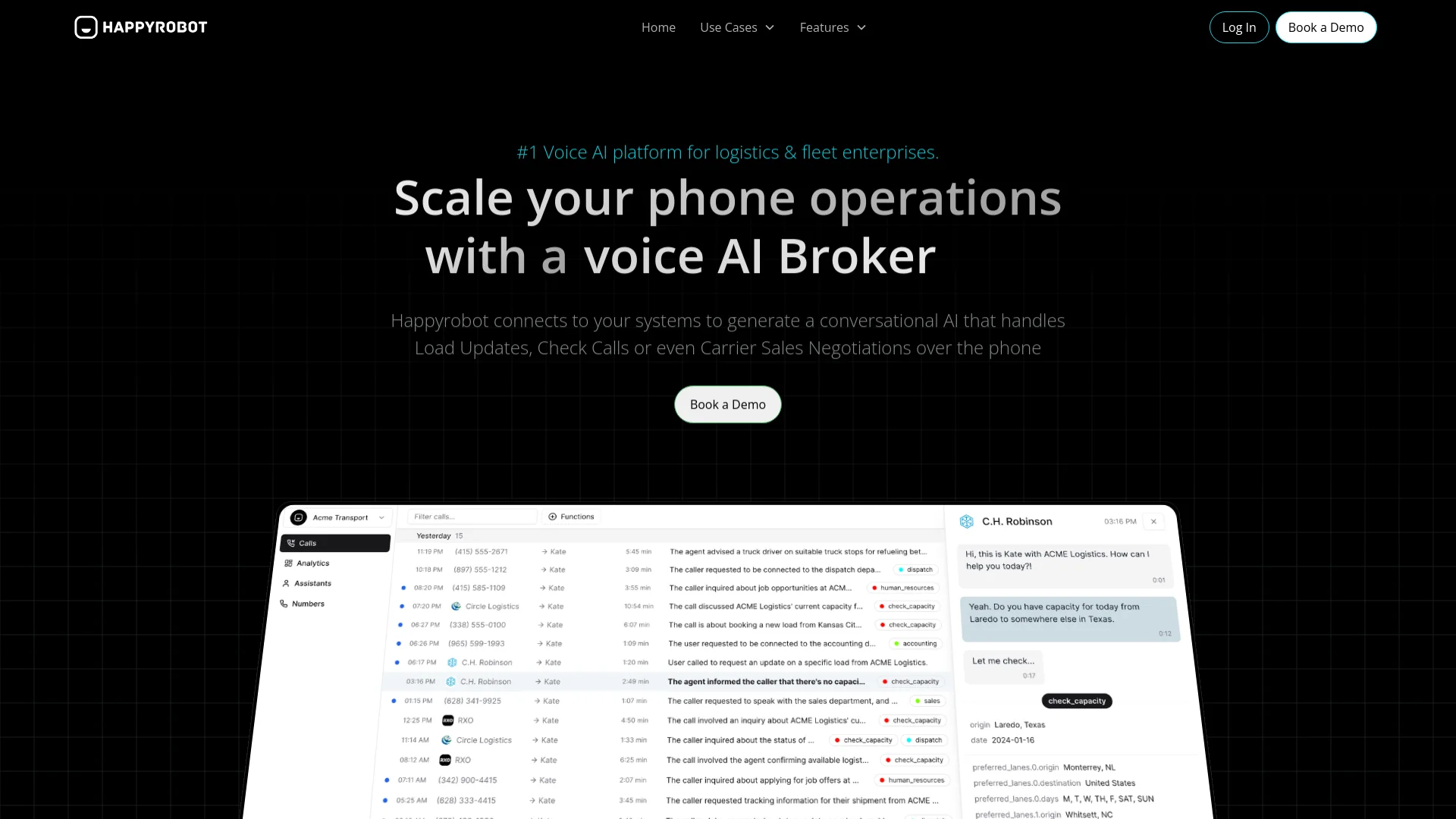
HAPPYROBOT is an advanced AI tool designed specifically for the logistics and fleet management industry, focusing on automating phone operations. It enhances communication efficiency by leveraging AI to handle calls, making operations smoother and more efficient.
HAPPYROBOT stands out due to its tailored focus on logistics and fleet management. It provides a specialized solution that understands the unique needs of the logistics sector, offering features that significantly enhance communication efficiency.
HAPPYROBOT excels in revolutionizing phone-based operations within the logistics industry. With its seamless system integration and specialized features, it enhances customer service, operational efficiency, and provides round-the-clock functionality. It is a top-tier choice for businesses aiming to innovate and optimize their communication strategies.
Who is Using HAPPYROBOT?
Logistics Companies
Enhancing communication between dispatchers and drivers.
Fleet Management Teams
Efficiently managing large fleets and task distribution.
Customer Support Centers
Handling high volumes of inbound and outbound calls.
Sales Teams
Utilizing AI to improve engagement in sales calls.
Uncommon Use Cases
Employed by emergency response units for better coordination; used in training simulations for customer service teams.
Key Features
Rating Breakdown
Pricing Plans
Free Trial
- Offers a comprehensive trial to experience its capabilities before committing
Subscription Model
- Pricing varies based on usage and the specific features enabled
HAPPYROBOT Use Cases
Carrier appointment scheduling
The AI worker matches carrier ETAs to dock availability, confirms appointments, follows up on non-responses, and escalates unreachable parties.
Outcome: Fewer missed appointments and less manual coordination.
Shipment tracking and check calls
The AI worker contacts carriers at milestones, captures updated ETAs, flags exceptions, and updates downstream systems.
Outcome: More visible shipments and earlier delay detection.
Inbound lead qualification
The AI worker responds to inbound leads, captures requirements, qualifies fit, and routes the opportunity to the right representative.
Outcome: Faster response times and more qualified leads.
Outbound sales reactivation
The AI worker contacts dormant accounts, identifies active needs, and books new business across phone, email, and messaging.
Outcome: Additional pipeline and revenue from inactive accounts.
Document collection and processing
The platform receives documents and uses AI extraction, classification, and workflow logic to process the contents.
Outcome: Less manual document handling and more structured operational data.
Workflow Ideas with HAPPYROBOT
Email-triggered customer follow-up
- 1Receive a new email through Gmail or Outlook
- 2Use an AI agent and integration tools to inspect the request
- 3Send a follow-up email through the connected provider
Shipment status escalation
- 1Trigger a workflow through a webhook or schedule
- 2Look up shipment information in an operational system
- 3Contact the carrier, update the ETA, and alert the internal team
Inbound lead qualification
- 1Receive an inbound phone call, message, or email
- 2Capture and classify lead requirements
- 3Write the outcome to the CRM and route qualified leads to sales
How HAPPYROBOT fits into your stack
TMS Integration
Connects seamlessly with major Transportation Management Systems.
Real-Time Updates
Compatible with systems like Samsara for live vehicle tracking.
Communication Tools
Integrates with email and messaging platforms like Slack for efficient internal communication.
Data Retrieval and Input
Allows for real-time data interactions, improving operational responsiveness.
Pros
- +200+ enterprise integrations
- +Documented REST API and TypeScript SDK
- +50+ language voice support
- +End-to-end workflow automation
- +Role-based access control with Owner, Editor, and Viewer roles
Cons
- −Technology Adoption: Requires a willingness to integrate AI into daily operations, which might be challenging for some businesses.
- −Dependency on Tech: Heavy reliance on system functionality means downtime can impact operations significantly.
- −Complexity in Setup: Initial setup and customization can be complex, depending on existing infrastructure.
Limitations & when to consider alternatives
Known limitations
- Custom-quoted pricing. HappyRobot does not publish standard self-serve pricing; pricing is scoped to the deployment and workflows.
- Enterprise-oriented deployment. The platform is positioned for enterprise deployments and commonly involves demos, scoped implementations, and Forward Deployed Engineer support.
- Integration dependency. New use cases can be limited by the availability and quality of APIs that provide required operational data.
- Workflow complexity requires configuration. Production workflows require configuring triggers, integrations, credentials, agents, tools, environments, testing, and deployment controls.
Look elsewhere when
- You need a low-cost self-serve voice platform with published monthly plans.
- You need a native mobile application.
How to Use HAPPYROBOT
- 1
Detailed tutorials are available on the HAPPYROBOT website, covering everything from basic setup to advanced feature utilization.
Who is HAPPYROBOT For?
Enterprise operations teams
HappyRobot is designed for complex, high-volume operational work across fragmented business systems.
Logistics providers
Logistics companies can automate load booking, rate negotiation, shipment tracking, appointment scheduling, and document collection.
Sales organizations
Sales teams can use AI workers for outbound prospecting, inbound qualification, follow-up, quoting, negotiation, and booking.
Customer support teams
Support organizations can automate inquiries across phone, email, chat, SMS, and messaging while preserving context.
Large regulated enterprises
HappyRobot targets enterprises needing governance, auditability, role-based access, compliance support, and controlled deployments.
Frequently Asked Questions
How does HappyRobot integrate with existing systems?
HappyRobot integrates with enterprise systems including Salesforce, HubSpot, CRMs, quoting systems, databases, ERPs, ticketing platforms, and communication tools.
What types of communication can HappyRobot automate?
HappyRobot supports voice, email, SMS, WhatsApp, Slack, Microsoft Teams, and embedded chat workflows.
Can HappyRobot handle complex workflows?
Yes. Workflows combine triggers, agents, tools, branching logic, deterministic steps, integrations, and code.
How quickly can HappyRobot go live?
HappyRobot states that enterprises can reach production in weeks, supported by Forward Deployed Engineers.
Does HappyRobot support human escalation?
Yes. Workflows can use escalation paths so complex cases are routed to the appropriate human with conversation context.
How is HappyRobot priced?
Pricing is quote-based and scoped to the deployment or workflows delivered rather than published as a standard self-serve plan.
Community reviews
1 review from people who use HAPPYROBOT.
Sign in to leave a review for HAPPYROBOT.
Christian Damico
HAPPYROBOT Alternatives
Looking for alternatives to HAPPYROBOT? Here are similar tools in the same category:
Learn to Master HAPPYROBOT
With Skill Leap courses
Get in-depth training on HAPPYROBOT and 50+ other AI tools with our expert-led video courses.
Start 7-Day Free Trial