
HarmonAI
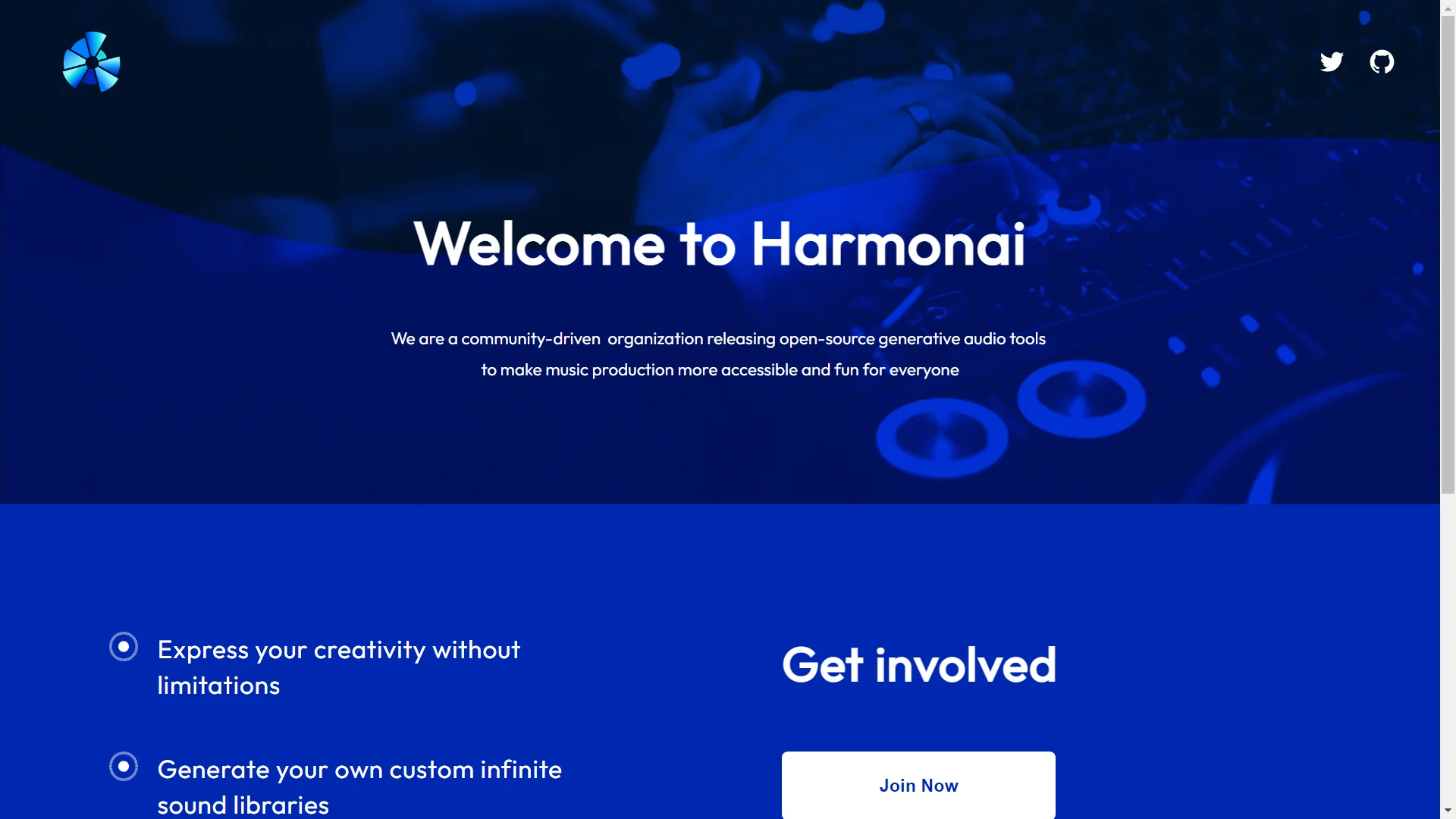
Unleash music creativity with AI-powered, open-source production tools.
Watch HarmonAI in Action
Key Takeaways
- What it is
- Unleash music creativity with AI-powered, open-source production tools.
- Best for
- Generative Audio Tools
- Open-Source Platform
- User-Centric Design
- Rating
- 4.6/5
What is HarmonAI?
HarmonAI represents a pioneering initiative at the intersection of artificial intelligence and music, emerging as a catalyst for innovation. Developed within Stability AI Lab, HarmonAI aims to democratize music production by providing accessible and inventive tools. Through its array of open-source generative audio tools, HarmonAI seeks to empower musicians of all levels, fostering a more inclusive and enjoyable music creation experience.
HarmonAI sets itself apart by fostering a collaborative community where musicians and developers converge to push the boundaries of AI in music production. Its commitment to open-source tools ensures that the creative power remains in the hands of artists, fostering innovation without financial barriers.
HarmonAI emerges as a transformative force in music production, blending technology and creativity to redefine the landscape. With its open-source ethos and commitment to artist empowerment, HarmonAI transcends being just a tool, evolving into a movement towards a more inclusive and innovative future for musicians and producers. Its unique position as a free, community-driven solution offers unparalleled opportunities for exploration and advancement in music creation.
Who is Using HarmonAI?
Music Producers
Harnessing AI for generating unique sounds and textures in their compositions.
Independent Artists
Exploring new creative avenues without extensive production resources.
Sound Designers
Crafting bespoke audio elements for diverse multimedia projects.
Educators
Utilizing tools for teaching music technology and production courses.
Uncommon Use Cases
Podcasters creating original background music; Game developers integrating unique soundscapes.
Key Features
Rating Breakdown
Pricing Plans
Free Access
- HarmonAI provides its tools free of charge as an open-source project
Donations
- Users are encouraged to support the project through voluntary donations
HarmonAI Use Cases
Generate audio samples
Use diffusion models to generate new audio from noise.
Outcome: Create original sounds and musical material.
Create custom sound libraries
Generate custom, potentially infinite collections of audio sounds.
Outcome: Expand a producer’s available sound palette.
Train on arbitrary audio
Train a generative model using the user’s own audio samples.
Outcome: Produce model outputs shaped by a custom audio dataset.
Audio inpainting
Use diffusion inpainting to preserve selected portions while regenerating others.
Outcome: Modify or repair sections of an audio track.
Infinite audio generation
Compose additional spans after an existing audio input.
Outcome: Extend audio beyond the original clip.
Workflow Ideas with HarmonAI
Train a custom audio model
- 1Collect arbitrary audio samples
- 2Install the official Python project
- 3Train the generative model on the samples
Generate audio with Dance Diffusion
- 1Install the required Python packages
- 2Load a Dance Diffusion model
- 3Generate new audio samples
Extend an existing track
- 1Provide an audio input
- 2Use diffusion inpainting or span composition
- 3Generate additional audio while preserving the beginning
How HarmonAI fits into your stack
Cross-Platform Use
Compatible with various operating systems for widespread accessibility.
DAW Integration
Seamlessly integrates with popular Digital Audio Workstations (DAWs) for enhanced production workflow.
API Access
Provides developers with API access for custom applications and integrations.
Community Contributions
Encourages additional functionality development through open-source collaboration.
Pros
- +Accessibility: Widens the scope of music production, welcoming a broader audience.
- +Creative Freedom: Provides an outlet for unrestricted artistic expression.
- +Cost Efficiency: Minimizes reliance on expensive sound libraries and production tools.
- +Artist Support: Empowers creators by putting music creation capabilities back in their hands.
Cons
- −Learning Curve: New users may require time to fully grasp the capabilities of AI tools.
- −Niche Focus: Primarily targets music production enthusiasts, potentially excluding other demographics.
- −Community Dependency: Reliance on community contributions for progress, which can be inconsistent.
Limitations & when to consider alternatives
Known limitations
- Python setup required. The official sample-generator requires Python 3.7 or later and installation through pip.
- Developer-oriented workflow. The documented workflow uses notebooks, repositories, model files, and Python tooling rather than a polished consumer application.
- Audio-focused scope. Official materials focus on generative audio models and do not document image, code, or general-purpose language capabilities.
How to Use HarmonAI
- 1
While specific tutorials were not mentioned, the open-source nature suggests the availability of community-generated tutorials across platforms like YouTube, forums, and HarmonAI community resources.
Who is HarmonAI For?
Musicians
Harmonai is built around AI audio tools intended to make music production more accessible.
Producers
Dance Diffusion and related models support generative audio experimentation for music producers.
Artists
The project emphasizes returning creative control and generative capabilities to artists.
Community reviews
Be the first to share your experience.
Sign in to leave a review for HarmonAI.
HarmonAI Alternatives
Looking for alternatives to HarmonAI? Here are similar tools in the same category:
Learn to Master HarmonAI
With Skill Leap courses
Get in-depth training on HarmonAI and 50+ other AI tools with our expert-led video courses.
Start 7-Day Free Trial