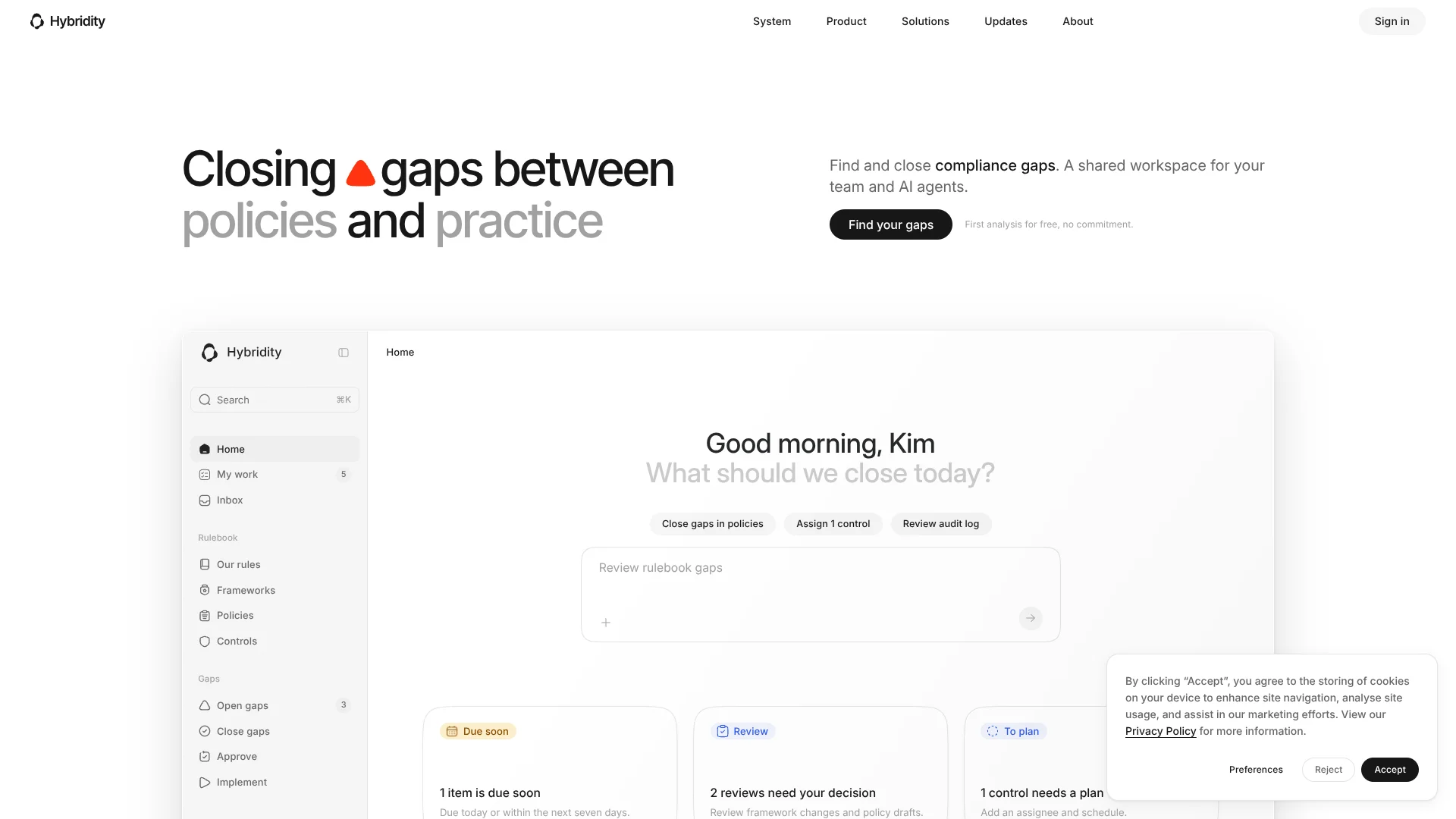
Hybridity
Turns regulations into a traceable Rulebook for compliance teams.
Key Takeaways
- What it is
- Turns regulations into a traceable Rulebook for compliance teams.
- Pricing
- Freemium
- Best for
- Company Rulebook
- Gap Detection
- Controls and Tasks
- Rating
- 4.1/5
What is Hybridity?
Hybridity turns company policies, regulations, and contracts into a connected Rulebook for compliance teams. Its AI extracts requirements from uploaded documents, links each rule to its source passage, and compares those rules with frameworks such as DORA, NIS2, and GDPR. Teams can then assign controls, tasks, owners, and evidence from the same workspace.
Hybridity keeps every AI recommendation traceable to the regulation or document behind it, while requiring human approval before generated content becomes part of the compliance record.
Compliance officers, governance teams, and regulated organizations will get the most value when they need to connect changing requirements with daily work and audit evidence. It is less suitable for small teams seeking a low-cost checklist app or a broad general-purpose AI tool. Hybridity is built for turning regulatory text into reviewed, owned work.
Who is Using Hybridity?
Compliance Officers
Review rule changes, coordinate owners, assess evidence, and prepare records for audits.
Governance Managers
Turn approved policies into controls and recurring tasks with clear responsibilities.
Legal and Regulatory Teams
Compare regulations and contracts with internal policies to identify missing or outdated coverage.
Control Owners
See assigned tasks, collection schedules, required proof, and follow-up actions in one workspace.
Auditors
Follow the chain from task to evidence to the requirement and source clause it supports.
Uncommon Use Cases
Review supplier and customer contract commitments; coordinate recovery exercises and evidence across multiple sites.
Key Features
Rating Breakdown
Pricing Plans
First analysis
Free
- The official site says the first analysis is free.
- No commitment is required.
- Submit company details and optional policies to request a gap analysis.
Which Hybridity plan should you pick?
Start with the free first analysis to see whether Hybridity can structure your policies and expose gaps, then request a subscription discussion if the workflow fits your compliance program.
First analysis
Good for organizations that want to test a company policy against applicable requirements before discussing a broader deployment.
Subscription
Good for compliance teams that need ongoing Rulebook management, controls, tasks, evidence review, and regulatory change monitoring.
Hybridity Use Cases
Policy Gap Analysis
Existing policies are compared with regulatory obligations to show covered, partial, and missing requirements.
Outcome: A reviewable coverage map with proposed policy wording.
Regulatory Change Review
Changed requirements are connected to affected policy rules so teams can focus on the areas that moved.
Outcome: A targeted list of policy updates and responsible teams.
Evidence Collection
Controls specify what proof is needed, who provides it, and how often it must be collected.
Outcome: Evidence that stays linked to the control and requirement it supports.
Contract Compliance
Supplier and customer commitments are reviewed against company rules and assigned for follow-up.
Outcome: Contract obligations connected to owners, rules, and evidence.
Audit Preparation
Review decisions, evidence, tasks, controls, and source clauses remain connected for inspection.
Outcome: A traceable record from operational work back to the requirement.
Workflow Ideas with Hybridity
From Policy to Control
- 1Upload policies, procedures, and instructions.
- 2Review AI-extracted rules beside their source passages.
- 3Approve rules and assign controls, owners, and evidence requirements.
Regulation Gap Review
- 1Select a regulation or framework such as DORA, NIS2, or GDPR.
- 2Compare its obligations with the company Rulebook.
- 3Review gaps and approve proposed policy amendments.
Evidence to Audit Record
- 1Assign a task with a collection schedule and acceptance criteria.
- 2Have the owner submit supporting evidence.
- 3Review the AI assessment and record the human decision.
How Hybridity fits into your stack
Policy and document layer
Hybridity sits after your policies, procedures, contracts, and regulatory sources. It turns those documents into structured rules linked to their original text.
Compliance operations
The Rulebook becomes the working layer for controls, recurring tasks, owners, review decisions, and evidence.
AI tools
Hybridity provides a Model Context Protocol integration so compatible AI tools can connect to the workspace after account approval.
Audit preparation
Evidence and decisions stay connected to the controls, requirements, and source clauses they support, giving reviewers a traceable record.
Security oversight
The service publishes ISO 27001:2022 certification, annual penetration testing, data encryption controls, and human approval requirements through its security materials.
Pros
- +Source traceability: Every AI recommendation links back to the regulation or document it references.
- +Human review: AI-generated rules, gap findings, and evidence assessments stay subject to approval.
- +Connected compliance work: Policies, controls, tasks, owners, and evidence remain linked in one Rulebook.
- +Flexible document intake: The platform accepts documents in any format and language without requiring cleanup first.
Cons
- −Enterprise focus: The product is aimed at regulated organizations and compliance teams rather than casual users.
- −Quote-based pricing: Public subscription prices are not shown on the official site.
- −Narrower scope: Hybridity focuses on compliance execution instead of broad writing, research, or coding tasks.
Limitations & when to consider alternatives
Known limitations
- Human approval remains required. AI can draft, compare, and assess, but generated content must be reviewed and approved before implementation.
- The Rulebook is built from your policies. Regulations are used as checks against approved company controls rather than automatically becoming the organization's controls.
- Public pricing is unavailable. The official site offers a first analysis for free but does not publish subscription plan prices.
- Upstream compliance focus. Hybridity structures requirements and evidence before traditional GRC systems rather than replacing every existing compliance or audit system.
Look elsewhere when
- You need a broad general-purpose AI tool for writing, coding, or research.
- Your team needs a public self-serve subscription price before requesting a product discussion.
- Your organization wants automated decisions with no human review.
How to Use Hybridity
- 1
Start with company documents
Upload policies, procedures, and instructions so Hybridity can structure them into a Rulebook.
- 2
Review extracted rules
Check each suggested rule against the source passage and approve the wording your organization will use.
- 3
Run a framework check
Compare the Rulebook with a regulation, standard, contract, or customer requirement to find missing coverage.
- 4
Assign the remediation work
Turn approved rules into controls and tasks with named owners, schedules, and evidence expectations.
- 5
Review submitted proof
Let AI flag evidence issues, then make the final approval decision as the responsible reviewer.
- 6
Monitor changes
Review regulatory updates and follow the affected rules, controls, and teams.
Who is Hybridity For?
Compliance Teams
A shared Rulebook connects requirements, controls, owners, evidence, and review decisions.
Banking and Finance
DORA, AMLR, GDPR, and national requirements can be mapped to policies and operational controls.
Critical Infrastructure
NIS2, CER, continuity planning, recovery testing, and supplier requirements can be tracked together.
Healthcare and Life Sciences
Teams can connect MDR, GDPR, national requirements, responsibilities, and supporting evidence.
Public Sector
Departments can assign governance responsibilities and keep decisions linked to the requirements they support.
Frequently Asked Questions
Does Hybridity offer a free plan?
The official site offers a first analysis for free with no commitment. It does not show a permanent free subscription plan.
How is Hybridity priced?
The official site does not publish subscription prices. Prospective customers are directed to start with a company analysis or request a product discussion.
What documents can Hybridity process?
The platform accepts policies, procedures, instructions, contracts, and other documents in any format and language.
Does Hybridity support DORA, NIS2, and GDPR?
Yes. The site names DORA, NIS2, and GDPR as examples of requirements that can be run against a company's own Rulebook.
Does AI make final compliance decisions?
No. AI can draft rules, identify gaps, and check evidence, but human approval is required before implementation.
Can other AI tools connect to Hybridity?
Yes. Hybridity provides a Model Context Protocol integration for compatible AI tools, with sign-in and connection approval required.
Community reviews
Be the first to share your experience.
Sign in to leave a review for Hybridity.
Hybridity Alternatives
Looking for alternatives to Hybridity? Here are similar tools in the same category: