
LanceDB
Revolutionize AI data management with multimodal, real-time processing.
Key Takeaways
- What it is
- Revolutionize AI data management with multimodal, real-time processing.
- Pricing
- Freemium · $49.99 per month
- Best for
- Multimodal Data Handling
- Scalable Infrastructure
- Advanced Security Measures
- Rating
- 4.5/5
What is LanceDB?
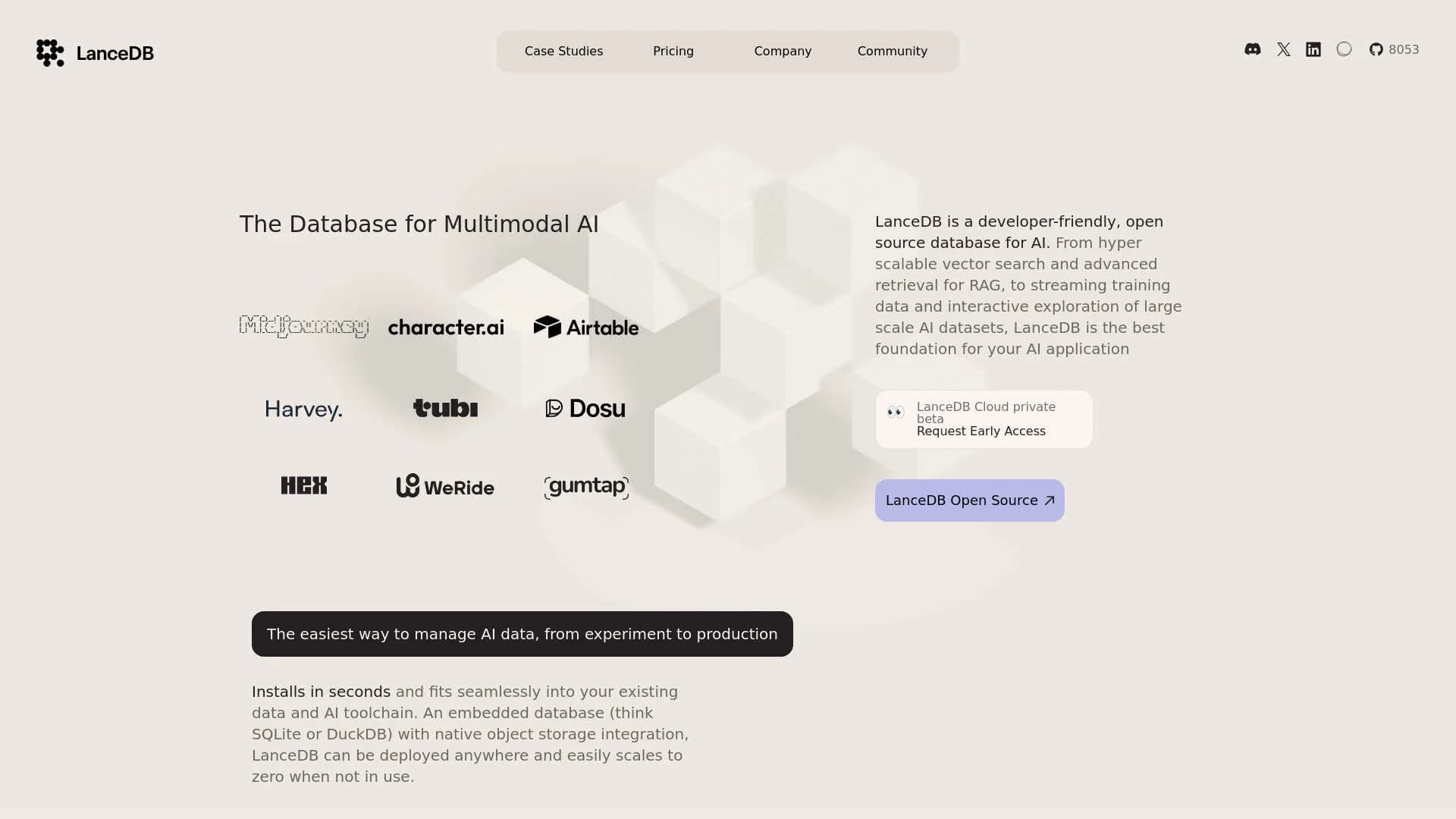
LanceDB is a groundbreaking tool designed to revolutionize the way businesses and individuals handle multimodal AI applications. Positioned at the cutting edge of technology, LanceDB offers robust database solutions that cater specifically to the needs of AI-driven environments. Whether you are a developer, a data scientist, or a business analyst, LanceDB simplifies the complexities associated with managing diverse data types, from text and images to video and audio, all within a single unified platform.
LanceDB stands out with its specialized focus on multimodal AI data management, a game-changer for industries requiring integrated handling of diverse data forms. Its ability to process and analyze different data types in real-time sets it apart from conventional database systems.
LanceDB excels in providing innovative solutions for managing multimodal AI data, making it an essential tool for businesses and researchers alike. Its real-time processing capabilities and robust security measures offer significant advantages, ensuring that LanceDB remains a top choice for those in need of advanced data management options.
Who is Using LanceDB?
AI Researchers
Utilizing the platform for developing and testing new AI models.
Tech Startups
Employing LanceDB to manage diverse data types efficiently.
Multimedia Content Creators
Leveraging the tool to store and process large volumes of multimedia content.
Educational Institutions
Using it for research and educational purposes in AI courses.
Uncommon Use Cases
Non-profit organizations utilize LanceDB for data management in humanitarian projects; indie game developers use it for game design and testing.
Key Features
Rating Breakdown
Pricing Plans
Free Tier
Free
- Experience LanceDB with a 30-day free trial
Pro Tier
$49.99 per month
Which LanceDB plan should you pick?
Start with LanceDB OSS for local development and smaller datasets; upgrade to LanceDB Enterprise when you need distributed scale, managed operations, or BYOC deployment.
LanceDB OSS
Good for developers and smaller AI workloads who need an open-source embedded database and local vector or multimodal retrieval.
LanceDB Enterprise
Good for teams who need distributed infrastructure, large-scale datasets, production monitoring, managed or BYOC deployment, and enterprise security controls.
LanceDB Use Cases
Retrieval-augmented generation
Store documents and embeddings, then retrieve relevant context using vector, full-text, or hybrid search.
Outcome: More relevant context for AI applications.
Multimodal search
Store and query images, audio, video, PDFs, documents, embeddings, and metadata together.
Outcome: Unified search across multimodal datasets.
Training dataset curation
Explore, filter, deduplicate, version, and sample large datasets for model development.
Outcome: More reproducible, training-ready data.
Feature engineering
Use Geneva jobs and UDFs to create derived columns and run distributed backfills on LanceDB tables.
Outcome: Scalable feature computation close to the data.
Recommendation systems
Use vector similarity, metadata filters, full-text search, and hybrid retrieval for recommendation workloads.
Outcome: Fast semantic and filtered recommendations.
Workflow Ideas with LanceDB
Build a RAG application
- 1Ingest documents or other source data into a LanceDB table
- 2Generate embeddings and create vector or full-text indexes
- 3Retrieve relevant records and pass them to an application model
Create a multimodal search system
- 1Store images, audio, video, PDFs, or documents as binary data
- 2Generate embeddings or derived features for the stored modalities
- 3Run vector, full-text, or hybrid searches with metadata filters
Run distributed feature engineering
- 1Define UDFs for feature computation
- 2Trigger Geneva backfill or materialized-view jobs
- 3Monitor jobs and use checkpoints or incremental updates to resume processing
How LanceDB fits into your stack
API Access
Developers can utilize LanceDB's API for custom integrations, enhancing flexibility.
Cloud Integration
Seamlessly integrates with major cloud platforms, facilitating easy data synchronization.
Analytics Tools Compatibility
Compatible with popular analytics tools, enhancing data interpretation capabilities.
Multi-Platform Support
Offers versions compatible with various operating systems, ensuring broad accessibility.
Pros
- +Enhanced Data Organization: Simplifies the management of complex data sets with intuitive tools and interfaces.
- +Cost-Effective: Reduces overhead costs by minimizing the need for multiple data management systems.
- +User-Friendly Interface: Designed for ease of use, ensuring that even users with minimal technical expertise can navigate effectively.
- +Robust Support: Backed by a dedicated support team to assist with setup, troubleshooting, and optimization.
Cons
- −Initial Learning Curve: New users may require some time to fully leverage all functionalities.
- −Limited Customization Options: While highly efficient, customization options are somewhat restricted.
- −Dependency on Internet Connectivity: Optimal performance requires a stable internet connection.
Limitations & when to consider alternatives
Known limitations
- OSS is embedded and single-process. LanceDB OSS runs inside the application process and is limited by the CPU, memory, and storage of one host.
- Large-scale production workloads require Enterprise. The documentation recommends Enterprise for hundreds of millions of vectors, terabytes of data, or billions of rows.
- OSS maintenance is manual. Index compaction and rebuild operations must generally be scheduled and run by the application or operators in OSS.
- OSS has no built-in distributed cache. LanceDB OSS has no built-in cache, while Enterprise provides distributed NVMe caching.
- Some file-ingestion support is Python-specific. The documentation states that TypeScript and Rust support for file-based dataset ingestion is still being tracked.
How to Use LanceDB
- 1
Explore a range of tutorials on the LanceDB website, covering everything from basic setup to advanced data management techniques.
Who is LanceDB For?
AI and ML engineers
LanceDB provides multimodal data storage, retrieval, feature engineering, and training-oriented access for AI and machine-learning workloads.
Teams building RAG applications
LanceDB supports vector, full-text, hybrid search, metadata filtering, and integrations with frameworks such as LangChain and LlamaIndex.
Data practitioners working with multimodal datasets
LanceDB stores images, audio, video, PDFs, documents, embeddings, and metadata together in tables.
Organizations with large-scale AI workloads
LanceDB Enterprise provides distributed infrastructure, managed or BYOC deployment, caching, monitoring, and high-throughput search.
Frequently Asked Questions
What is LanceDB?
LanceDB is a multimodal lakehouse for AI, built on the open-source Lance lakehouse format. It supports storage, retrieval, search, feature engineering, and training-oriented data workflows.
Is LanceDB open source?
LanceDB OSS is an Apache 2.0-licensed embedded retrieval library. LanceDB Enterprise is the commercial managed or bring-your-own-cloud offering.
How does LanceDB differ from Lance?
Lance is the underlying multimodal lakehouse format, while LanceDB adds indexes and retrieval capabilities for applications such as RAG, QA bots, and recommender systems.
How large a dataset can LanceDB handle?
LanceDB OSS is suited to millions of vectors on one node. Enterprise is recommended for hundreds of millions of vectors, terabytes of data, or billions of rows.
Does LanceDB support concurrent operations?
LanceDB supports concurrent reads and concurrent writing, although too many concurrent writers can cause failed commits because writer retries are limited.
Do I need a vector index for vector search?
No. LanceDB supports brute-force k-nearest-neighbor search for smaller datasets, while indexes are beneficial for larger or higher-dimensional collections.
Community reviews
Be the first to share your experience.
Sign in to leave a review for LanceDB.
LanceDB Alternatives
Looking for alternatives to LanceDB? Here are similar tools in the same category:
Learn to Master LanceDB
With Skill Leap courses
Get in-depth training on LanceDB and 50+ other AI tools with our expert-led video courses.
Start 7-Day Free Trial