Lockchain.ai
Traceable risk monitoring for institutions managing digital-asset exposure.
Key Takeaways
- What it is
- Traceable risk monitoring for institutions managing digital-asset exposure.
- Best for
- Custom watchlists
- Custom scoring frameworks
- Configurable framework layouts
- Rating
- 4.0/5
What is Lockchain.ai?
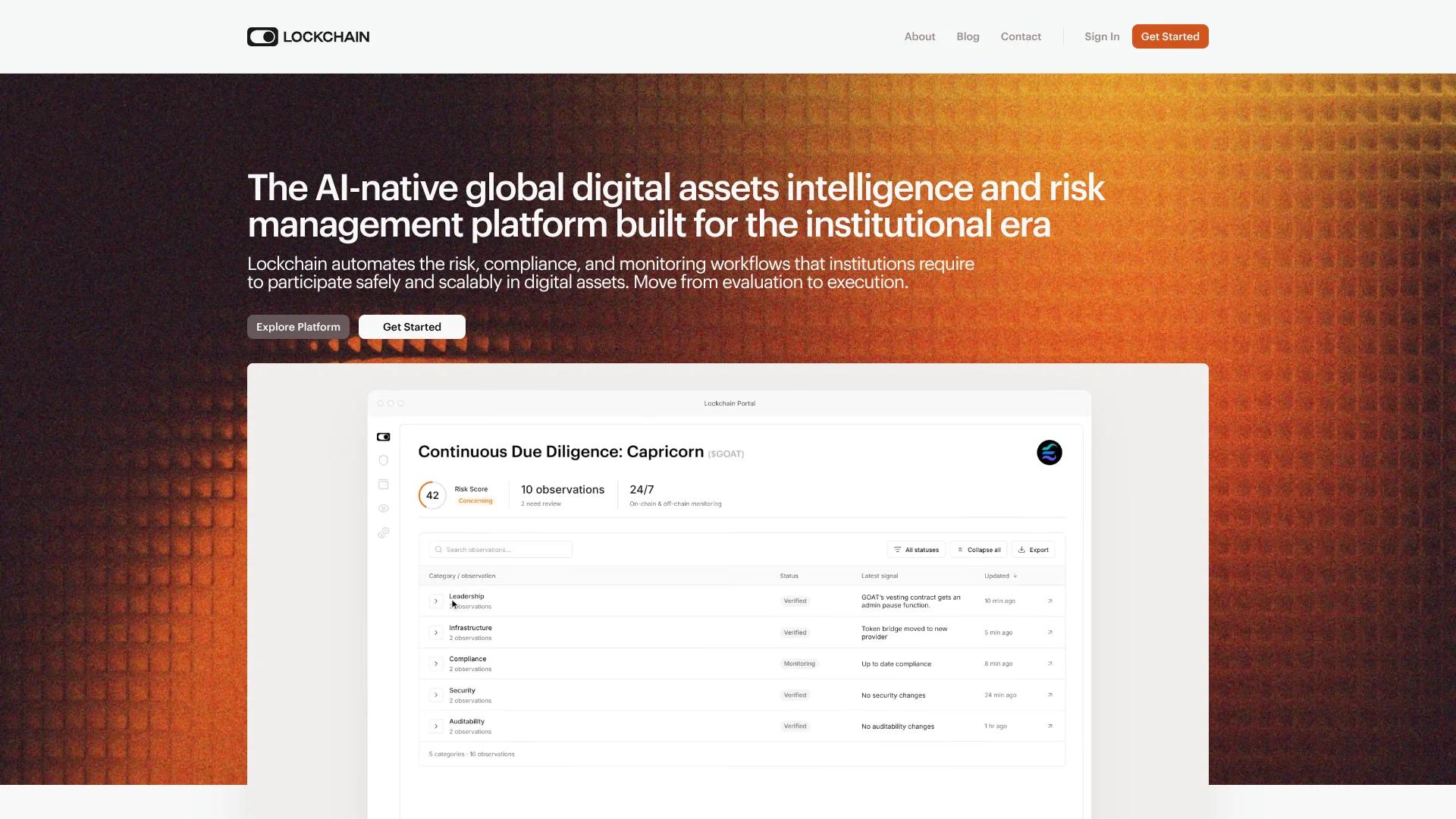
Lockchain monitors digital-asset risks across tokens, protocols, networks, and counterparties, then surfaces material changes for institutional teams to review. Its AI-supported data collection is aimed at organizations assessing crypto exposure and documenting due diligence across scattered sources. Watchlists can be tailored to the assets and entities an institution holds or needs to track.
Lockchain says every data point behind its outputs can be traced to its source, while assessments, classifications, events, and actions are logged in an exportable audit trail. That gives risk teams a way to check where an AI-generated finding came from and preserve a record of what followed.
Asset managers and other institutions handling digital assets are the clearest fit. The public site focuses on institutional risk work, and pricing is set through a service order rather than listed as a self-serve plan, so Lockchain suits teams that value tailored monitoring and audit records over quick, self-serve setup.
Who is Using Lockchain.ai?
Digital-asset risk analyst
Portfolio-specific watchlists help the analyst spot material changes across monitored assets and counterparties.
Compliance officer
Sourced findings and an exportable audit trail support review of assessments and follow-up actions.
Portfolio manager
Risk updates help the manager understand how monitored digital-asset exposure changes over time.
Due diligence analyst
Custom scoring frameworks help rank tokens and protocols against the institution’s own risk priorities.
Uncommon Use Cases
Track counterparties alongside tokens and protocols; adapt risk layouts to match an institution’s decision-making process.
Key Features
Rating Breakdown
Pricing Plans
Subscription Plans
- Lockchain.ai offers customized subscription plans based on business needs and scale. Specific pricing details are provided upon request
Demo and Consultation
- Potential users can arrange a demo and discuss their specific requirements by contacting Lockchain.ai directly
Lockchain.ai Use Cases
Monitor portfolio exposure
Portfolio-specific watchlists keep attention on selected assets, networks, protocols, and counterparties.
Outcome: Material changes relevant to the watchlist are surfaced for review.
Rank tokens and protocols
Institution-specific scoring weights help teams compare digital assets against their risk priorities.
Outcome: Tokens and protocols are ranked using the institution’s chosen risk dimensions.
Document risk reviews
Traceable outputs and logged actions create records teams can review and export.
Outcome: An exportable audit trail of assessments, classifications, events, and actions.
Reduce manual data gathering
Automated collection supports recurring risk and monitoring work so teams can focus on decisions.
Outcome: Less time spent collecting information manually.
Workflow Ideas with Lockchain.ai
Set up portfolio monitoring
- 1Choose the tokens, protocols, networks, and counterparties relevant to your institution.
- 2Build a watchlist around those assets and entities.
- 3Review material changes surfaced for the watchlist.
Apply an institutional risk framework
- 1Identify the risk dimensions your team uses in due diligence.
- 2Weight those dimensions in a custom scoring framework.
- 3Review how tokens and protocols rank under the framework.
Keep a review record
- 1Review an assessment and check the sources behind its data points.
- 2Record the related classifications, events, and actions in Lockchain.
- 3Export the audit trail for institutional review.
How Lockchain.ai fits into your stack
Risk monitoring
Lockchain centers on monitoring digital-asset exposure across watchlisted assets and counterparties. Its risk collection and review workflows are intended for institutional teams.
Data sources
The company says its services connect to third-party sites including Alchemy, Etherscan, DefiLlama, TradingView, and GitHub to provide service data.
Alerts and notifications
Lockchain describes risk notifications through email, Slack, or Telegram, with webhook alerts also described for wallet transaction monitoring.
Institutional records
Assessments, classifications, events, and actions can be logged and exported as an audit trail.
Pros
- +Source traceability: Risk findings can be checked against their underlying data.
- +Tailored risk scoring: Frameworks can reflect an institution’s own risk priorities.
- +Exportable records: Assessments and related actions can be preserved for review.
- +Focused monitoring: Watchlists help teams concentrate on assets and entities relevant to their portfolios.
Cons
- −No public plan prices: Teams need to discuss requirements before comparing costs.
- −Institutional focus: Its risk-management approach may be more than an individual crypto holder needs.
Limitations & when to consider alternatives
Known limitations
- Customer-managed backups. Lockchain’s terms say customers should keep their own backups because Lockchain retains no copies or archives for retrieval.
- Service-order pricing. Subscription fees and service details are specified in a service order, so the public site does not provide a fixed price for comparison.
Look elsewhere when
- You need a public, fixed subscription price before speaking with the vendor.
- Your team needs a self-serve retail crypto tracking product rather than an institutional risk platform.
How to Use Lockchain.ai
- 1
Arrange a walkthrough
Contact Lockchain to discuss your institution’s digital-asset monitoring needs and see a demo.
- 2
Define what to monitor
Identify the tokens, protocols, networks, counterparties, and organizations your team needs to track.
- 3
Set your risk priorities
Map your policies and due diligence process to a custom scoring framework.
- 4
Review sourced findings
Check the data sources behind outputs and use the results to guide your team’s assessment.
- 5
Preserve the audit record
Review logged assessments, classifications, events, and actions, then export records when needed.
Who is Lockchain.ai For?
Asset managers
Portfolio watchlists and risk monitoring help teams follow digital-asset exposure.
Financial institutions
Custom scoring and audit records support institutional review of digital-asset risks.
Digital-asset risk teams
Automated data collection can reduce manual work in recurring monitoring and due diligence.
Compliance teams
Sourced outputs and exportable records help document assessments and actions.
Frequently Asked Questions
How is Lockchain priced?
Subscription fees are specified in a service order. Contact Lockchain to discuss a demo and your requirements.
Can teams tailor risk scoring?
Yes. Lockchain describes custom scoring frameworks that weight risk dimensions according to an institution’s priorities.
Can users check where a risk output came from?
Lockchain says every data point in its outputs can be verified and traced to its origin.
Does Lockchain use customer data to train its models?
Lockchain says customer portfolios, classifications, and disclosures are not used to train its models.
Which third-party services does Lockchain connect to?
Its privacy policy names Alchemy, Etherscan, DefiLlama, TradingView, and GitHub among the third-party services.
Community reviews
Be the first to share your experience.
Sign in to leave a review for Lockchain.ai.
Lockchain.ai Alternatives
Looking for alternatives to Lockchain.ai? Here are similar tools in the same category: