
Lucid Engine
See and grow your store's visibility in AI.
Watch Lucid Engine in Action
Key Takeaways
- What it is
- See and grow your store's visibility in AI.
- Pricing
- $55 per month · $449 per month · $549 per month
- Best for
- AI Visibility Audit
- Competitor Radar & Share of Voice
- Action Backlog with P0/P1/P2 Priority
- Rating
- 4.3/5
What is Lucid Engine?
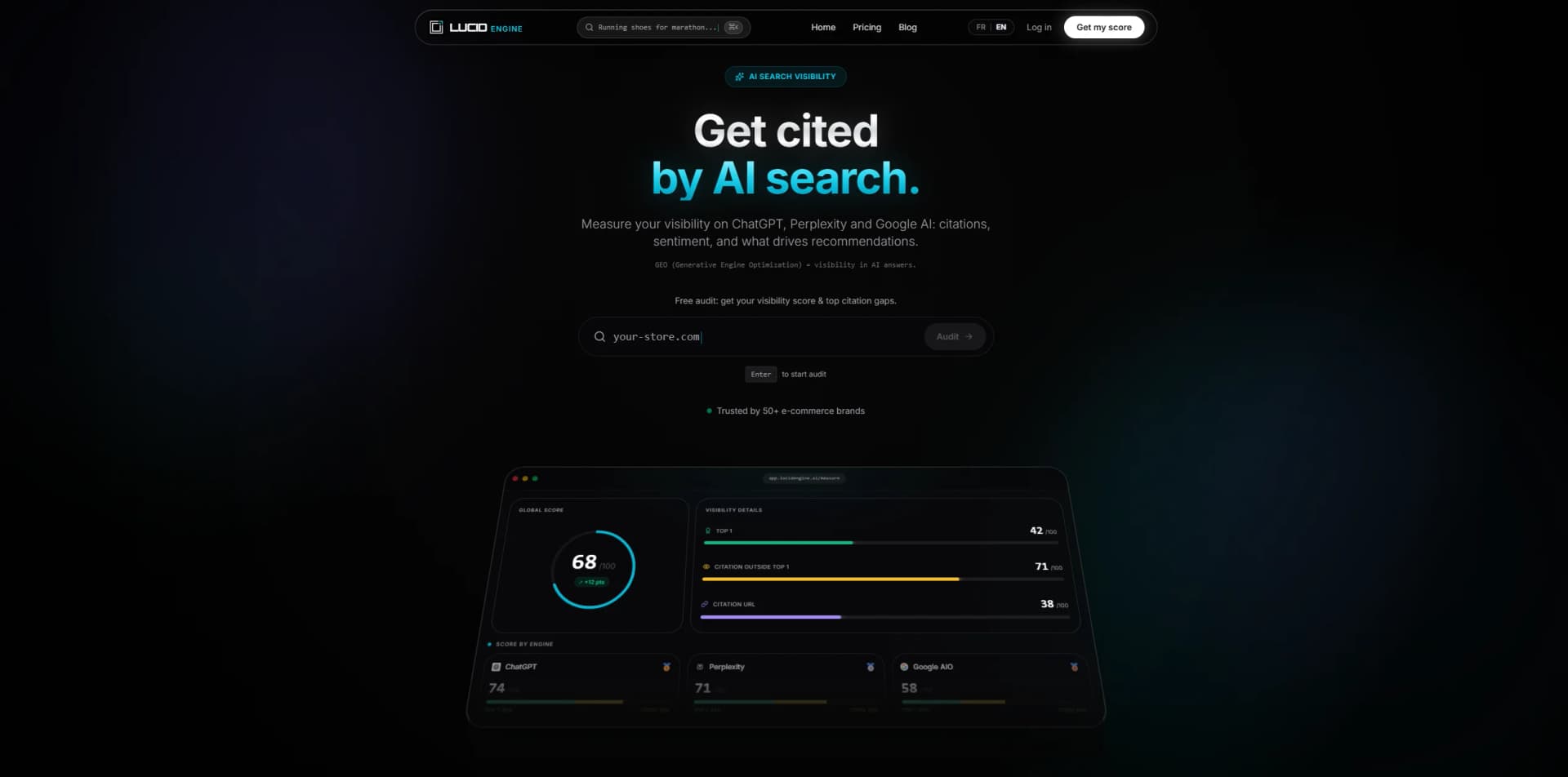
Lucid Engine focuses on AI search visibility for e‑commerce brands, showing how often and how prominently a store is cited in answers from ChatGPT, Perplexity, and Google’s AI Overviews. It treats Generative Engine Optimization (GEO) as a measurable channel, combining AI visibility scoring, competitor benchmarking, and a prioritized fix list so teams can win more AI recommendations instead of guessing what models see.
Lucid Engine treats AI search visibility like a quantifiable channel instead of a mystery. By tying GEO to concrete metrics such as per‑engine scores, share‑of‑voice vs competitors, and clear technical or content tasks, it brings structure to a space that often feels opaque. Its emphasis on explainability, from specific third‑party sources that drive recommendations to the language models repeat about a brand, helps teams move from “Why are we missing in AI answers?” to a clear outreach and content plan. For e‑commerce marketers who already live in Shopify or Magento, that blend of AI‑level intelligence and very practical site‑level tasks is especially appealing.
Lucid Engine gives brands a clear window into how AI assistants talk about them, how often they appear versus competitors, and which on‑site or off‑site levers are most likely to move that visibility. For e‑commerce teams that already invest in SEO and performance marketing, it adds a GEO layer that reveals what AI models reward today and where to strengthen content, reviews, and technical foundations. As AI search interfaces spread across shopping and discovery journeys, this kind of focused GEO analytics becomes a practical way to protect and grow demand that might otherwise quietly shift to rivals.
Who is Using Lucid Engine?
E‑commerce Retailers
Tracking how AI assistants recommend their products in shopping‑oriented queries and where competitor brands are preferred.
Direct‑to‑Consumer Brands
Measuring AI share of voice in lifestyle, fashion, beauty, and home categories, and aligning PR, reviews, and content with what models quote.
Performance Marketing & SEO Teams
Using GEO insights to complement paid and organic search, feeding the P0/P1/P2 backlog into existing sprint workflows.
Marketplaces and Multi‑brand Retailers
Understanding which brands in their catalog AI tends to mention, and where to push content or reviews to close gaps.
Uncommon Use Cases
Used by PR and communications teams to audit narrative and sentiment in AI answers before major campaigns; adopted by investor or research teams as an extra signal when assessing brand strength and share of attention in AI assistants.
Key Features
Rating Breakdown
Pricing Plans
Discovery Plan
$55 per month
- Early access pricing for 3 months, then $99 per month. Includes 1 brand, 1 country, 60 prompts, up to 3 personas, weekly refresh, and email support
Growth Plan
$449 per month
- 1 brand, 3 countries, 200 prompts, up to 5 personas, weekly refresh, and priority support
Enterprise Plan
$549 per month
- Custom brand, country, prompt, and persona counts, personalized support, and a custom engine configuration
Which Lucid Engine plan should you pick?
Start with the Free checker for a baseline, use the One-shot snapshot for a full diagnostic, and upgrade to the Monitoring plan for recurring weekly tracking.
Free checker
Good for teams who need a $0 baseline score, category gap, and initial competitor signal without signup.
One-shot snapshot
Good for teams who need one full diagnostic with competitor analysis, Truth Layer, AI readiness, and action briefs.
Monitoring plan
Good for brands that need weekly runs, run history, drift detection, readiness checks, publication verification, and ongoing action briefs.
Lucid Engine Use Cases
Measure AI visibility
Track how often AI engines cite or recommend a brand compared with competitors across markets and engines.
Outcome: A visibility score and competitor comparison.
Diagnose product-data gaps
Inspect structured data, pricing consistency, product variants, image alt text, and FAQ structure.
Outcome: A prioritized list of root causes and fixes.
Prioritize optimization work
Use P0, P1, and P2 action priorities to focus on the most important visibility improvements.
Outcome: A concrete action backlog.
Monitor recommendation share
Run recurring checks across ChatGPT, Perplexity, and Google AI to identify changes and competitor movement.
Outcome: Weekly visibility tracking and run history.
Coordinate publication proof
Generate an /llms.txt draft, publish release-note proof, verify it live, and retain the result in run history.
Outcome: A documented publication and verification loop.
Workflow Ideas with Lucid Engine
Run a GEO audit
- 1Enter an accessible website or brand for analysis
- 2Review the AI Visibility Score and engine-level results
- 3Open the prioritized action backlog
Fix structured-data gaps
- 1Inspect root causes such as missing prices, variants, or incomplete schema.org data
- 2Apply the recommended website changes
- 3Re-run the audit to measure visibility changes
Monitor AI recommendation share
- 1Configure the brand, market, strategic prompts, and supported engines
- 2Run weekly monitoring checks
- 3Review drift detection, cited sources, competitors, and next actions
How Lucid Engine fits into your stack
Browser
Lucid Engine is a web-based GEO workspace accessed through lucidengine.tech. It provides AI-visibility audits, engine-by-engine monitoring, competitor analysis, citation audits, and prioritized optimization actions.
Automation and APIs
The Terms describe plan-dependent API access and API quotas, while the product focuses on recurring visibility tracking, publication verification, and run history for AI-discovery operations.
Pros
- +AI‑native GEO focus: Built specifically around being cited in AI answers rather than classic blue‑link SEO rankings.
- +Actionable diagnostics: The P0/P1/P2 backlog and impact estimates turn abstract visibility scores into concrete next steps for content, schema, and technical fixes.
- +Strong competitive context: Share‑of‑voice visualizations make it easy to spot rising rivals and shifting AI preferences before traffic drops show up in analytics.
- +Monitoring of model shifts: Volatility timelines and continuous prompt tracking help teams link visibility swings to AI model updates instead of guessing what changed.
- +Geo and source breakdowns: City‑level answers, sentiment, and source‑type splits (brand, editorial, UGC, marketplaces) provide more nuance than a single blended score.
Cons
- −E‑commerce centric: Brands outside transactional or catalog‑driven use cases may find some depth, such as SKU‑level actions, less relevant.
- −Prompt quality dependency: Insights depend heavily on how well strategic prompts are chosen and maintained, which can be a new skill set for many teams.
- −Early category maturity: GEO as a practice is still young, so linking visibility scores directly to revenue outcomes will take testing and internal education.
Limitations & when to consider alternatives
Known limitations
- Single-brand and single-market monitoring. The monitoring plan includes one brand and one market.
- Prompt quota. The monitoring plan includes 60 strategic prompts; additional prompt capacity is listed as coming soon.
- Limited engine coverage by plan. The listed monitoring plan covers ChatGPT, Perplexity, and Google AI; Claude, Gemini, and DeepSeek add-ons are coming soon.
- Public-data focus. Lucid analyzes public website data and does not access internal, transactional, or confidential data.
- No guaranteed business outcome. Lucid does not guarantee sales growth, citation improvement, AI-engine positions, or other performance indicators.
Look elsewhere when
- You need a native mobile app
- You need a desktop installer
- You need documented developer API documentation
- You need file-based analysis of private documents
How to Use Lucid Engine
- 1
Start the free checker
Run the $0 baseline assessment to see whether AI engines include your brand in relevant recommendations.
- 2
Review the diagnostic
Inspect the visibility score, engine-level results, competitor overlap, cited sources, and identified truth gaps.
- 3
Work through the action backlog
Use prioritized directives and P0/P1/P2 recommendations to decide which website or proof changes to make first.
- 4
Publish supporting proof
Use the /llms.txt generator and release-note workflow to create and verify evidence intended to improve AI understanding.
- 5
Enable recurring monitoring
Choose the Monitoring plan when you need weekly runs, drift detection, run history, and ongoing visibility tracking.
Who is Lucid Engine For?
Online brands
Lucid is built for online brands that want to understand and improve how generative AI recommends their products.
E-commerce businesses
The platform focuses on catalogs, pricing, inventory, product attributes, and structured product data.
Solo founders
Lucid describes its maker workflow as strategic tooling for solo founders seeking stronger AI discovery.
Marketing and GEO practitioners
Lucid provides visibility scores, competitor comparisons, citation analysis, diagnostics, and prioritized action plans.
Frequently Asked Questions
What exactly is Lucid?
Lucid is a Generative Engine Optimization platform that analyzes how AI engines perceive and recommend an online business, then produces a prioritized action plan.
Which AI engines does Lucid analyze?
The FAQ lists ChatGPT, Google AI Overviews, Perplexity, Gemini, and Bing Copilot.
What data does Lucid analyze?
Lucid analyzes public website content, schema.org data, meta tags, and visible information, without accessing internal or transactional data.
Which platforms are compatible with Lucid?
Lucid supports Shopify, Magento, WooCommerce, PrestaShop, and any accessible website. Jira, Linear, and Slack integrations sync the action backlog.
How much does Lucid cost?
The pricing page lists a free checker, a $29 one-shot snapshot, and an $89-per-month monitoring plan.
Can I cancel anytime?
Lucid states that users can cancel anytime, with monthly and annual plans and no long-term contract.
Community reviews
Be the first to share your experience.
Sign in to leave a review for Lucid Engine.
Lucid Engine Alternatives
Looking for alternatives to Lucid Engine? Here are similar tools in the same category:
Learn to Master Lucid Engine
With Skill Leap courses
Get in-depth training on Lucid Engine and 50+ other AI tools with our expert-led video courses.
Start 7-Day Free Trial