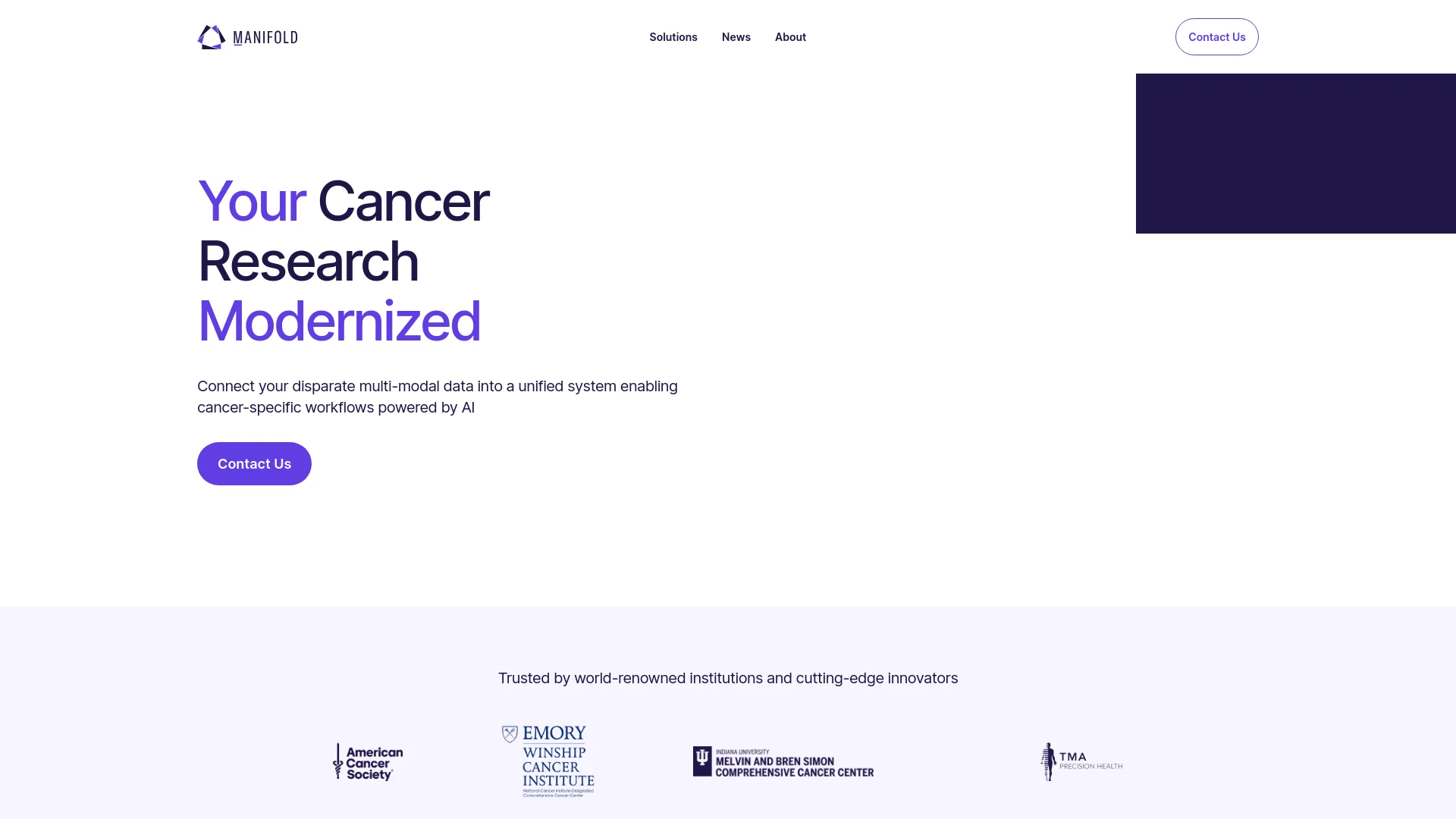
Manifold
Streamline clinical research with AI-driven data integration and collaboration.
Key Takeaways
- What it is
- Streamline clinical research with AI-driven data integration and collaboration.
- Best for
- AI-Powered Solutions
- Integrated Data Management
- Collaborative Environment
- Rating
- 4.5/5
What is Manifold?
Manifold is a pioneering AI-powered platform designed to streamline clinical research management and data operations. By automating complex tasks and enhancing data integration, Manifold significantly boosts the efficiency and accuracy of clinical studies. It is tailored for researchers, healthcare institutions, and biobanks, making it easier to handle intricate data and collaborative research efforts.
Manifold's specialization in clinical research management sets it apart by offering tailored solutions that meet the high compliance and accuracy requirements of the field. Its integration capabilities and secure collaboration features are designed to handle diverse data types and research needs effectively.
Manifold excels in revolutionizing clinical research management with its robust AI-driven capabilities and user-centric design. It simplifies the handling of complex data and fosters secure, collaborative research efforts, making it an invaluable tool for research institutions and healthcare providers. With its strong emphasis on accuracy, scalability, and secure data management, Manifold is well-positioned to support the evolving needs of the clinical research landscape.
Who is Using Manifold?
Research Institutions
Utilize the platform to efficiently manage complex research data and operations.
Healthcare Providers
Integrate clinical outcomes with research data to enhance research efforts.
Biobanks
Streamline the integration of biospecimen data with clinical information.
Pharmaceutical Companies
Accelerate and improve the accuracy of clinical trials.
Uncommon Use Cases
Non-profits managing population science research; educational institutions for research training.
Key Features
Rating Breakdown
Pricing Plans
Custom Pricing
- Tailored pricing plans based on specific institutional needs and scale
Contact for Quote
- Prospective users should reach out to Manifold directly for pricing details and package options
Manifold Use Cases
Cohort building
Researchers query clinical and genomic records in plain language and create research cohorts.
Outcome: Faster feasibility assessment and cohort analysis.
Biomedical data discovery
Teams search datasets, metadata, lineage, variables, and distributions before requesting access.
Outcome: Better-scoped research requests and less manual data steward work.
Partner data access
Organizations give external partners governed access to query and analyze data without moving it.
Outcome: Self-service collaboration with permissions and audit trails.
Bioinformatics analysis
Users run biostatistics, survival analysis, differential expression, spatial analysis, and bioinformatics pipelines.
Outcome: End-to-end analysis from question to verifiable result.
Sequencing data delivery
Providers package, validate, track, and deliver sequencing outputs directly into customer environments.
Outcome: Faster delivery with QC metadata, version control, and reduced support burden.
Workflow Ideas with Manifold
Turn raw data into a research-ready dataset
- 1Upload or connect clinical, genomic, or spreadsheet data
- 2Use AI-assisted metadata generation and schema mapping
- 3Publish the governed dataset for cohorting and analysis
Answer a partner feasibility request
- 1Grant the partner scoped access to a dataset or workbench
- 2Let the partner ask a natural-language cohort question
- 3Review the auditable query, result, and permitted export
Run an AI-assisted bioinformatics analysis
- 1Ask an AI agent to analyze the available research data
- 2Inspect generated code, queries, dataframes, and intermediate results
- 3Continue in Jupyter, R, SQL, WDL, or Nextflow when more control is needed
How Manifold fits into your stack
Secure Data Handling
Complies with healthcare regulations and data security standards.
Flexible Data Inputs
Supports various data types, including clinical and genomic data.
Custom API Access
Provides APIs for specialized integrations, enhancing adaptability for research-specific needs.
Integration with Healthcare Systems
Compatible with existing healthcare and research systems to streamline workflows.
Pros
- +Enhanced Productivity: Automates data handling tasks, drastically reducing turnaround times and operational workload.
- +Increased Accuracy: AI-driven analytics ensure high precision in data interpretation and study results.
- +Scalability: Adapts to various research scales, from small-scale studies to extensive multi-center trials.
- +Secure Collaboration: Facilitates secure and compliant data sharing among research teams and institutions.
Cons
- −Initial Learning Curve: Users may need time to become familiar with the platform's features and functionalities.
- −Specialized Focus: Primarily targeted at clinical research, which may limit applicability to other research fields.
- −Dependency on Data Quality: The effectiveness of AI insights depends heavily on the quality of the input data.
Limitations & when to consider alternatives
Known limitations
- Enterprise sales process. The public site emphasizes demos and customer deployments rather than self-service signup.
- No public plan comparison. The site describes usage-based or customer-specific deployment options but does not publish standard consumer plan names or prices.
- Life sciences focus. The platform is purpose-built for biomedical, clinical, genomic, imaging, and related research data.
- Cloud and governance setup may be required. Bring-your-own-cloud deployments require AWS bucket policies, compute accounts, and access configuration.
- No documented native mobile or browser extension. The public product materials describe cloud research environments and workbenches, not native mobile apps or browser extensions.
Look elsewhere when
- You need a self-service free plan.
- You need a native mobile app.
- You need a browser extension.
- You need a publicly documented developer API.
How to Use Manifold
- 1
Visit the Manifold website for a range of tutorials, from basic setup to advanced features, designed to help users fully utilize the platform’s capabilities.
Who is Manifold For?
Life sciences teams
Manifold helps teams query, analyze, and share governed clinical, genomic, and real-world data.
Data stewards and engineers
They can ingest data, generate metadata, map schemas, track lineage, and prepare research-ready datasets.
Researchers
Researchers can discover data, build cohorts, ask questions in natural language, and run analyses without waiting for specialists.
Biobanks and population studies
The platform supports discoverable collections, governed collaboration, feasibility queries, and research data partnerships.
Molecular diagnostics and omics providers
Providers can deliver agent-powered self-service analysis and governed access to genomic and assay data.
Frequently Asked Questions
What is Manifold?
Manifold is an enterprise agent platform for life sciences that connects specialist AI agents to governed biomedical data.
Who is Manifold built for?
It is designed for life sciences organizations, research teams, data providers, biobanks, diagnostics companies, and academic medical centers.
What kinds of data does Manifold support?
The platform supports clinical, genomic, specimen, claims, imaging, and other multimodal or file-based research data.
Can teams collaborate in Manifold?
Yes. Shared workbenches support collaborators, shared notebooks, dashboards, computational environments, storage, and fine-grained permissions.
Where does customer data run?
Manifold can run in a managed environment or in the customer's own cloud, including AWS-based bring-your-own-cloud deployments.
What tools can users access?
Users can work with AI agents, Jupyter, R, SQL, WDL, Nextflow, Python, dashboards, and batch bioinformatics workflows.
Community reviews
Be the first to share your experience.
Sign in to leave a review for Manifold.
Manifold Alternatives
Looking for alternatives to Manifold? Here are similar tools in the same category: