Mem0
Persistent memory for AI agents that carries user context across conversations.
Key Takeaways
- What it is
- Persistent memory for AI agents that carries user context across conversations.
- Pricing
- Freemium · $19 per month · $249 per month
- Best for
- Memory add and search
- Memory updates and history
- Memory Compression Engine
- Rating
- 4.2/5
What is Mem0?
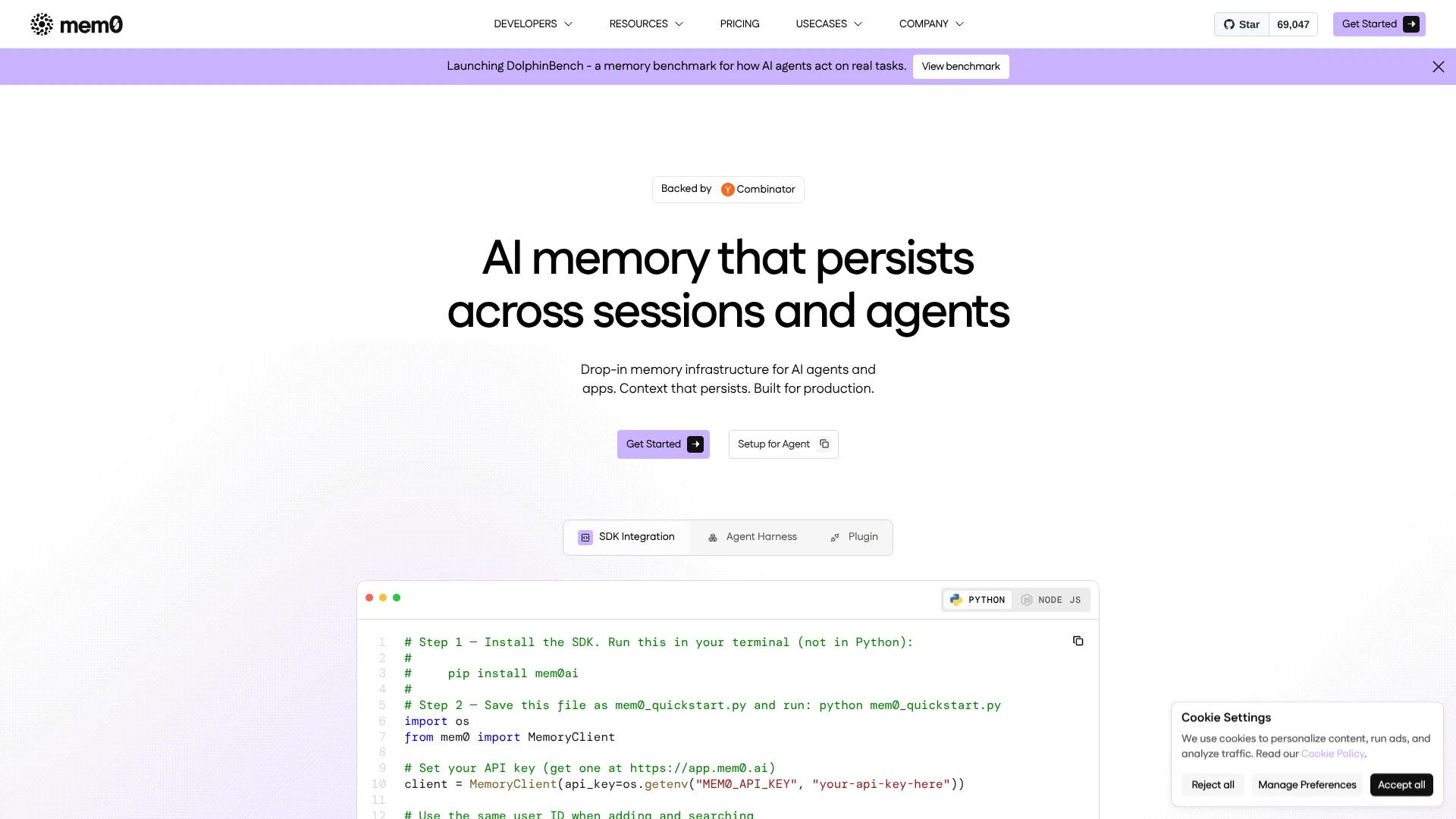
AI applications often lose useful details when a conversation ends. Mem0 stores facts from conversations as searchable memories, then retrieves relevant context for later interactions. Developers can add it to an AI app through a hosted API or run its open-source version on their own infrastructure, helping agents remember user preferences and past interactions without resending the full conversation.
Mem0’s Memory Compression Engine turns conversation history into compact memories and retrieves context by user or other filters. That gives developers a separate memory layer they can connect to different AI models and apps, rather than tying remembered context to a single conversation thread.
Mem0 is best suited to developers building personalized AI agents, especially products that need context across sessions or users. It is infrastructure, not a ready-made chatbot, so it takes coding and an AI application to put its memory to work.
Who is Using Mem0?
AI application engineers
An engineer adds the SDK or API so an agent can store and retrieve user-specific context.
Agent platform developers
A developer uses Mem0 MCP to let an AI agent manage its own memories.
Healthcare AI developers
A product builder can structure patient facts such as preferences and history for later retrieval.
Learning product developers
A developer can help a tutoring agent remember a learner's pace and what has worked in earlier lessons.
Sales technology developers
A builder can give a sales agent recall of prior conversations, objections, and milestones.
Uncommon Use Cases
Keeping a user's writing preferences available across ChatGPT, Claude, and other supported browser AI tools; carrying project context between different AI agents.
Key Features
Rating Breakdown
Pricing Plans
Hobby
Free
- 10,000 add requests per month
- 1,000 retrieval requests per month
- 1 project
- Community support
Starter
$19 per month
- 50,000 add requests per month
- 5,000 retrieval requests per month
- 1 project
- Community support
Pro
$249 per month
- 500,000 add requests per month
- 50,000 retrieval requests per month
- Unlimited projects
- Private Slack support
- Advanced analytics and graph memory
Enterprise
- Unlimited add and retrieval requests
- On-prem deployment
- Audit logs
- Custom integrations and SSO
- SLA support
Which Mem0 plan should you pick?
Start with Hobby to test memory in a project, then move to Starter or Pro as request volume or project needs grow.
Hobby
Good for individuals exploring Mem0 or testing a side project within its monthly request limits.
Starter
Good for solo builders shipping an AI agent with higher monthly request limits than Hobby.
Pro
Good for production apps that need higher request limits, multiple projects, analytics, or graph memory.
Enterprise
Good for teams that need unlimited listed requests, on-premises deployment, audit logs, SSO, or SLA support.
Mem0 Use Cases
Personalized AI conversations
An agent retrieves a user's preferences and relevant past details before responding in a new session.
Outcome: The user does not need to repeat context the agent has already stored.
Patient context across visits
A healthcare AI can retrieve relevant stored patient facts across conversations and visits.
Outcome: The assistant can respond with continuity based on prior context.
Adaptive tutoring
A tutoring app can retain what works for a learner and use it in later lessons.
Outcome: Lesson responses can reflect the learner's pace and preferences.
Sales interaction recall
An AI sales tool can search earlier interactions for objections and milestones in a long sales cycle.
Outcome: Sales reps can access relevant history at a later touchpoint.
Shared personal context across AI tools
OpenMemory can carry saved preferences across supported browser-based AI tools.
Outcome: The user can get more tailored replies without restating the same preferences.
Workflow Ideas with Mem0
Add memory to an AI agent
- 1Create a Mem0 Platform account and get an API key.
- 2Send conversation messages to the add operation with a user ID.
- 3Search for relevant memories before the agent responds.
Keep an agent's memory current
- 1Search memories using the user's ID and the current question.
- 2Update or delete details when the user's context changes.
- 3Retrieve the relevant memories for the next interaction.
Run memory on your own infrastructure
- 1Install the open-source library or launch the self-hosted server.
- 2Choose and configure the language model and vector store.
- 3Connect the app to Mem0 to add and search memories.
How Mem0 fits into your stack
Application code
Python and JavaScript SDKs let an application add and search memories as part of its existing conversation flow.
AI agent connections
Mem0 MCP lets compatible agents call memory operations to save, find, or update context.
Browser-based AI tools
The OpenMemory Chrome extension brings saved preferences to ChatGPT, Claude, Perplexity, Grok, and Gemini.
Self-hosted infrastructure
The open-source version can run as a library or self-hosted server, with developer-selected components such as the vector store.
Pros
- +Context that carries over: Memories can be searched in later sessions instead of being tied to one chat thread.
- +Choice of deployment: Developers can use the hosted Platform or run the open-source version on their own infrastructure.
- +Clear entry-level limits: The free Hobby plan includes 10,000 add requests and 1,000 retrieval requests per month.
- +Cross-tool personal memory: The OpenMemory Chrome extension can carry preferences across ChatGPT, Claude, Perplexity, Grok, and Gemini.
Cons
- −Developer-focused setup: Mem0 is a memory layer to add to an AI product, not a finished conversational app.
- −Usage-metered plans: The hosted plans cap monthly memory additions and retrievals.
- −Separate extension experience: OpenMemory serves individual browser users, while the Platform is aimed at developers building AI products.
Limitations & when to consider alternatives
Known limitations
- Hobby request caps. The free Hobby plan includes 10,000 add requests and 1,000 retrieval requests per month.
- Hobby project limit. The Hobby plan includes one project.
- Starter project limit. The Starter plan includes one project; unlimited projects are listed for Pro and Enterprise.
- Graph memory availability. Graph memory is listed as a Pro and Enterprise feature, not a Hobby or Starter feature.
Look elsewhere when
- You need a ready-to-use chatbot rather than memory infrastructure to integrate into an AI application.
- You need a native mobile or desktop app from Mem0.
- Your project needs more monthly requests than the published plan limits and you do not want a usage-based or Enterprise arrangement.
How to Use Mem0
- 1
Choose the hosted or self-hosted version
The Platform is hosted by Mem0; the open-source version is for developers who want to run and configure the memory layer themselves.
- 2
Create a Platform API key
The hosted API uses an account API key to authenticate requests.
- 3
Install an SDK
The quickstart covers Python and JavaScript, with cURL also available for direct API requests.
- 4
Add conversation messages
Send the conversation and a user ID so Mem0 can extract and associate memories with the right user.
- 5
Search before responding
Query Mem0 with the current question and user filter, then pass relevant returned memories into the agent's response context.
- 6
Review and manage stored memories
Use the memory operations to retrieve, update, or delete facts when they are no longer accurate.
Who is Mem0 For?
AI app developers
The SDK and API provide a way to add persistent user context to an existing AI application.
AI product teams
Teams can give an agent searchable memory across user sessions and interactions.
Healthcare AI builders
Mem0 describes patient-history and preference recall across visits as a healthcare use case.
Education product teams
An AI tutor can retain information about a learner's pace and preferences between lessons.
Sales and CRM teams building agents
Persistent memory can help an AI sales tool recall prior interactions and milestones.
Frequently Asked Questions
Does Mem0 have a free plan?
Yes. The Hobby plan costs $0 and includes 10,000 add requests and 1,000 retrieval requests per month, with one project.
What does a memory add request do?
It sends conversation content to Mem0 to extract and store relevant memories.
What does a retrieval request do?
It searches stored memories for context relevant to a query.
Can Mem0 run on my own infrastructure?
Yes. Mem0 Open Source can run as a library in an app or as a self-hosted server.
Which AI tools work with OpenMemory?
The OpenMemory Chrome extension lists ChatGPT, Claude, Perplexity, Grok, and Gemini as supported tools.
Does Mem0 support SSO?
The pricing page lists SSO as an Enterprise feature.
Community reviews
Be the first to share your experience.
Sign in to leave a review for Mem0.
Mem0 Alternatives
Looking for alternatives to Mem0? Here are similar tools in the same category: