
Modl
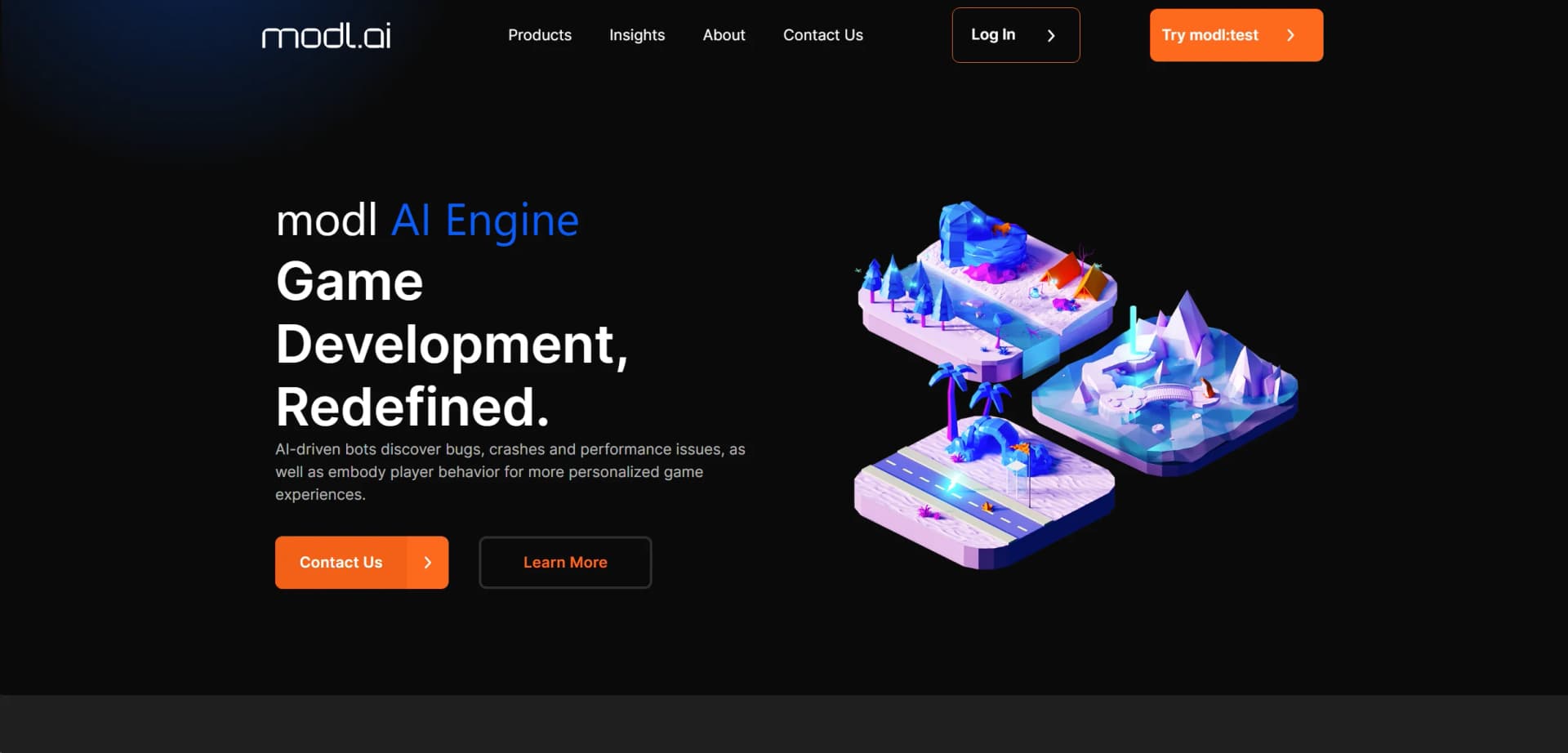
Revolutionizes game development with AI-driven testing and player experience enhancement.
Key Takeaways
- What it is
- Revolutionizes game development with AI-driven testing and player experience enhancement.
- Best for
- Automated QA Bots
- Player Bots for On-demand Use
- Self-Updating Bots
- Rating
- 4.4/5
What is Modl?
In the ever-evolving landscape of game development, Modl emerges as a revolutionary AI engine designed to redefine the standards of game testing and player experience enhancement. At its core, Modl leverages AI-driven bots to meticulously discover bugs, crashes, and performance issues, alongside embodying player behavior for more personalized game experiences. Aimed at developers and gaming professionals, Modl simplifies and streamlines the game development lifecycle, from quality assurance to ensuring engaging player interactions.
Modl stands out in the game development industry with its comprehensive approach to integrating AI throughout the game development lifecycle. Its unique selling point lies in its ability to provide both automated QA testing and player experience enhancement through a single AI engine. This dual capability enables game developers to not only identify and rectify technical issues efficiently but also to deeply understand and cater to player behaviors and preferences, a feature unmatched by traditional game development tools.
Modl excels in revolutionizing game development by automating quality assurance and enhancing player experiences through its AI-driven engine. Its ability to simulate real player behaviors and automate testing processes sets it apart, making it an indispensable tool for developers aiming to create engaging and error-free games. With its continuous learning capabilities, Modl not only addresses current game development challenges but also adapts to future trends, offering unparalleled support throughout the game development lifecycle.
Who is Using Modl?
Game Developers
Leveraging the tool for both large-scale and indie game projects to ensure quality and player engagement.
QA Teams
Utilizing automated bots to streamline the testing process, allowing for more focus on critical testing areas.
Game Designers
Employing player bots to test game balance and user experience from early development stages.
Production Teams
Ensuring that games are launched with minimal bugs, enhancing player satisfaction and reducing post-launch support needs.
Uncommon Use Cases
Educational institutions incorporate Modl into their curriculum to teach students about game development and testing. Additionally, Modl is used in competitive game analysis to understand and predict player behavior patterns.
Key Features
Rating Breakdown
Modl Use Cases
Automated gameplay testing
Upload a build, define tasks such as completing a tutorial or reaching a level, and let AI agents execute them.
Outcome: Pass/fail results and test-run evidence.
Exploratory QA
Assign open-ended exploratory tasks so agents navigate game environments and interact with available content.
Outcome: Discovery of crashes, softlocks, broken menus, and gameplay issues.
Visual bug detection
Analyze gameplay sessions and videos for missing assets, visual glitches, and other on-screen issues.
Outcome: Visual reports containing descriptions, screenshots, timestamps, and severity.
Continuous build testing
Trigger automated runs from a CI or build pipeline whenever new builds are available.
Outcome: Earlier detection of regressions and actionable reports for QA teams.
Performance analysis
Capture performance data during agent sessions and inspect CPU, memory, and performance problems.
Outcome: Performance insights that help teams prioritize fixes.
Workflow Ideas with Modl
Automated build QA
- 1Upload the latest game build
- 2Define test tasks in plain language
- 3Run AI-agent tests and review generated reports
Video-based visual analysis
- 1Upload a gameplay video
- 2Start visual analysis
- 3Review screenshots, timestamps, severity, and detected visual issues
CI regression testing
- 1Connect the test trigger to the CI or build pipeline
- 2Run tests automatically on new builds
- 3Review dashboard results or push reports to QA tools
How Modl fits into your stack
API Access
Developers can use Modl's API for custom integrations, allowing for flexible incorporation into existing development pipelines.
Data Import/Export Capabilities
Supports seamless data exchange, enabling developers to utilize external player data for bot training.
Continuous Integration/Continuous Delivery (CI/CD) Systems): Modl can be integrated with CI/CD pipelines for automated testing and deployment.
Analytics Tools Integration
The platform can be connected with analytics tools to further analyze game performance and player engagement data.
Pros
- +Enhanced Testing Efficiency: Significantly reduces the time and resources required for game testing by automating the detection of bugs and performance issues.
- +Improved Player Experience: By simulating real player behaviors, developers can gain valuable insights into game dynamics and player engagement.
- +Cost-Effectiveness: Reduces the need for extensive manual testing teams, thereby saving on development costs.
- +Scalability: Modl's AI engine scales with the game's development, supporting a wide range of game genres and sizes.
- +Continuous Learning and Improvement: The self-updating nature of the bots ensures that the game evolves in response to actual player feedback and behaviors.
Cons
- −Initial Setup Complexity: The integration and initial setup of Modl's system may require a steep learning curve for developers unfamiliar with AI technologies.
- −Dependence on Quality Data: The effectiveness of player bots heavily relies on the quality and quantity of player data available for training.
- −Potential for Overreliance: Developers might become overly reliant on automated testing, potentially overlooking the nuanced feedback human testers can provide.
Limitations & when to consider alternatives
Known limitations
- Fast-paced gameplay is not fully supported. Very fast-paced or timing-critical gameplay is still an area of active development.
- Advanced player skill remains difficult. The agent is designed to test rather than win, so human testers are better for cases requiring advanced skill or intuition.
- Platform coverage is still expanding. Android and desktop are supported today, while iOS, console, and additional PC workflows are being expanded.
- Game-specific model training may be needed. Each game benefits from a custom-trained model, and major visual overhauls or new gameplay features may require model refreshes.
Look elsewhere when
- You need a public API for scripted test execution.
- Your game requires iOS testing today.
- Your workflow requires a native desktop application.
How to Use Modl
- 1
For those looking to dive deeper into Modl's functionalities, the platform offers a range of learning materials, including comprehensive tutorial series, case studies, and insightful blog posts on its website. These resources are designed to assist users in maximizing the tool's potential, from basic setup to advanced features exploration.
Who is Modl For?
QA teams
They can automate routine test cases, run exploratory tests, and receive generated bug reports.
Game studios
Studios can upload builds and test functionality, performance, gameplay logic, and visual quality across supported platforms.
Game developers
Developers can define tests in plain language, run builds automatically, and review videos, logs, performance data, and issue reports.
Frequently Asked Questions
How does the AI see and test the game?
Modl.ai uses visual models and OCR to read text, UI elements, and game states on screen.
Do you need to integrate with the game engine or codebase?
The current solution is described as a black-box system that operates through visual observation and simulated inputs without SDKs, plugins, or code changes.
What platforms are supported?
Android and desktop testing are currently supported. iOS support is described as in development, with console and additional PC workflows expanding.
What games can be tested?
The system currently excels at mobile games and titles with structured interactions or clear UI elements, including match, narrative, card, and turn-based games.
Will the agent play as well as a human?
The agent is intended to test functionality, performance, and logic rather than win. Human testers remain better suited to advanced skill and intuition-based cases.
Can tests run automatically in CI pipelines?
Yes. Runs can be triggered automatically as part of a CI or build pipeline, with results available through the dashboard or pushed to QA tools.
Community reviews
Be the first to share your experience.
Sign in to leave a review for Modl.
Modl Alternatives
Looking for alternatives to Modl? Here are similar tools in the same category:
Learn to Master Modl
With Skill Leap courses
Get in-depth training on Modl and 50+ other AI tools with our expert-led video courses.
Start 7-Day Free Trial