Ocular AI
Real-conversation benchmarks help voice AI teams test speech models.
Key Takeaways
- What it is
- Real-conversation benchmarks help voice AI teams test speech models.
- Best for
- Converse-STT
- Converse-Diarization
- Open-source evaluation harness
- Rating
- 3.9/5
What is Ocular AI?
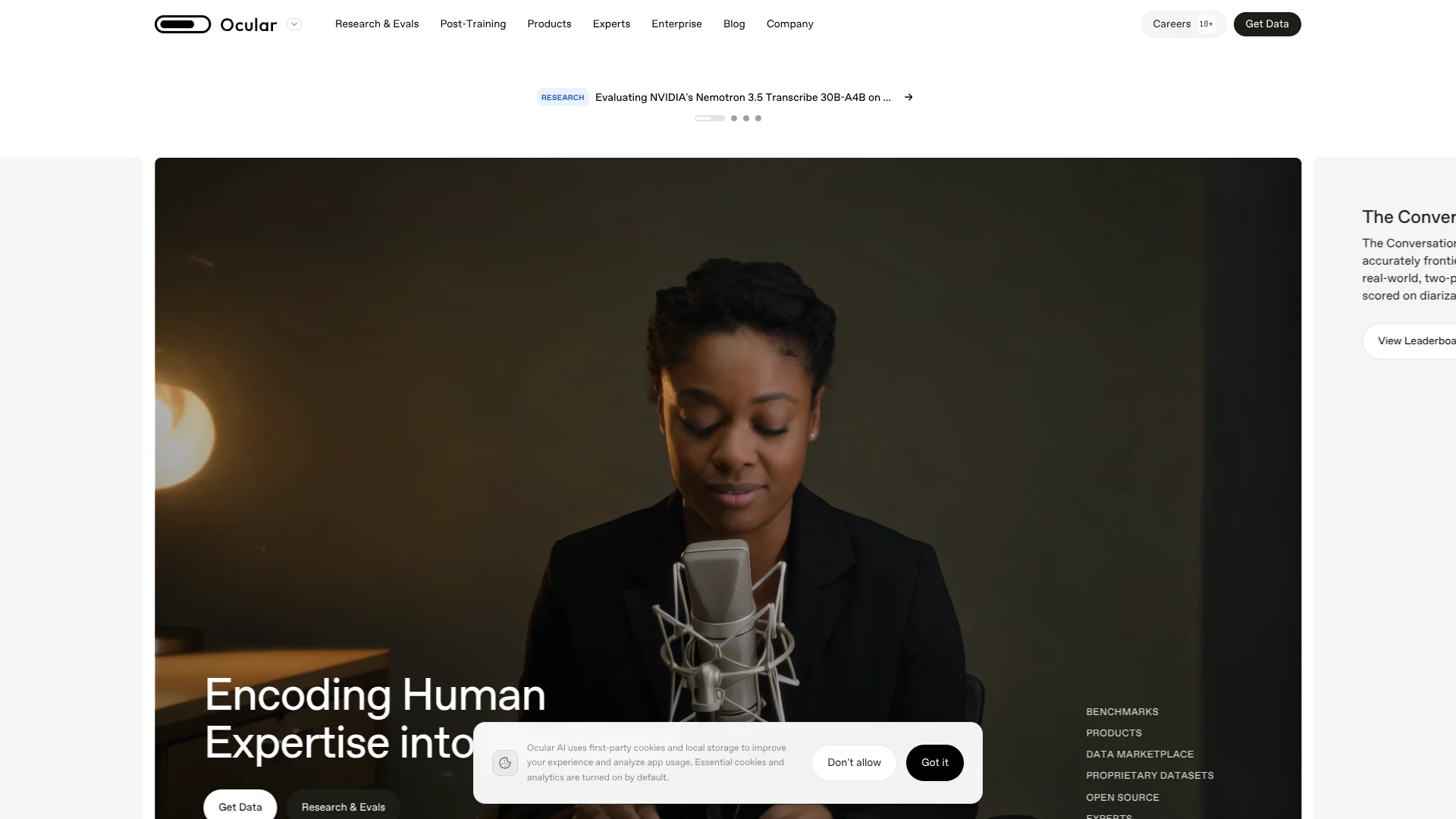
Ocular AI helps teams improve AI models with human-created training data and evaluations, especially for voice systems that struggle with real conversations. Its expert network and Data Foundry turn professional knowledge into datasets, evaluation tasks, and benchmarks. Teams can license existing datasets or work with Ocular on data shaped around a specific model weakness.
Ocular's Converse benchmarks test speech models on unscripted conversations between two people, rather than relying only on short, clean audio clips. Its open-source evaluation harness lets teams inspect how scores were produced and compare systems on the same recordings.
The company is best suited to AI labs and product teams building or evaluating models, particularly voice AI. The live Converse benchmarks currently cover American English and two skills: speech-to-text and speaker diarization. Ocular is a data and research partner, not a self-serve tool for everyday transcription.
Who is Using Ocular AI?
Speech ML engineers
Model error patterns on Converse can help them assess speech-to-text and speaker attribution.
AI research leads
Benchmark results and technical reports give them a way to compare voice systems on natural conversation.
Training data leads
Ocular's dataset process helps them scope expert data around a specific model weakness.
Localization leads
Ocular's multilingual expert network can support data projects across languages and dialects.
Uncommon Use Cases
Voice teams can study how models handle backchannels and interruptions; model teams can commission professional-domain data for specialized tasks.
Key Features
Rating Breakdown
Pricing Plans
Custom Pricing Model
- Ocular AI offers tailored pricing depending on the deployment scale
- Chosen features
- Integration needs
Ocular AI Use Cases
Compare speech-to-text models
Converse-STT ranks systems on real two-person American English conversations using word error rate.
Outcome: A comparable view of transcription accuracy on conversational speech.
Check speaker attribution
Converse-Diarization measures whether a system assigns speech to the correct speaker.
Outcome: A score for speaker identification performance on conversation audio.
Build model-specific training data
A custom dataset project starts from a model gap, then moves through design, expert pilot, review, and delivery.
Outcome: A dataset tailored to the target capability and use case.
Add human-reviewed audio annotations
Ocular's transcription service annotates client audio with speaker attribution and conversational cues.
Outcome: Human-verified transcripts and audio annotations.
Source existing speech datasets
Teams can review off-the-shelf datasets instead of commissioning a new collection from scratch.
Outcome: Access to available, documented datasets for evaluation.
Workflow Ideas with Ocular AI
Choose a voice model using Converse
- 1Select Converse-STT or Converse-Diarization based on the capability being tested.
- 2Compare model scores and review the benchmark's technical report.
- 3Use the results to shortlist systems for your own evaluation.
Commission a targeted training dataset
- 1Describe the model gap and intended use to Ocular.
- 2Review sample data and agree on the dataset scope and license.
- 3Pilot the task with experts, refine the guidance, then scale and receive the dataset.
Add human-reviewed audio annotations
- 1Share the audio use case and relevant domain with Ocular.
- 2Agree on the annotation needs, such as emotion, overlap, or speaker attribution.
- 3Receive human-verified transcripts and annotations for your model work.
How Ocular AI fits into your stack
Model evaluation
Converse provides public scoreboards and reports for speech-to-text and speaker diarization. Teams can use them to compare model performance on real conversation.
Training data
Ocular supplies off-the-shelf and custom datasets for model training and evaluation. Custom projects are scoped with the Ocular team.
Audio annotation
Transcription-as-a-Service adds human-verified labels to client audio, including speaker attribution and conversational cues.
Expert knowledge
Ocular's expert network supports data projects that need professional judgment, including work across languages and specialist domains.
Pros
- +Real conversation data: Converse tests speech models on unscripted exchanges, including interruptions and overlapping speech.
- +Inspectable results: The open-source harness and technical reports help teams understand how benchmark scores are produced.
- +Data shaped to a model: Ocular's process includes piloting expert-created datasets and refining them against quality checks.
Cons
- −Business-focused offering: The services and datasets are aimed at AI teams rather than individual users.
- −Sales-led purchasing: Dataset samples and pricing are requested through Ocular instead of selected from public plan prices.
Limitations & when to consider alternatives
Known limitations
- Converse coverage is currently narrow. The live benchmarks cover two-person American English conversation and measure speech-to-text and speaker diarization.
- Full test sets are held out. Ocular keeps benchmark test sets private; public samples are available for inspection.
- Pricing is shared through sales. The site asks prospective customers to request samples and pricing rather than listing dataset prices publicly.
Look elsewhere when
- You need a self-serve app for transcribing meetings or audio.
- Your benchmark needs to score languages beyond the current Converse coverage.
- Your team needs public access to the full Converse test sets.
How to Use Ocular AI
- 1
Start with the public benchmarks
Open Converse-STT or Converse-Diarization to see which voice capability each benchmark measures.
- 2
Compare systems and scoring details
Review the leaderboard and technical report; lower error scores indicate a closer match to the reference.
- 3
Decide whether existing or custom data fits
Browse off-the-shelf datasets for available material, or identify a model gap for a custom project.
- 4
Request samples and pricing
Contact Ocular with your intended use and expected data volume to discuss samples, pricing, and a suitable dataset.
- 5
Agree on the data scope and license
For a custom project, define the dataset requirements and intended use before Ocular begins the work.
Who is Ocular AI For?
Frontier AI labs
Teams developing foundation models can source expert-built training data and evaluations for model gaps.
Voice AI companies
Speech teams can compare systems on conversational audio rather than relying only on clean clips.
Enterprise AI teams
Organizations building models for specialized work can commission data designed around their use case.
AI research teams
Researchers can review public Converse scores, datasets, and technical reports when studying voice models.
Frequently Asked Questions
What does Ocular AI provide?
Ocular provides expert-built training data, datasets, audio annotation services, and evaluations for AI teams.
What is Ocular Converse?
Converse is a benchmark family for voice AI. Its live benchmarks measure speech-to-text accuracy and speaker diarization on real two-person American English conversation.
Can Ocular build a custom dataset?
Yes. Ocular works with clients to identify a model gap, design and pilot a dataset, then refine and deliver it.
Does Ocular publish dataset prices?
The site asks customers to request samples and pricing from the team; it does not list dataset prices publicly.
Can Ocular evaluate my model or license data?
Yes. Ocular invites teams to contact it about model evaluation and licensing conversational speech data.
Community reviews
Be the first to share your experience.
Sign in to leave a review for Ocular AI.
Ocular AI Alternatives
Looking for alternatives to Ocular AI? Here are similar tools in the same category: