
OpenMeter
Maximize billing accuracy with real-time data metering.
Key Takeaways
- What it is
- Maximize billing accuracy with real-time data metering.
- Pricing
- Freemium
- Best for
- Real-Time Data Aggregation
- Embeddable Customer Dashboards
- Flexible Credit and Quota Systems
- Rating
- 4.7/5
What is OpenMeter?
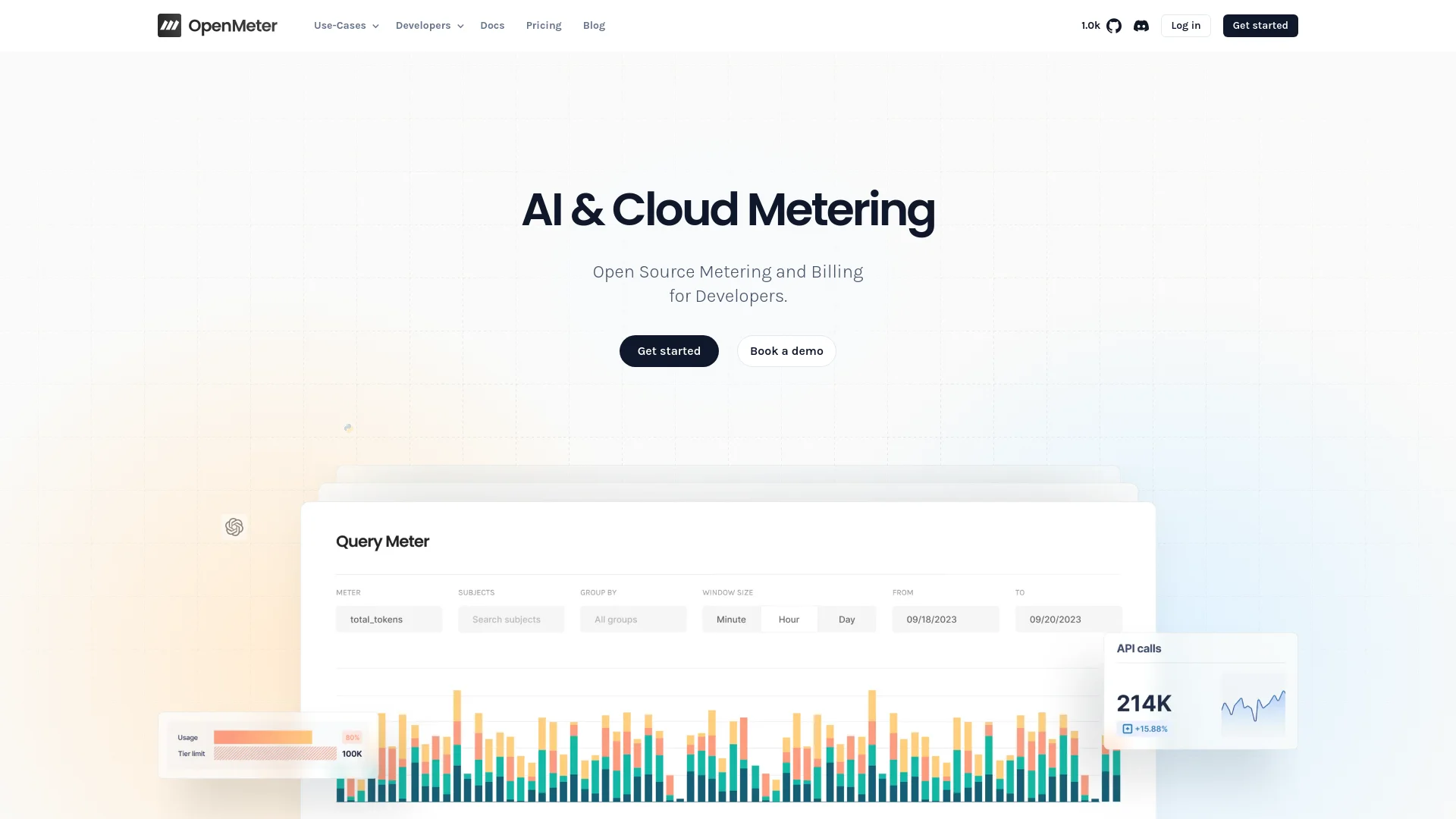
As a professional constantly seeking to optimize and streamline operations within various tech environments, I recently explored OpenMeter. This tool is a beacon for developers and product teams looking to implement sophisticated usage-based billing and metering solutions. OpenMeter excels in converting events, logs, and metrics into insightful, billable data, which can be seamlessly integrated with existing infrastructures. It's particularly designed for those who thrive in the AI, cloud, and software development spheres, aiming to enhance cost-efficiency and resource management through precise metering.
OpenMeter stands out by offering real-time, scalable usage metering and billing solutions that are easy to integrate and manage. Its ability to provide detailed, customer-facing dashboards and enforce usage limits dynamically sets it apart in the market, making it an indispensable tool for modern tech companies.
OpenMeter excels in providing powerful, real-time billing and metering solutions that are crucial for businesses leveraging modern technology stacks. Its robust feature set, combined with exceptional scalability and integration capabilities, makes it an essential tool for those looking to implement sophisticated, usage-based pricing models. Whether you're a startup or a large enterprise, OpenMeter offers the tools needed to manage and optimize your billing and metering processes effectively.
Who is Using OpenMeter?
Cloud Service Providers
Utilizing the tool to meter and bill for cloud resource usage.
AI Companies
Employing OpenMeter to measure and charge for AI-driven computations and data processing.
Software as a Service (SaaS) Businesses
Integrating the tool to adopt usage-based pricing models effectively.
Large Enterprises
Using the platform to manage internal cost allocations and departmental billing.
Uncommon Use Cases
Non-profits using the platform to maintain transparency in resource usage; educational tech companies integrating it for usage-based access to digital resources.
Key Features
Rating Breakdown
Pricing Plans
Free Tier
Free
- Enjoy OpenMeter with a free forever plan
- No credit card required
Subscription Options
- Detailed subscription management through Stripe
- Offering scalable solutions as your needs grow
Which OpenMeter plan should you pick?
Start with the Free Plan for prototyping and smaller workloads, then upgrade to Pro or Enterprise when usage, support, compliance, or security requirements increase.
Free Plan
Good for teams starting prototypes, AI workloads, or side projects with generous usage limits and no credit card requirement.
Pro Plan
Good for growing deployments that need higher usage thresholds, higher rate limits, Slack support, and compliance documentation.
Enterprise Plan
Good for organizations needing custom integrations, specific security requirements, audit logs, SAML SSO, and fine-grained access control.
OpenMeter Use Cases
Usage-based pricing
Meter customer consumption and charge per unit, by graduated tiers, by volume, or dynamically.
Outcome: Customers are billed according to actual usage.
Recurring billing
Define recurring plans with fixed prices, usage limits, and billing cadences.
Outcome: Subscription charges can be generated on monthly, weekly, or annual schedules.
Entitlements and usage limits
Assign metered, static, or boolean entitlements to customers and enforce feature access.
Outcome: Applications can control access and prevent usage beyond configured limits.
Custom customer deals
Create custom plans, discounts, commitments, add-ons, and customer-specific pricing.
Outcome: Enterprise or negotiated offers can be represented without changing the base catalog.
Billing integrations
Connect OpenMeter apps such as Stripe and External Invoicing to billing profiles.
Outcome: Invoices, tax calculations, and payment collection can be synchronized with external systems.
Workflow Ideas with OpenMeter
Meter usage and enforce entitlements
- 1Send CloudEvents usage data to OpenMeter
- 2Aggregate events through configured meters
- 3Check entitlement balance and enforce access in the application
Create and bill a subscription
- 1Create a plan with prices and entitlements
- 2Assign the plan to a customer subscription
- 3Generate invoices from usage and billing configuration
Synchronize billing with Stripe
- 1Install and authorize the Stripe app
- 2Configure the billing profile
- 3Synchronize invoices, calculate tax, and collect payments
How OpenMeter fits into your stack
Cloud Infrastructure Compatibility
Easily integrates with major cloud service providers.
Programming Language Support
Offers SDKs for Node.js, Python, and Go.
Real-Time Data Processing
Integrates smoothly with real-time data streams for immediate metering and billing.
Flexible API
Robust API supports a wide range of custom integrations.
Pros
- +Cost-Effective: Reduces the need for extensive in-house development, thereby lowering operational costs.
- +High Scalability: Capable of handling vast amounts of data without compromising performance.
- +User Empowerment: Enables end-users to monitor and control their usage and spending directly.
- +Rapid Deployment: Quick setup times accelerate the path from integration to deployment.
Cons
- −Complexity for Beginners: The initial setup and plethora of features might be overwhelming for new users.
- −Integration Limitations: While extensive, integration capabilities might not cover all niche or legacy systems without custom work.
- −Dependency on Modern Infrastructure: Best suited for modern, cloud-based environments, which might not be ideal for all businesses.
Limitations & when to consider alternatives
Known limitations
- CloudEvents ingestion is currently JSON-based. OpenMeter currently supports JSON CloudEvents, with Protobuf and other formats planned for future support.
- Entitlement resets are limited. The same entitlement can be reset only once per minute.
- Usage history depends on retention. Historical entitlement balances are subject to OpenMeter data-retention limitations.
- No standalone package-manager CLI. A standalone npm, PyPI, or Homebrew CLI package is not currently published.
- Add-on billing cadences must align. An add-on's billing cadence must match the billing cadence of the associated plan.
Look elsewhere when
- You need a native mobile application.
- You need a browser extension or desktop client.
- You need file, image, or document analysis.
- You need AI model training or fine-tuning.
How to Use OpenMeter
- 1
Explore extensive documentation and tutorials directly on the OpenMeter website, covering everything from basic setup to advanced usage and customization.
Who is OpenMeter For?
Developers
They can deploy metering and billing through REST APIs, SDKs, CloudEvents, and self-hosted infrastructure.
Product managers
They can test pricing and packaging, manage plans, and roll out pricing changes without hard-coding them.
Sales teams
They can support custom deals and customer-specific pricing through plans, discounts, and subscriptions.
Finance teams
They get billing records, invoices, tax settings, payment integrations, and usage-based pricing data.
AI and API companies
They can meter tokens, API requests, usage limits, entitlements, and variable infrastructure costs.
Frequently Asked Questions
What is OpenMeter?
OpenMeter is an open-source usage metering and billing platform for usage-based SaaS products.
Does OpenMeter offer a free plan?
Yes. The Free Forever Plan supports up to 1 million metered events and requires no credit card to start.
Does OpenMeter provide an API?
Yes. OpenMeter provides REST APIs, OpenAPI definitions, API keys, and official Node.js, Python, Go, and TypeScript clients.
Can OpenMeter be self-hosted?
Yes. OpenMeter can run locally or be self-hosted using release artifacts and container workflows.
Which integrations are available?
The documented marketplace includes Stripe, External Invoicing, and Sandbox apps. Slack notifications are also documented through Svix.
Does OpenMeter support SSO and encryption?
OpenMeter documents SAML SSO, RBAC, AES-256 encryption at rest, and HTTPS/TLS encryption in transit.
Community reviews
Be the first to share your experience.
Sign in to leave a review for OpenMeter.
OpenMeter Alternatives
Looking for alternatives to OpenMeter? Here are similar tools in the same category:
Learn to Master OpenMeter
With Skill Leap courses
Get in-depth training on OpenMeter and 50+ other AI tools with our expert-led video courses.
Start 7-Day Free Trial