
Powabase
Ship AI apps: Postgres, RAG, agents, workflows.
Key Takeaways
- What it is
- Ship AI apps: Postgres, RAG, agents, workflows.
- Pricing
- Freemium · $150 per month · $600 per month
- Best for
- Unified Postgres + vector backend
- Production grade RAG pipeline
- Agent runtime with tools and sessions
- Rating
- 4.5/5
What is Powabase?
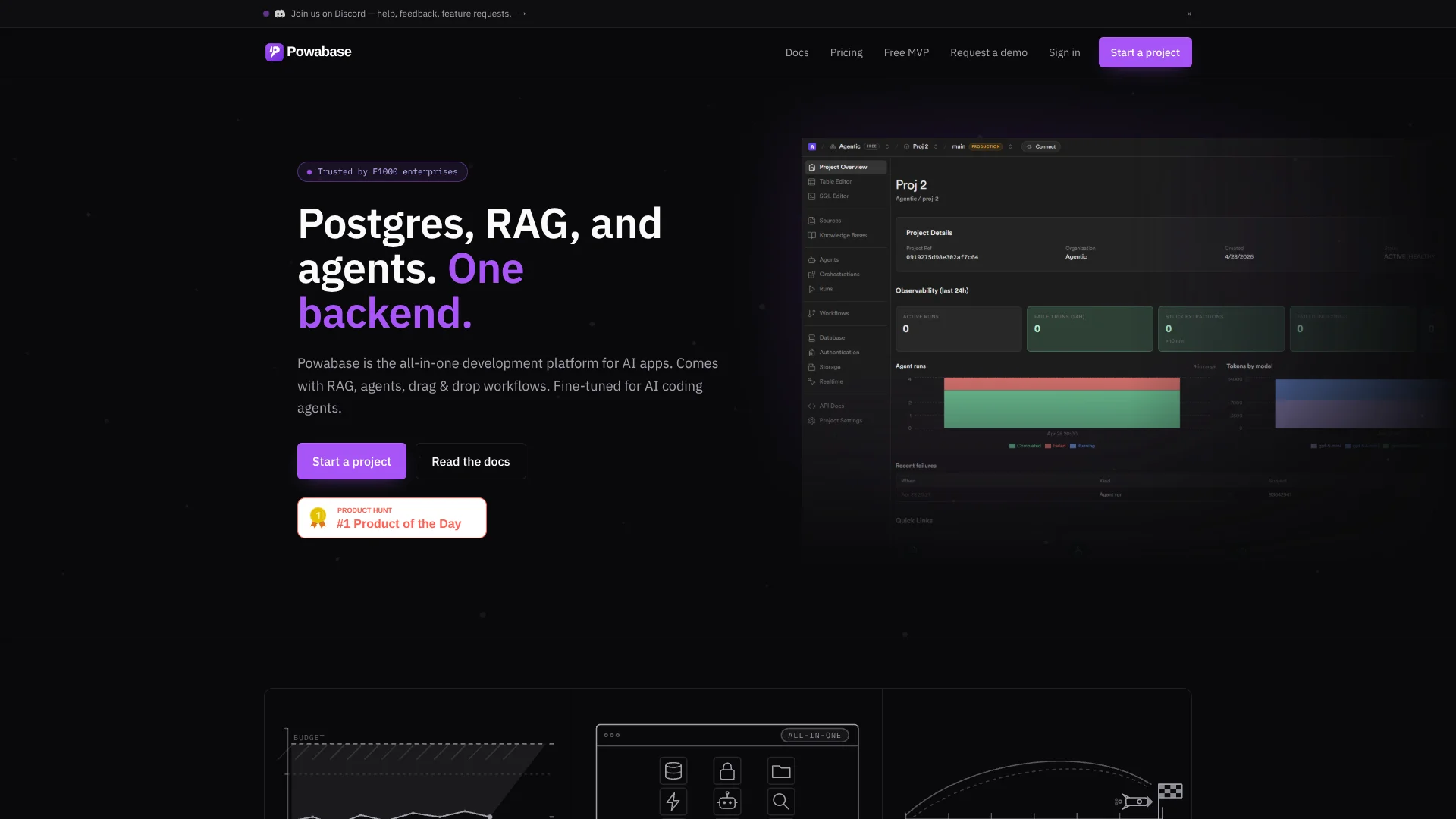
Powabase focuses on giving teams a single backend for AI applications, combining Postgres, retrieval augmented generation (RAG), agents, and visual workflows in one stack. It targets developers building AI products who want managed Postgres with vectors, high quality retrieval pipelines, and an agent runtime without stitching together half a dozen separate services or building infrastructure from scratch.
Powabase stands out by treating Postgres, RAG, agents, and workflows as a single, opinionated backend for AI applications rather than a loose toolkit. The platform leans hard into agentic patterns with first class tools, multi agent orchestration, and detailed streaming telemetry. Its focus on coding agents, through MCP support and API designs that LLMs can understand, is unusual and makes it practical to have an AI assistant help build and maintain the backend itself. Combined with per project dedicated compute and flexible deployment, it sits neatly between classic BaaS products and bespoke enterprise AI stacks.
Powabase provides a tightly integrated, AI first backend that suits teams who care as much about retrieval quality and agent orchestration as they do about tables and indexes. For startups and enterprises that want to move from prototype to production without building a custom RAG and agent infrastructure layer, it offers a fast route to a serious stack, while still keeping options open for teams that need self hosting, strict data controls, or heavy use of coding assistants in their development workflow.
Who is Using Powabase?
AI product startups
Building chat style assistants, copilots, and agentic workflows that need Postgres, vectors, and orchestration in one stack.
Enterprise innovation and data teams
Prototyping and shipping internal assistants over docs, knowledge bases, and analytics data with stronger data residency controls.
Consultancies and agencies
Delivering custom AI automations and vertical assistants for multiple clients without rebuilding infrastructure each time.
Existing SaaS vendors
Adding RAG search, assistants, and workflow automation to established products backed by Postgres.
Uncommon Use Cases
Adopted by legal operations groups to run contract Q&A systems on internal documents, and by knowledge management teams using it as the backbone for searchable institutional archives with conversational access.
Key Features
Rating Breakdown
Pricing Plans
Free
Free
- All platform features, $10 in free credits on sign-up, an additional $25 in credits with a first purchase of $25 or more, Postgres + pgvector, Auth, Storage, Realtime, RAG pipeline with OCR, agents and workflows, retrieval and reranking tools, custom integrations, bring-your-own LLM keys, and pay-as-you-go billing with no monthly minimum
Self Serve
$150 per month
- $150 in monthly credits, up to 25% lower per-call costs than Free, 15% lower compute costs, reduced overage rates, and email support
Scale
$600 per month
- $600 in monthly credits, up to 50% lower per-call costs than Free, 20% lower compute costs, the lowest overage rates, and priority live support
Enterprise
- Managed cloud or private deployment options, free MVP build for select annual commitments, BYO cloud or data center support, regional data residency, air-gapped deployments, SOC 2 and ISO 27001 compliance, SSO, audit logs, RBAC, priority support with SLAs, and a dedicated solutions engineer
Which Powabase plan should you pick?
Start with Free for evaluation and small projects, move to Self Serve for steady workloads, Scale for production throughput, and Enterprise for private hosting and compliance requirements.
Free
Good for developers evaluating Powabase or running small projects that can tolerate inactivity suspension and usage-based billing.
Self Serve
Good for solo developers and small teams needing steady workloads, monthly credits, and lower usage rates.
Scale
Good for teams running production AI workloads at higher throughput with priority live support.
Enterprise
Good for organizations needing private hosting, regional residency, SSO, RBAC, audit logs, SLAs, or dedicated support.
Powabase Use Cases
RAG support chatbot
Ingest product documentation and resolved tickets into a knowledge base, then expose a citation-enabled support agent.
Outcome: A support assistant that can answer questions and hand off low-confidence cases.
Internal knowledge assistant
Index wikis, runbooks, and exported threads, then add watchlists, alerts, realtime feeds, and scheduled digests.
Outcome: A searchable internal assistant with ongoing knowledge updates.
Invoice and receipt automation
Accept PDF and image uploads, extract fields with an agent, validate records, and route uncertain fields for review.
Outcome: Structured accounting data with approval and human-review workflows.
AI help desk
Model tickets and organizations, automatically triage tickets, draft replies, and escalate low-confidence cases.
Outcome: A live support queue with automated classification and response drafting.
News monitoring app
Pull RSS feeds and news APIs on a schedule, deduplicate articles, embed them, and cluster and summarize stories.
Outcome: Watchlists, alerts, realtime feeds, and scheduled news digests.
Workflow Ideas with Powabase
Document-processing pipeline
- 1Receive a customer question through a webhook
- 2Search a knowledge base with a platform API block
- 3Use an agent to draft a grounded response
- 4Check confidence with a condition block
- 5Post the answer externally or escalate to a human
Invoice extraction and review
- 1Upload PDF or image files to storage
- 2Extract vendor, line items, totals, and dates with an agent
- 3Write validated records to Postgres
- 4Route low-confidence fields to human review
Scheduled news monitoring
- 1Fetch RSS feeds and news APIs on a schedule
- 2Deduplicate and embed incoming articles
- 3Cluster, summarize, and tag stories
- 4Deliver a realtime feed or daily email digest
How Powabase fits into your stack
Browser
The Powabase Studio web application provides project management, database, authentication, storage, realtime, agent, and workflow surfaces.
Knowledge and files
Powabase stores uploaded documents and runs extraction, OCR, indexing, retrieval, embeddings, and reranking for RAG applications.
Automation and APIs
Teams use the REST API, webhooks, scheduled triggers, platform API blocks, external HTTP blocks, and deployed workflow endpoints.
Desktop / IDE
Powabase integrates with coding agents and development tools including Claude Code, Codex, Cursor, Replit, Lovable, v0, Base44, and Bolt.
Pros
- +End to end AI backend in one place: Database, retrieval pipeline, agents, and workflows sit in a single product, which shortens MVP timelines for AI apps and automations.
- +Built for cost awareness: Claims of up to 70 percent token savings and 2 to 4 times lower build cost reflect how retrieval, agents, and workflows are tuned to avoid wasteful calls.
- +High quality retrieval stack: Multiple indexing modes, hybrid and vector search, and rerankers tuned on public benchmarks give serious accuracy for knowledge heavy assistants.
- +Strong observability for agents: Streaming SSE responses with detailed logs of retrieval and tool use make debugging prompts and flows more practical than with opaque hosted chat widgets.
- +Per project isolation: Each project runs on dedicated compute with its own Postgres, vector index, storage, and backups, which suits teams that care about noisy neighbors and data separation.
Cons
- −Early access status: The platform is still in early access, so pricing, limits, and some edges of the developer experience may evolve quickly.
- −Best suited for AI centric apps: Simple CRUD products that do not lean on RAG, agents, or workflows might find the platform heavier than necessary.
- −Self hosting complexity: Running the full stack in a private cloud or on premises introduces Kubernetes, networking, and security work that smaller teams may not want to own.
Limitations & when to consider alternatives
Known limitations
- Inactive free projects are suspended. Free-plan projects suspend after seven days of inactivity and are deleted after 30 days.
- Self-hosting is single-project. The free self-hosted edition runs the full single-project stack rather than a multi-project control plane.
- Usage-based charges apply. Compute, storage, requests, extraction, indexing, workflow, and agent actions can incur usage charges.
- MCP support is not yet available. The integrations page states that MCP support is coming soon.
Look elsewhere when
- You need a native mobile app.
- You need a browser extension.
- You need model fine-tuning.
- You need built-in MCP integrations today.
How to Use Powabase
- 1
Create a project
Start a Powabase Cloud project or self-host the open-source stack, then configure the project API keys.
- 2
Authenticate requests
Use the project URL, apikey header, and Bearer authorization header; keep the service-role key server-side.
- 3
Upload sources
Upload PDFs, images, Word files, spreadsheets, or URLs so Powabase extracts content for indexing.
- 4
Create a knowledge base
Choose an indexing strategy such as ChunkEmbed, PageIndex, GraphIndex, or Doc2JSON.
- 5
Configure an agent
Attach knowledge bases and tools to an agent, then run it through the REST API or streaming endpoint.
- 6
Deploy a workflow
Connect triggers, agents, conditions, HTTP calls, and code blocks, then deploy the workflow as an HTTP endpoint.
Who is Powabase For?
Developers
They can build AI-native applications using REST APIs, Postgres, RAG, agents, and workflows.
Engineering teams
They can deploy production AI applications with isolated infrastructure, authentication, storage, and realtime services.
Businesses
Businesses can operate customer-facing or internal applications using managed cloud or private deployments.
Solo developers
The Self Serve plan targets solo developers and small teams running steady workloads.
Enterprise teams
Enterprise customers receive private hosting, regional residency, SSO, RBAC, audit logs, and support SLAs.
Frequently Asked Questions
What is Powabase?
Powabase is an AI Backend-as-a-Service combining Postgres, RAG, agents, authentication, storage, realtime, and workflow automation.
What file formats can Powabase process?
Powabase processes PDFs, Word files, images, spreadsheets, and URLs, extracting content for indexing.
How does Powabase handle RAG and document retrieval?
It extracts documents, supports multiple indexing strategies, and provides vector, BM25, hybrid, tree retrieval, and reranking.
What are Powabase agents?
Agents use ReAct orchestration with LLMs, knowledge bases, sessions, built-in tools, custom HTTP tools, and MCP servers.
How is Powabase priced?
Powabase offers a free tier, usage-based billing, paid monthly credit plans, and custom Enterprise pricing.
Can I self-host Powabase?
Yes. The full single-project stack is available under Apache-2.0 and can run with one Docker Compose command.
Community reviews
Be the first to share your experience.
Sign in to leave a review for Powabase.
Powabase Alternatives
Looking for alternatives to Powabase? Here are similar tools in the same category:
Learn to Master Powabase
With Skill Leap courses
Get in-depth training on Powabase and 50+ other AI tools with our expert-led video courses.
Start 7-Day Free Trial