Quanthealth
Simulate clinical trials before pharmaceutical teams commit patients or capital.
Key Takeaways
- What it is
- Simulate clinical trials before pharmaceutical teams commit patients or capital.
- Best for
- Protocol Optimization
- Outcome Predictions
- Enrollment Prediction
- Rating
- 4.0/5
What is Quanthealth?
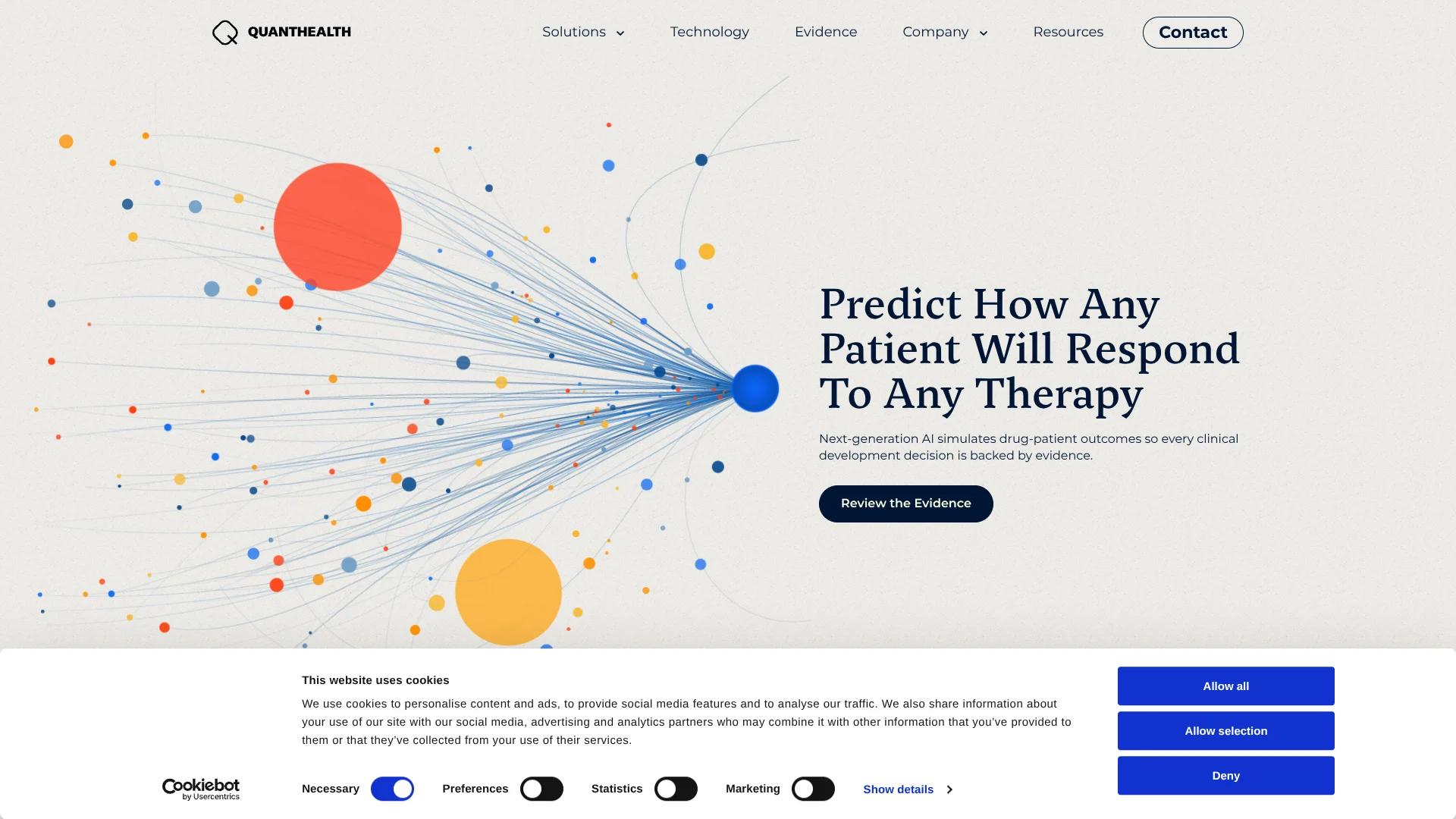
QuantHealth simulates how different patient groups may respond to a therapy before a clinical trial begins. Its platform helps pharmaceutical, biotechnology, and life sciences teams test trial designs, compare treatment scenarios, estimate enrollment, and assess commercial potential using clinical, biomedical, and epidemiological data.
QuantHealth predicts clinical trial and commercial outcomes before results exist, including for competing therapies and assets with limited sponsor data. Its simulations can connect protocol choices, patient subgroups, enrollment feasibility, probability of technical success, and market forecasts in a single development view.
QuantHealth is presented as an enterprise clinical simulation platform; the official site directs prospective customers to book a meeting and does not publish pricing or plan limits.
Who is Using Quanthealth?
Clinical Development Leaders
Protocol design and indication decisions become testable before a trial begins.
Clinical Trial Designers
Detailed changes to arms, comparators, endpoints, eligibility criteria, and analysis methods can be evaluated through simulation.
Competitive Intelligence Analysts
Competitive programs can be assessed by likely efficacy, safety, patient populations, and trial outcomes.
Business Development Professionals
Asset search, diligence, valuation, licensing, and disposition decisions gain predicted clinical and commercial context.
Portfolio Strategy Leaders
Portfolio gaps, asset overlap, synergies, and prioritization can be examined across disease areas and lines of therapy.
Uncommon Use Cases
Stress-testing a first-in-class therapy with no asset-specific clinical history; comparing how patient subgroups may change competitive positioning
Key Features
Rating Breakdown
Pricing Plans
Enterprise Custom Solutions
- Tailored pricing based on the specific needs and scale of the organization
Which Quanthealth plan should you pick?
Start with Enterprise Custom Solutions if your organization needs clinical simulation across development, business development, competitive intelligence, or portfolio decisions.
Enterprise Custom Solutions
Good for pharmaceutical, biotechnology, and life sciences organizations that need tailored simulation work for high-stakes development and portfolio decisions.
Quanthealth Use Cases
Clinical Trial Protocol Design
Trial teams compare eligibility rules, treatment arms, doses, controls, endpoints, and analysis methods before locking the protocol.
Outcome: A protocol design supported by predicted clinical, operational, and commercial tradeoffs.
Enrollment Planning
Recruitment planning combines cohort definitions with site-level information and protocol burden.
Outcome: Expected enrollment curves for comparing recruitment scenarios.
Indication Selection
Development teams compare expected drug efficacy and safety across potential medical conditions.
Outcome: A more focused view of which indications may offer stronger development potential.
Asset Diligence
Business development teams evaluate potential assets against competing therapies and future market conditions.
Outcome: Evidence for licensing, valuation, disposition, and go or no-go decisions.
Portfolio Prioritization
Portfolio leaders compare planned and ongoing studies using technical success, budget, commercial forecasts, and net present value.
Outcome: A ranked view of where resources may have the greatest strategic impact.
Workflow Ideas with Quanthealth
Pretrial Protocol Review
- 1Define the investigational arm, comparator, cohort, endpoints, and eligibility criteria.
- 2Run virtual trial scenarios across the major protocol choices.
- 3Compare predicted outcomes, feasibility, enrollment, and commercial impact before finalizing the design.
Asset Evaluation
- 1Select an investigational or marketed therapy and its target indication.
- 2Compare predicted performance against relevant competing therapies and patient subgroups.
- 3Use the results to support diligence, valuation, licensing, or disposition decisions.
Portfolio Prioritization
- 1Place planned and ongoing studies side by side.
- 2Review budget, probability of technical success, commercial forecast, and net present value.
- 3Identify priority assets, overlaps, gaps, and potential combinations.
How Quanthealth fits into your stack
Clinical Development
QuantHealth sits before trial execution, helping teams test protocol choices and assess likely outcomes before patient enrollment.
Competitive Intelligence
The platform adds predicted clinical performance to traditional competitive research, including comparisons where sponsor data is unavailable.
Business Development
Licensing and asset evaluation teams can use predicted outcomes, patient segments, and market views to support diligence and valuation.
Portfolio Strategy
Portfolio leaders can compare programs using technical success, financial, commercial, and overlap measures.
Evidence Review
QuantHealth's evidence section provides examples of prospective validation and simulated versus actual trial results for selected studies.
Pros
- +Pretrial predictions: Helps teams test development choices before patient enrollment and capital deployment.
- +Broad decision coverage: Connects protocol design, enrollment, market forecasts, and portfolio strategy.
- +Prospective validation: The company reports predictions made before trial readouts, including up to 90% accuracy on primary endpoints.
- +Competitive insight: Evaluates likely performance of competing therapies without requiring sponsor data.
Cons
- −Enterprise buying process: The public site directs visitors to book a meeting rather than start with a self-serve plan.
- −Specialized audience: Its value is concentrated in pharmaceutical, biotechnology, and life sciences development work.
- −Limited public detail: The website does not publish consumer pricing, plan limits, or a public developer API.
Limitations & when to consider alternatives
Known limitations
- No Public Self-Serve Pricing. The public website does not show subscription prices, plan limits, or a free trial, and directs prospective customers to book a meeting.
- Prediction Accuracy Is Not Universal. QuantHealth reports up to 90% endpoint prediction accuracy, while its evidence materials also describe 85% accuracy for prospective primary-endpoint prediction, so results vary by evaluation and use case.
Look elsewhere when
- You need a general-purpose AI tool for writing, coding, or everyday research.
- Your team needs a public API or self-serve subscription with published usage limits.
- You need a consumer health app for personal treatment guidance.
How to Use Quanthealth
- 1
Book a Meeting
Start through QuantHealth's commercial contact path because the public site does not offer self-serve access or published plan limits.
- 2
Choose the Decision Area
Clarify whether the project centers on protocol optimization, indication selection, enrollment, market forecasting, competitive positioning, or portfolio management.
- 3
Define the Scenario
Set the relevant therapy, patient cohort, treatment arms, comparator, endpoints, eligibility criteria, and other study parameters.
- 4
Run Simulations
Compare virtual trial or market scenarios to see how different choices may affect efficacy, safety, enrollment, cost, and commercial potential.
- 5
Review Validation and Tradeoffs
Examine the predicted results alongside QuantHealth's evidence and validation materials before using them in development planning.
- 6
Apply the Findings
Use the scenario comparisons to guide protocol decisions, asset prioritization, business development, or portfolio strategy.
Who is Quanthealth For?
Pharmaceutical Companies
Drug development and strategy teams can evaluate trial designs, indications, competitors, and market opportunities before major commitments.
Biotechnology Companies
Biotech teams can quantify development scenarios when clinical evidence is limited and each investment decision carries high risk.
Clinical Development Teams
Clinical teams can compare protocol parameters, predict outcomes, and improve enrollment planning.
Business Development Teams
Licensing and evaluation teams can compare assets, assess likely value, and prioritize opportunities.
Portfolio Management Teams
Portfolio leaders can compare studies and assets using technical success, commercial forecasts, budget, and net present value.
Frequently Asked Questions
What does QuantHealth predict?
It predicts clinical trial and patient-subpopulation outcomes for therapies in development and on the market. It also supports enrollment prediction, market forecasting, and competitive positioning.
Who is QuantHealth for?
The platform is aimed at pharmaceutical, biotechnology, and life sciences teams working in clinical development, competitive intelligence, business development, commercial strategy, and portfolio management.
Does QuantHealth offer a free plan?
The public site does not show a free plan, free trial, or self-serve subscription.
How does QuantHealth validate its predictions?
QuantHealth presents retrospective, blind extrapolation, and prospective validation approaches, including comparisons between simulated and actual results for selected clinical trials.
Does QuantHealth require sponsor data?
Its competitive positioning materials state that competing assets can be evaluated without sponsor data. The exact data requirements may vary by project.
How do you buy QuantHealth?
The public website directs interested organizations to book a meeting with the QuantHealth team.
Community reviews
Be the first to share your experience.
Sign in to leave a review for Quanthealth.
Quanthealth Alternatives
Looking for alternatives to Quanthealth? Here are similar tools in the same category: