Rebellions.ai
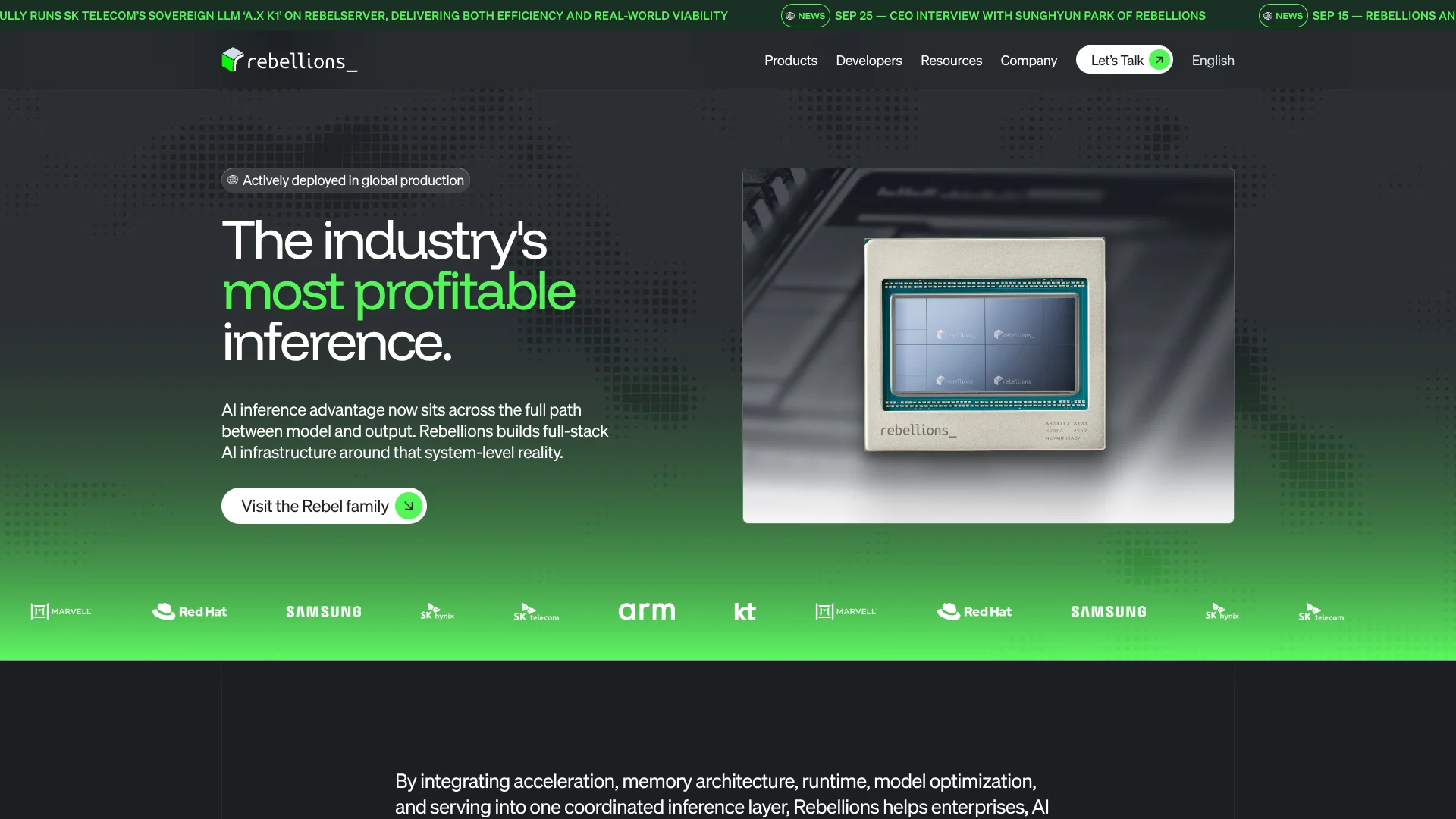
AI accelerator chips built to run trained models in data centers.
Key Takeaways
- What it is
- AI accelerator chips built to run trained models in data centers.
- Best for
- RBLN SDK
- Model Zoo
- Serving software support
- Rating
- 4.2/5
What is Rebellions.ai?
Rebellions builds AI accelerator cards, servers, racks, and software for running trained AI models in production. Its RBLN SDK compiles models for Rebellions processors and supports PyTorch, TensorFlow, and Hugging Face models. The company serves organizations that need to operate AI inference at data center scale, including enterprises, AI service providers, and national AI programs.
The same software stack can run from a single RebelCard to a RebelServer, RebelRack, or RebelPOD, so teams can scale their Rebellions hardware deployment without changing that stack.
Rebellions is best suited to organizations with AI models to serve and the technical staff and data center capacity to deploy specialized hardware. Its SDK is designed for inference, not model training, and currently supports Linux rather than Windows, so it is not a fit for teams looking for a general-purpose AI app.
Who is Using Rebellions.ai?
Machine learning engineers
Model compatibility and compiler tools help prepare supported models for inference on Rebellions hardware.
Inference platform engineers
Serving integrations let platform teams deploy models with vLLM, NVIDIA Triton Inference Server, or TorchServe.
Kubernetes administrators
Device plugins and node discovery help administrators make Rebellions NPUs available to cluster workloads.
AI infrastructure architects
RebelServer, RebelRack, and RebelPOD offer deployment options from a server to data center-scale systems.
Uncommon Use Cases
Speech and vision inference on supported models; monitoring NPU power and utilization through Prometheus and Grafana.
Key Features
Rating Breakdown
Pricing Plans
Custom Pricing Solutions
- Given the specialized nature of the products
- Rebellions.ai offers tailored pricing based on the specific needs and scale of the project
Which Rebellions.ai plan should you pick?
Contact Rebellions sales to discuss hardware and deployment needs because public plan prices are not listed.
Custom Pricing Solutions
Organizations planning a Rebellions hardware deployment should contact sales to discuss the systems and scale they need.
Rebellions.ai Use Cases
Serve large language models
Production teams can compile supported language models and serve them with vLLM on Rebellions NPUs.
Outcome: Run model inference on Rebellions hardware.
Deploy existing AI models
Teams working in PyTorch, TensorFlow, or Hugging Face can prepare supported models for Rebellions hardware.
Outcome: Run supported models without changing to a different model development framework.
Operate inference on Kubernetes
Cluster operators can discover Rebellions NPU nodes and schedule inference workloads through Kubernetes tools.
Outcome: Make Rebellions NPU resources available to cluster workloads.
Scale data center inference
Organizations can move from a server deployment to integrated racks or RebelPOD infrastructure.
Outcome: Deploy AI inference at larger infrastructure scale.
Inspect model performance
Engineers can profile latency, throughput, and memory use while testing model deployments.
Outcome: Identify performance bottlenecks and compare model runs.
Workflow Ideas with Rebellions.ai
Prepare and serve a model
- 1Choose a supported PyTorch, TensorFlow, or Hugging Face model.
- 2Compile it with the RBLN SDK for a Rebellions NPU.
- 3Serve the compiled model with a supported serving tool.
Bring NPUs into a Kubernetes cluster
- 1Install the Rebellions Kubernetes device tools in the cluster.
- 2Discover and label nodes with Rebellions NPUs.
- 3Schedule inference workloads and monitor device metrics.
Evaluate inference performance
- 1Run a supported model on Rebellions hardware.
- 2Measure latency, throughput, and memory use with the SDK Profiler.
- 3Adjust model or serving settings and compare results.
How Rebellions.ai fits into your stack
Model development
The SDK supports models built with PyTorch, TensorFlow, and Hugging Face tools. Supported models can be compiled for Rebellions NPUs.
Model serving
vLLM, NVIDIA Triton Inference Server, and TorchServe can serve models on Rebellions hardware.
Cluster operations
Kubernetes device plugins and node discovery connect Rebellions NPUs to cluster scheduling.
Monitoring
The Metrics Exporter makes NPU metrics available to Prometheus and Grafana.
Data center infrastructure
RebelServer, RebelRack, and RebelPOD provide deployment choices from server systems to larger integrated installations.
Pros
- +Familiar model tools: Supports PyTorch, TensorFlow, and Hugging Face models.
- +Multiple serving options: Compatible with vLLM, NVIDIA Triton Inference Server, and TorchServe.
- +Scale across Rebellions hardware: The software stack spans a single accelerator through rack- and data center-scale systems.
- +Deployment monitoring: SDK profiling and Kubernetes metrics help teams examine device use and model performance.
Cons
- −Specialized hardware required: The SDK runs models on Rebellions NPUs, so it is not a general-purpose cloud AI service.
- −Inference focus: The SDK is designed to run models, not train them.
- −Linux only: Developers using Windows cannot run the SDK in a supported Windows environment.
Limitations & when to consider alternatives
Known limitations
- Inference-only SDK. The developer FAQ says the current SDK is designed for inference and does not support model training.
- Linux support. The developer FAQ says the SDK currently supports Linux, not Windows.
- Hardware dependency. The SDK compiles models for Rebellions NPUs, so running it requires access to supported Rebellions hardware.
Look elsewhere when
- You need to train models with the same hardware and SDK.
- You need an AI service that runs without Rebellions hardware.
- Your development environment depends on Windows.
How to Use Rebellions.ai
- 1
Check model and hardware support
Review the supported models and compatibility information before choosing an NPU deployment.
- 2
Get SDK access
Request RBLN SDK and portal access through Rebellions before setting up a development environment.
- 3
Set up a supported Linux environment
The SDK currently supports Linux, and the driver requires a compatible kernel.
- 4
Compile a model
Use the RBLN Compiler to prepare a supported model for execution on Rebellions hardware.
- 5
Choose a serving path
Deploy through a supported option such as vLLM, NVIDIA Triton Inference Server, or TorchServe.
- 6
Measure and tune
Use the SDK Profiler to review latency, throughput, and memory use during testing.
Who is Rebellions.ai For?
Enterprises
Organizations running production AI services can deploy Rebellions inference hardware in their own data centers.
AI service providers
Providers serving models at scale can use the software stack with Rebellions servers and racks.
National AI programs
Programs seeking locally controlled AI infrastructure can evaluate on-premises Rebellions systems.
AI infrastructure teams
Teams operating Kubernetes environments can manage Rebellions NPU resources alongside cluster workloads.
Frequently Asked Questions
Can I train models with the RBLN SDK?
No. Rebellions says the current SDK is designed for inference.
Which model tools does the SDK support?
The SDK supports PyTorch and TensorFlow models and is compatible with Hugging Face Transformers and Diffusers.
Does the SDK work on Windows?
No. Rebellions says the SDK currently supports Linux.
Which serving tools are compatible?
Rebellions lists vLLM, NVIDIA Triton Inference Server, and TorchServe.
How much does Rebellions hardware cost?
Rebellions product pages direct buyers to contact sales; they do not show public prices.
Community reviews
Be the first to share your experience.
Sign in to leave a review for Rebellions.ai.
Rebellions.ai Alternatives
Looking for alternatives to Rebellions.ai? Here are similar tools in the same category: