Responsiv
Streamlines legal research and documentation with AI precision.
Key Takeaways
- What it is
- Streamlines legal research and documentation with AI precision.
- Pricing
- Freemium
- Best for
- Advanced Legal Research
- Natural Language Processing (NLP)
- Survey Builder
- Rating
- 4.6/5
What is Responsiv?
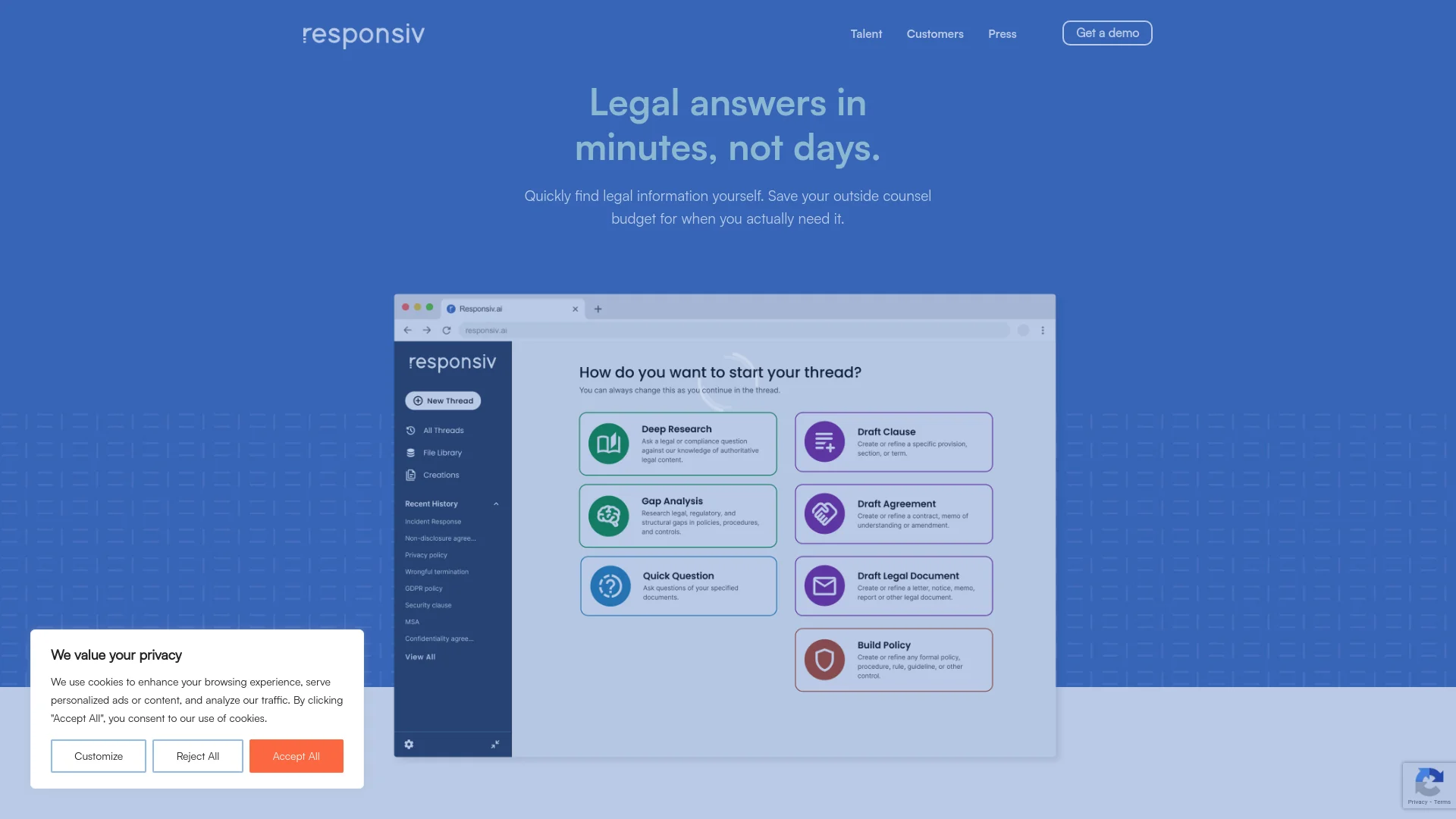
Responsiv revolutionizes the way in-house legal and compliance teams operate by offering a robust AI-driven platform designed to streamline legal research and documentation processes. Specifically tailored for legal professionals, Responsiv simplifies the task of obtaining accurate and actionable legal information, enabling teams to focus on more complex, high-stakes matters. By leveraging advanced natural language processing (NLP) algorithms, Responsiv provides precise legal answers, generates draft clauses, templates, and policies, and significantly reduces the need for external counsel, thereby saving both time and budget.
Responsiv stands out with its ability to deliver precise, reference-backed legal answers using advanced AI and NLP technologies. Its capability to generate tailored policies, clauses, and templates directly from the research conducted sets it apart, making it an invaluable tool for legal professionals. The comprehensive survey builder and policy builder features further enhance its utility, allowing for customized, multi-jurisdictional legal analysis.
Responsiv excels in providing legal professionals with accurate, actionable legal information, making it an essential tool for in-house legal and compliance teams. Its unique features, such as the survey builder and policy builder, offer unmatched advantages in creating tailored legal documents and conducting multi-jurisdictional analysis. With its focus on reducing external counsel costs and enhancing efficiency, Responsiv is a game-changer in the legal tech landscape.
Who is Using Responsiv?
In-House Legal Teams
Utilizing Responsiv for efficient legal research and documentation.
Compliance Officers
Employing the platform to ensure regulatory adherence and create compliance policies.
Corporate Legal Departments
Leveraging Responsiv to streamline legal processes and reduce dependency on external counsel.
Law Firms
Using the tool to support junior lawyers and paralegals in research tasks.
Uncommon Use Cases
Adopted by academic institutions for legal research training; used by freelance legal consultants to enhance service offerings.
Key Features
Rating Breakdown
Pricing Plans
Free Tier
Free
- Experience Responsiv with a 14-day free trial
Responsiv Use Cases
Regulatory change monitoring
Monitor regulatory sources and route relevant alerts to the right people by business unit, topic, or jurisdiction.
Outcome: Teams see important changes and ownership requirements sooner.
Obligation register management
Maintain a living inventory of applicable requirements mapped to policies, controls, and accountable owners.
Outcome: Organizations retain a current, structured view of their compliance obligations.
Policy scanning
Upload policies and procedures so Responsiv can identify the rules and obligations driving each document.
Outcome: Teams discover covered and uncovered obligations at the policy level.
Compliance gap analysis
Compare regulatory requirements with existing policies and controls to identify missing coverage.
Outcome: Compliance gaps are surfaced before an examination or audit.
Remediation tracking
Assign tasks, prioritize actions, monitor progress, and keep a complete record of compliance decisions.
Outcome: Organizations can coordinate remediation and demonstrate how issues were addressed.
Workflow Ideas with Responsiv
Build a living regulatory register
- 1Define the organization, business units, products, licenses, and jurisdictions.
- 2Upload policies, procedures, and written supervisory procedures.
- 3Review suggested obligations and map them to policies, controls, and owners.
Turn a regulatory change into remediation
- 1Monitor regulatory sources and route relevant alerts.
- 2Break the change into actionable requirements and assess policy coverage.
- 3Assign remediation work and track completion through the audit trail.
Prepare for an examination
- 1Run a gap analysis against the applicable obligations.
- 2Share requirements and gaps with policy owners and business stakeholders.
- 3Maintain timestamped records showing decisions, actions, and remediation status.
How Responsiv fits into your stack
Browser
Responsiv is presented as a web platform for monitoring regulatory sources, analyzing requirements, identifying gaps, and tracking remediation.
Knowledge and files
Teams upload policies, procedures, and written supervisory procedures so Responsiv can map obligations to existing policies and controls.
Pros
- +Time Efficiency: Significantly reduces the time required to find and verify legal information.
- +Cost-Effective: Helps in-house teams save on external counsel costs by providing foundational legal information.
- +Trustworthy Sources: Answers are backed by citations from reliable sources, ensuring accuracy and credibility.
- +Comprehensive Coverage: Draws from a vast array of legal documents and opinions, covering all 50 states.
Cons
- −Initial Learning Curve: Requires some time for users to familiarize themselves with the advanced features.
- −Limited to Legal Sector: Primarily designed for legal and compliance teams, limiting its applicability to other sectors.
Limitations & when to consider alternatives
Known limitations
- Outputs require professional review. Responsiv states that AI output can be inaccurate and should be evaluated by a knowledgeable attorney or expert.
- Not legal advice. The service is informational and does not replace professional legal advice or consultation.
- No guaranteed security. Responsiv says it cannot guarantee absolute security for electronically stored or transmitted data.
- Programmatic extraction is restricted. The terms prohibit automated or programmatic extraction of service data or output.
Look elsewhere when
- You need a public developer API.
- You need a native mobile application.
- You need documented SSO or SAML support.
- You need code-generation or software-development features.
How to Use Responsiv
- 1
Define your organization
Set up your business units, products, licenses, jurisdictions, and regulatory topics so Responsiv can determine which rules apply.
- 2
Upload your compliance documents
Add policies, procedures, and written supervisory procedures to provide context for obligation and gap analysis.
- 3
Review suggested obligations
Validate Responsiv's suggested obligations, confirm applicability, and map each item to policies, controls, and owners.
- 4
Monitor regulatory changes
Use alerts and the regulatory source coverage to identify changes relevant to your organization.
- 5
Run gap analysis
Compare requirements with existing policies and controls to locate missing or insufficient coverage.
- 6
Assign and track remediation
Assign actions to team members, monitor progress, and preserve the resulting audit trail.
Who is Responsiv For?
Financial services organizations
Banks, broker-dealers, capital-markets firms, and asset managers can monitor regulations, map obligations, and manage remediation.
Health insurers and P&C carriers
Insurers can track state DOI, CMS, HIPAA, privacy, product, claims, and licensing requirements.
Consumer technology companies
Consumer platforms can monitor online safety, content moderation, subscriptions, privacy, AI, and transparency obligations.
Compliance teams
Compliance professionals can maintain obligation registers, identify gaps, assign work, and preserve audit trails.
Legal and regulatory professionals
Legal and regulatory teams can ask sourced regulatory questions and connect rules to policies, controls, and owners.
Frequently Asked Questions
What does Responsiv do?
Responsiv monitors regulatory sources, identifies relevant changes, maps requirements to policies and controls, and tracks remediation.
What regulatory coverage does Responsiv provide?
The platform covers thousands of sources across more than 50 jurisdictions, including the United States, Europe, Asia, and the Middle East.
Can Responsiv analyze existing policies?
Yes. Users can upload policies, procedures, and written supervisory procedures for policy scanning and obligation mapping.
Does Responsiv support gap analysis?
Yes. Responsiv identifies obligations without corresponding policies or controls and surfaces the resulting compliance gaps.
Does Responsiv provide legal advice?
No. Its terms state that the service is informational and does not constitute legal advice or create an attorney-client relationship.
How does Responsiv handle customer data?
Responsiv says customer data remains yours and that it does not use customer data to train its AI.
Community reviews
Be the first to share your experience.
Sign in to leave a review for Responsiv.
Responsiv Alternatives
Looking for alternatives to Responsiv? Here are similar tools in the same category: