
RunSybil
Revolutionize cybersecurity: AI-driven, rapid, accurate pentesting tool.
Key Takeaways
- What it is
- Revolutionize cybersecurity: AI-driven, rapid, accurate pentesting tool.
- Pricing
- Freemium · $99 per month
- Best for
- AI-driven Pentesting
- Rapid Onboarding
- Attack Replay
- Rating
- 4.6/5
What is RunSybil?
RunSybil is an advanced AI-driven pentesting tool designed to transform the cybersecurity landscape by automating hacker intuition. It helps organizations of all sizes identify and address vulnerabilities swiftly and accurately. By reducing the time and cost associated with vulnerability discovery, RunSybil offers a proactive approach to protecting digital assets from potential threats.
RunSybil stands out by integrating AI-driven technology with pentesting, offering a forward-looking approach to cybersecurity. Its ability to simulate and adapt to real-world cyber-attacks sets it apart, making it an essential tool for proactive security management.
RunSybil excels in providing advanced, AI-driven pentesting solutions, making it a crucial tool for enhancing cybersecurity measures. Its unique ability to simulate and adapt to real-world attacks delivers exceptional value, positioning RunSybil as a leader in the future of offensive security.
Who is Using RunSybil?
Tech Startups
Ensuring their innovations meet security standards from the outset.
Financial Institutions
Protecting sensitive financial data against sophisticated cyber threats.
Healthcare Providers
Securing patient information and adhering to regulatory requirements.
Educational Institutions
Defending academic data and supporting cybersecurity education.
Uncommon Use Cases
Non-profits securing donor information; small e-commerce platforms deploying rapid security assessments.
Key Features
Rating Breakdown
Pricing Plans
Free Tier
Free
- Provides limited access to RunSybil’s features at no cost
Pro Tier
$99 per month
RunSybil Use Cases
High-risk application security testing
Test critical systems handling customer data, transactions, and access for chained vulnerabilities.
Outcome: Validated exploitable findings before attackers discover them.
Continuous attack surface monitoring
Re-evaluate applications and infrastructure after deployments and focus testing on what changed.
Outcome: Current visibility into newly exploitable risks.
Multi-tenant and business-logic testing
Test cross-tenant access, privilege escalation, transaction manipulation, and broken authorization.
Outcome: Detection of logic and authorization flaws that scanners may miss.
Bug bounty and pentesting replacement
Use continuous coverage with pre-validated findings instead of point-in-time pentests or unpredictable bounty queues.
Outcome: More predictable security testing and reduced triage burden.
Cloud and infrastructure security validation
Test IAM misconfigurations, container escapes, CI/CD secret exposure, and lateral movement paths across layers.
Outcome: Visibility into attack chains connecting application and infrastructure weaknesses.
Workflow Ideas with RunSybil
Continuous pull-request testing
- 1Connect Sybil to the application and repository workflow
- 2Trigger testing from a pull request
- 3Review validated findings and remediation guidance
Authenticated application assessment
- 1Provide credentials or configure unauthenticated testing
- 2Let Sybil map authenticated and unauthenticated attack surfaces
- 3Review reproduced exploit chains and affected components
Fix and retest
- 1Review the finding and AI-generated remediation recommendation
- 2Apply the fix through the existing engineering workflow
- 3Trigger a retest to verify the original attack no longer succeeds
How RunSybil fits into your stack
Popular Security Tools
Works seamlessly with leading security platforms.
Cloud Services
Integrates with major cloud providers for secure cloud operations.
Custom API Access
Offers API integrations for customized security solutions.
Continuous Integration Systems
Integrates with CI/CD pipelines to embed security throughout the software development process.
Pros
- +Efficiency in Detection: Reduces the time required to find and fix vulnerabilities.
- +Cost-Effective: Lowers the financial burden of security testing through automation.
- +Enhanced Security Posture: Offers continuous and thorough security assessments to prevent breaches.
- +User-Friendly Interface: Features an intuitive dashboard for easy interpretation and management of pentest results.
Cons
- −Learning Curve: New users might need time to fully understand the tool's capabilities.
- −Integration Limitations: May have compatibility issues with less common platforms.
- −Resource Intensity: High-level functionalities may require substantial computational resources.
Limitations & when to consider alternatives
Known limitations
- Source-code access is optional but white-box testing is opt-in. Black-box testing works without source code, while white-box coverage requires sharing source code.
- Engagement duration varies by application complexity. Smaller applications may finish the same day, while large and complex applications can take up to 24 hours.
- Coverage focuses on web and API attack surfaces. The documented core scope covers web and API functionality, authentication, authorization, business logic, injection, and related attack paths.
- Retesting depends on an existing finding or fix workflow. Retests are described as rerunning the original attack after remediation rather than as a general-purpose software testing system.
Look elsewhere when
- You need a native mobile application.
- You need a browser extension.
- You need a desktop installer.
How to Use RunSybil
- 1
Find a range of tutorials on RunSybil’s official YouTube channel, covering everything from basic setup to advanced usage.
Who is RunSybil For?
Security teams
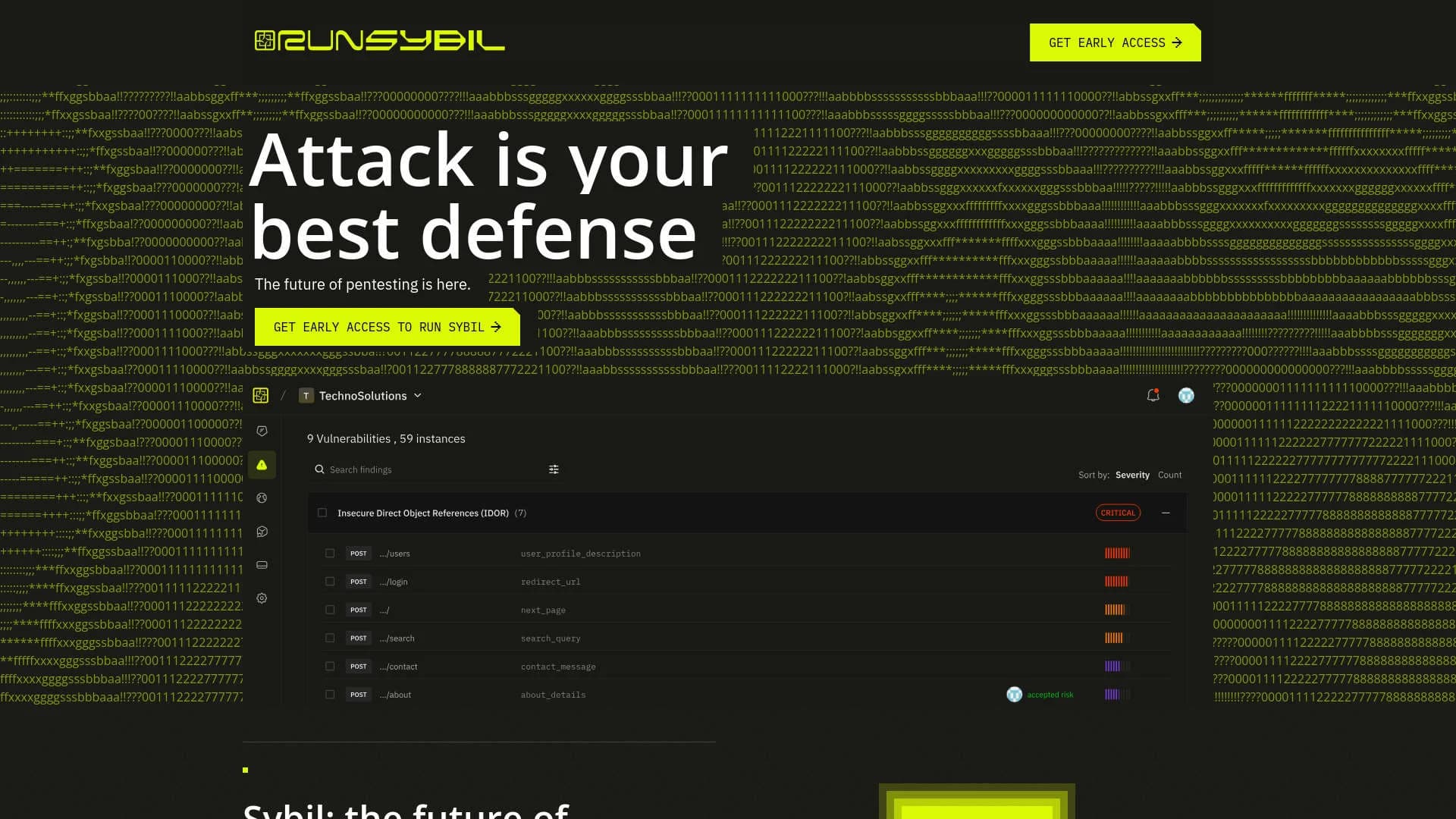
Sybil provides continuous offensive security testing, validated findings, coverage maps, and remediation tracking.
Developers
Security feedback can arrive on pull requests, with remediation guidance and retesting tied to fixes.
Enterprise security organizations
The platform covers applications, APIs, cloud, infrastructure, and continuous testing workflows.
Organizations replacing periodic pentests
Sybil supports continuous coverage instead of relying only on annual pentests or bug bounty queues.
Frequently Asked Questions
What does Sybil test?
Sybil tests web and API attack surfaces, including authenticated functionality, access control, business logic, injection, multi-tenant isolation, and novel bugs.
Do I need to share source code to get started?
No. Sybil runs black-box by default. Credentials and source code are optional; source code adds white-box coverage and code-level remediation.
How does Sybil avoid false positives?
Findings pass critique, reproducibility, false-positive triage, and duplicate-detection stages before being surfaced.
How long does an engagement take?
Smaller applications can complete the same day; large, complex applications can take up to 24 hours. Retests complete in under an hour.
Will auditors accept Sybil's findings for SOC 2 or ISO 27001?
RunSybil says customers have satisfied SOC 2 Type II and ISO 27001 audits using Sybil output with CVSS and CWE information.
Community reviews
Be the first to share your experience.
Sign in to leave a review for RunSybil.
RunSybil Alternatives
Looking for alternatives to RunSybil? Here are similar tools in the same category:
Learn to Master RunSybil
With Skill Leap courses
Get in-depth training on RunSybil and 50+ other AI tools with our expert-led video courses.
Start 7-Day Free Trial