
Scite
Transform research with AI-driven Smart Citations and deep insights.
Watch Scite in Action
Key Takeaways
- What it is
- Transform research with AI-driven Smart Citations and deep insights.
- Best for
- Smart Citations
- Deep Learning Model
- Custom Dashboards
- Rating
- 4.6/5
What is Scite?
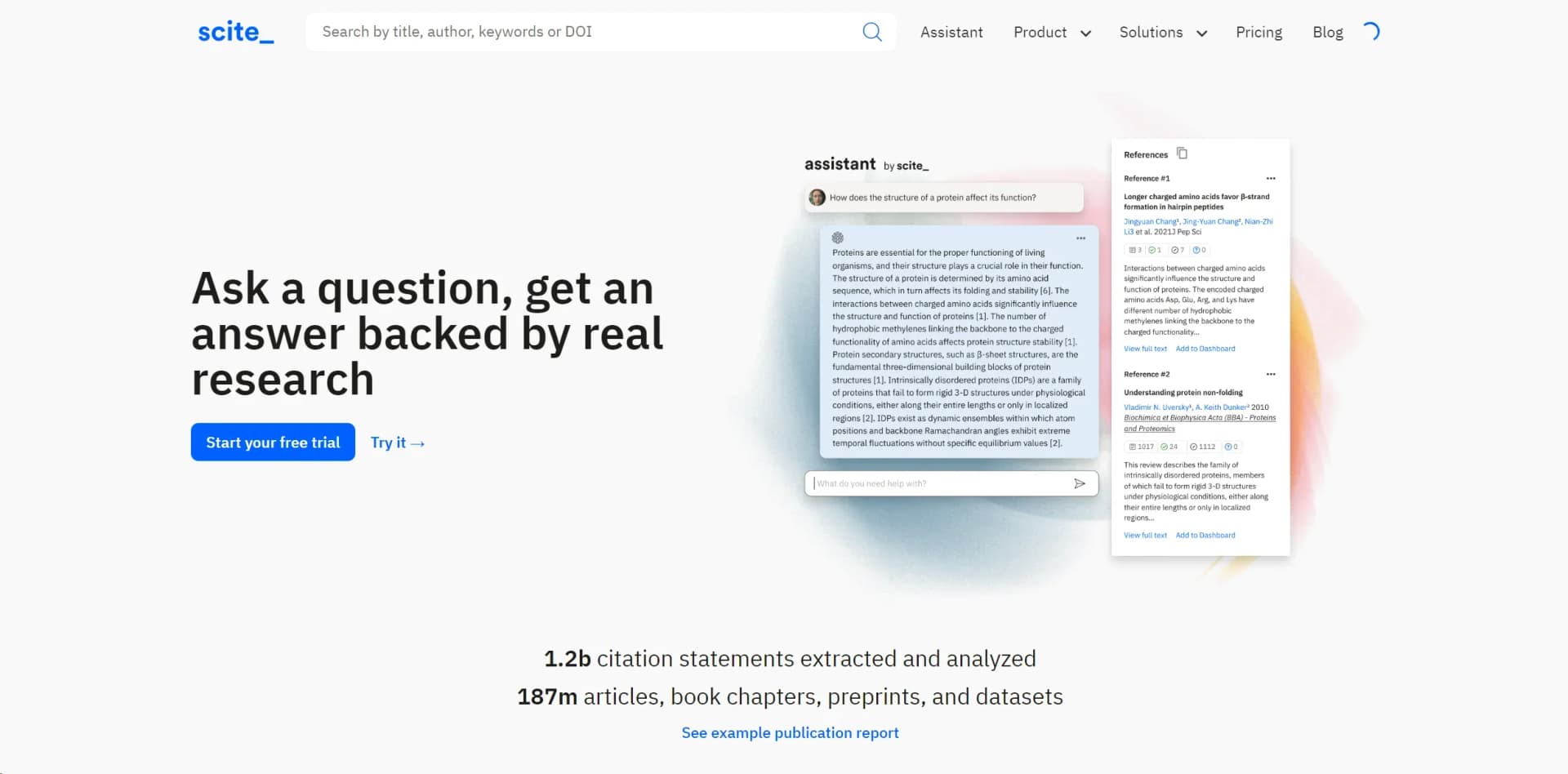
Scite is an innovative AI tool designed to revolutionize the way we interact with scientific literature. This platform enhances the research process by providing Smart Citations, which not only show how a publication has been cited but also the context and relevance of each citation. Developed with both the academic and corporate researcher in mind, Scite simplifies the daunting task of literature review and validation, offering a more efficient pathway through the maze of published research.
Scite stands out by not only tracking citations but also providing the context and significance of each citation through its Smart Citations feature. This capability is a game-changer in scientific research, where understanding the discourse surrounding findings is crucial.
Scite excels in enhancing the reliability and efficiency of research through its innovative use of Smart Citations. This tool is indispensable for anyone engaged in serious research, offering unparalleled support in navigating and verifying scientific literature. Its unique features, particularly the Smart Citations, provide an unmatched advantage, making Scite a vital resource in the academic and research community.
Who is Using Scite?
Academic Researchers
Leveraging the tool for comprehensive literature reviews and manuscript preparation.
Pharmaceutical Companies
Utilized for staying updated on drug development and clinical trials.
Government Agencies
Employed to track research outcomes and inform policy decisions.
Publishers
Used to enhance the discoverability and citation integrity of publications.
Uncommon Use Cases
Non-profit organizations use it to verify research before advocacy; legal professionals reference it for cases involving scientific evidence.
Key Features
Rating Breakdown
Pricing Plans
Free Trial
- Start with a free trial to explore the features without any initial investment
Subscription Plans
- Various tiers are available
- Catering to different user needs and organizational sizes
Which Scite plan should you pick?
Start with Free to test MCP access, choose Basic for the full platform, and upgrade to Pro when you need higher limits, expanded datasets, or API access.
Free
Good for users who want to try Scite through AI tools with 25 monthly MCP credits.
Basic
Good for individual researchers who need Assistant, Search, citation reports, alerts, dashboards, and collections.
Pro
Good for heavy researchers and developers who need API access, higher MCP usage, larger collections, and patent, clinical-trial, and grant datasets.
Scite Use Cases
Literature review
Search full-text scholarly literature and inspect how later studies support, contrast, or mention findings.
Outcome: More informed source selection and evidence synthesis.
Citation verification
Review Smart Citation classifications and citation statements before relying on a paper.
Outcome: Better understanding of whether research claims hold up.
Manuscript reference checking
Upload a manuscript PDF to identify retractions, editorial notices, and contrasting evidence among references.
Outcome: A reference report highlighting potential citation problems.
Research monitoring
Organize papers into Collections and monitor new citations and findings as literature develops.
Outcome: Ongoing awareness of updates in a research area.
AI-grounded research
Connect Scite to ChatGPT, Claude, Copilot, Cursor, or another MCP-compatible tool.
Outcome: AI answers grounded in searchable scholarly sources and citation context.
Workflow Ideas with Scite
Evidence-backed literature review
- 1Search Scite’s full-text scholarly index
- 2Review Smart Citation support and contrast classifications
- 3Save relevant papers to a Collection and monitor updates
Manuscript reference audit
- 1Upload a manuscript PDF to Reference Check
- 2Review retractions, editorial notices, and contrasting evidence
- 3Inspect flagged references and revise the manuscript bibliography
AI research verification
- 1Connect Scite MCP to ChatGPT, Claude, or another compatible AI tool
- 2Ask a research question and retrieve citation-backed sources
- 3Open citation context and full-text access instructions to verify claims
How Scite fits into your stack
Browser
Scite’s web platform runs in the browser for full-text literature search, AI Assistant queries, Collections, Smart Citation reports, and reference checking. Its browser extension adds citation context and Smart Citation badges to Google Scholar, PubMed, and journal pages.
Knowledge and files
Researchers can upload manuscript PDFs for Reference Check and import collections from Zotero, Mendeley, CSV files of DOIs, or search results. Collections organize papers, monitor new citations, and support focused Assistant questions.
Automation and APIs
Scite provides a documented API with endpoints for search, Assistant, Smart Citations, reference checking, metrics, and evidence datasets. Its MCP connects citation-backed research to ChatGPT, Claude, Copilot, Cursor, and other compatible AI tools.
Pros
- +Enhanced Research Efficiency: Dramatically reduces the time needed to assess the reliability and impact of research findings.
- +Increased Transparency: Provides clear visibility on how research has been previously interpreted, supporting or contradicting new findings.
- +User-Friendly Interface: Designed with the user in mind, making navigation and operation intuitive and straightforward.
- +Adaptable Tools: From creating custom dashboards to performing reference checks, the features are versatile and highly adaptable.
Cons
- −Learning Curve: New users may require some time to fully grasp the advanced features.
- −Subscription Cost: While offering immense value, the cost might be a consideration for individual researchers or smaller institutions.
Limitations & when to consider alternatives
Known limitations
- Free plan has limited access. The Free plan includes 25 MCP credits monthly but does not include Assistant or Search access.
- Usage and collection limits vary by plan. Basic includes 250 MCP credits and collections up to 1,000 papers; Pro includes 2,500 credits and collections up to 10,000 papers.
- Full-text access depends on entitlements. Access to paywalled content depends on open-access availability, institutional holdings, or configured library integrations.
- Reference Check may miss some references. References without DOIs, including some news articles and policy documents, may not appear in Reference Check reports.
- Uploaded Reference Check PDFs are temporary. Uploaded PDFs are stored in a restricted bucket during processing and automatically deleted after report generation.
Look elsewhere when
- You need a native mobile app.
- You need model fine-tuning on your own data.
- You need image or vision analysis.
How to Use Scite
- 1
Scite offers comprehensive tutorials that guide users from basic operations to advanced features, ensuring that all functionalities are maximally utilized.
Who is Scite For?
Researchers
Scite helps researchers discover literature, inspect citation context, and evaluate whether findings are supported or contradicted.
Students
Students can use Scite for literature searches, citation-backed answers, and evaluating sources for academic work.
Industry experts
Industry experts can use Scite to investigate scientific evidence, patents, clinical trials, grants, and related research.
Librarians and institutions
Institutional users can connect holdings, configure SSO, and provide access to licensed full-text research.
AI tool builders
Developers can use the API or MCP to add scholarly search, Smart Citations, and evidence data to AI workflows.
Frequently Asked Questions
Does Scite have a free plan?
Yes. The Free plan includes 25 MCP credits per month, but excludes Assistant and Search access.
Does Scite offer a free trial?
Yes. Basic and Pro offer a seven-day free trial for new users.
What does Scite’s API provide?
The API provides programmatic access to literature search, Assistant responses, citation classifications, tallies, Reference Check, metrics, and evidence datasets.
Can Scite analyze my own documents?
Yes. Assistant can accept uploaded PDFs or documents and answer questions about them alongside Scite’s indexed literature.
Does Scite support institutional SSO?
Yes. Institutional license holders can configure SAML-based single sign-on at the organizational level.
Can teams use Scite?
Yes. Team plans support inviting colleagues and providing shared access for small teams.
Community reviews
Be the first to share your experience.
Sign in to leave a review for Scite.
Scite Alternatives
Looking for alternatives to Scite? Here are similar tools in the same category:
Learn to Master Scite
With Skill Leap courses
Get in-depth training on Scite and 50+ other AI tools with our expert-led video courses.
Start 7-Day Free Trial