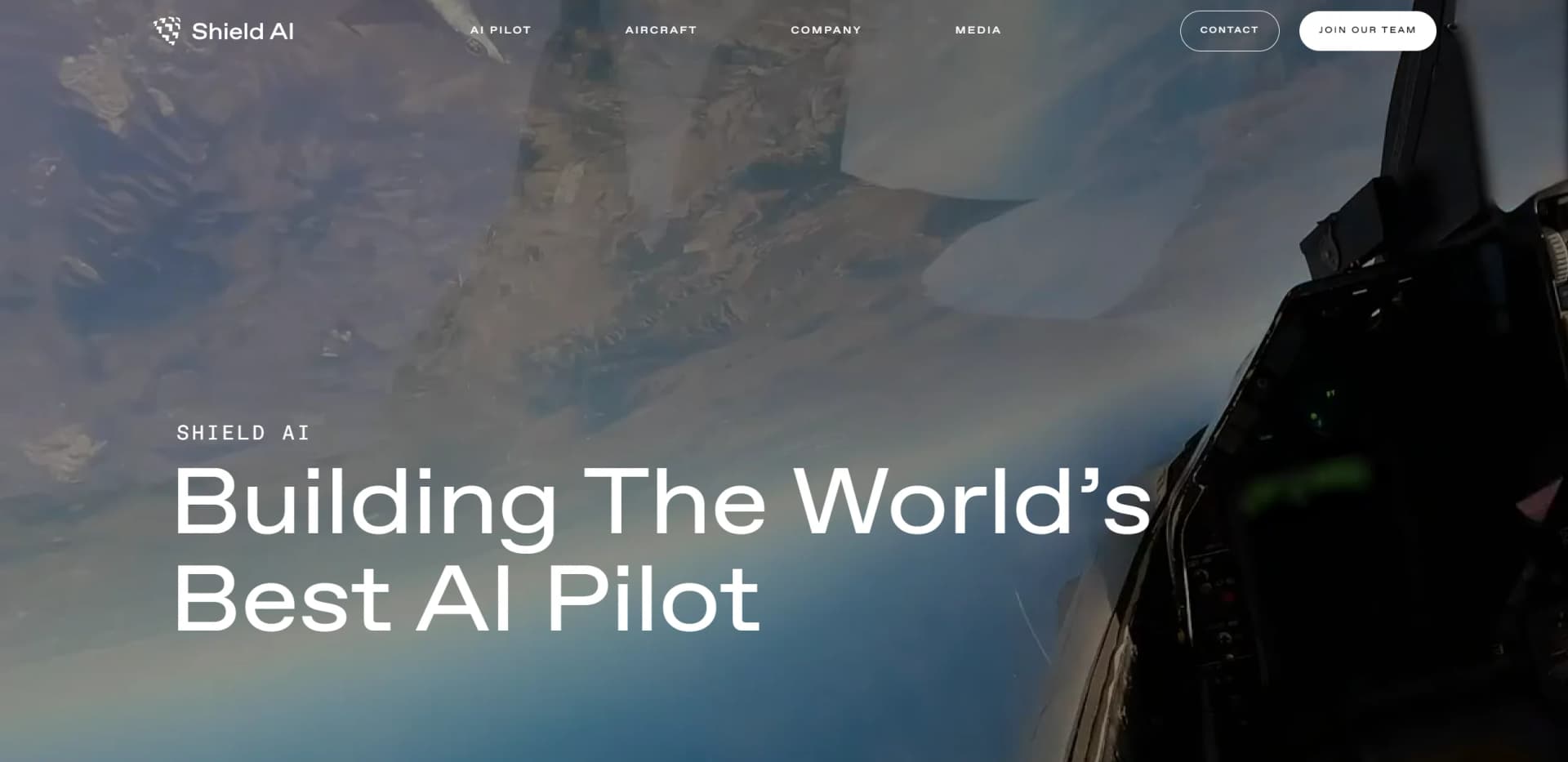
Shield AI
Autonomous AI pilots revolutionize aviation, enhancing safety and efficiency.
Key Takeaways
- What it is
- Autonomous AI pilots revolutionize aviation, enhancing safety and efficiency.
- Best for
- Hivemind AI
- V-BAT Teams
- Nova 2
- Rating
- 4.5/5
What is Shield AI?
Shield AI, is at the forefront of revolutionizing aviation with its groundbreaking AI pilot technology. Known as Hivemind, this AI pilot is designed to autonomously control drones and aircraft, enabling them to operate without the need for GPS, communications, or a human pilot. Shield AI's mission is to enhance safety for service members and civilians by leveraging intelligent systems. Their innovative approach simplifies complex aviation tasks, making it a go-to solution for both military and commercial applications.
Shield AI distinguishes itself with its Hivemind AI pilot, a pioneering technology that allows aircraft to operate autonomously without GPS or human intervention. This capability is a game-changer in both military and commercial aviation, offering unparalleled flexibility and efficiency.
Shield AI is transforming the landscape of aviation with its Hivemind AI pilot, offering a robust solution for autonomous flight operations. Its cutting-edge technology not only enhances safety and efficiency but also provides a strategic advantage in military and commercial sectors. Whether it's for battlefield supremacy or commercial logistics, Shield AI ensures a future where AI pilots are integral to aviation's evolution.
Who is Using Shield AI?
Military Forces
Utilizing AI pilots for enhanced battlefield operations.
Defense Contractors
Employing AI for developing next-gen military technology.
Aviation Industry
Integrating AI for autonomous aircraft control.
Logistics Companies
Leveraging AI for efficient cargo transportation.
Uncommon Use Cases
Oil and gas inspection services; educational institutions teaching AI in aviation.
Key Features
Rating Breakdown
Pricing Plans
Custom Solutions
- Shield AI offers tailored solutions based on specific needs and applications
Shield AI Use Cases
GPS-denied ISR and targeting
Operators use autonomous aircraft to conduct intelligence, surveillance, reconnaissance, and targeting in contested environments.
Outcome: Persistent mission execution despite GPS or communications disruption.
Multi-agent teaming
Hivemind coordinates multiple autonomous aircraft or vehicles during shared missions.
Outcome: A single operator can supervise coordinated autonomous systems.
Autonomy development and deployment
Organizations design, test, evaluate, and deploy mission autonomy across their own platforms.
Outcome: Faster transition from autonomy concept to operational flight.
Post-flight debrief
Shield AI’s analytics platform evaluates, scores, and visualizes flight maneuvers.
Outcome: Structured analysis for pilot and autonomy training.
Maritime surveillance
Hivemind-enabled systems search maritime areas, identify vessels, and coordinate responses.
Outcome: Autonomous wide-area maritime intelligence and surveillance.
Workflow Ideas with Shield AI
Catalyst Trial integration
- 1Bring an unmanned system, engineering team, and mission objective.
- 2Integrate Hivemind through software-in-the-loop, hardware-in-the-loop, and vehicle testing.
- 3Conduct a live flight demonstration and evaluate operational performance.
Build and field mission autonomy
- 1Define mission objectives and required autonomous capabilities.
- 2Develop and validate behaviors through simulation and integration testing.
- 3Deploy the validated autonomy to the target platform and mission.
Autonomous maritime search
- 1Plan waypoints and designate the maritime search area.
- 2Use radar, imagery, and AIS data to identify a vessel of interest.
- 3Coordinate autonomous vehicles to monitor or escort the vessel.
How Shield AI fits into your stack
Automation and APIs
Hivemind sits in autonomy-development workflows through its SDK, simulation, testing, analysis, and integrations with systems such as Palantir and Sedaro.
Pros
- +Autonomous Operation: Eliminates the need for GPS and human intervention, enhancing operational efficiency.
- +Combat Proven: Deployed since 2018, offering reliable performance in real-world scenarios.
- +Cost-Effective: Reduces operational costs with minimal infrastructure requirements.
- +Adaptability: Suitable for various environments, from sea to air and land.
Cons
- −Initial Investment: High upfront costs for deploying advanced AI systems.
- −Complexity: May require specialized training for optimal utilization.
- −Limited Civilian Use Cases: Primarily designed for military applications, with fewer civilian adaptations.
Limitations & when to consider alternatives
Known limitations
- Defense and mission-specific focus. Shield AI positions Hivemind around military, OEM, government, and mission-critical autonomy applications rather than general-purpose consumer AI.
- Customer hardware is required for Catalyst trials. The Catalyst Trial Program expects customers to provide an unmanned system, a small engineering team, and a mission objective.
- Catalyst trials are time-bound. The Catalyst Trial Program is described as a three-month integration and flight-demonstration engagement.
- Public self-service access is limited. Shield AI directs prospective customers to contact the company rather than offering public self-service signup or published plan pricing.
Look elsewhere when
- You need a consumer-facing conversational AI tool.
- You need a public self-service API with documented endpoints.
How to Use Shield AI
- 1
Contact Shield AI
Start through the company’s contact process because Hivemind is sold and deployed through customer engagements.
- 2
Define the mission
Specify the operational objective, platform, environment, and autonomous behaviors that need to be achieved.
- 3
Provide the target system
For a Catalyst engagement, bring the unmanned system, a small engineering team, and the mission objective.
- 4
Integrate Hivemind
Use the autonomy stack and integration tooling to connect Hivemind with the target aircraft, vehicle, or robotic platform.
- 5
Test and validate
Progress through software-in-the-loop, hardware-in-the-loop, vehicle, simulation, and integration testing.
- 6
Demonstrate and scale
Conduct flight or field demonstrations, assess results against mission objectives, and plan wider deployment across platforms.
Who is Shield AI For?
Militaries
Hivemind supports autonomous mission execution, GPS-denied operations, ISR, targeting, and coordinated systems.
Aircraft and robotics OEMs
The platform-agnostic autonomy stack helps OEMs integrate AI pilots across aircraft, drones, maritime systems, and robotics.
Autonomy developers
Developers receive software tools, middleware, simulation, testing, evaluation, and deployment capabilities.
Governments and defense agencies
Shield AI works with government organizations seeking sovereign development and deployment of mission autonomy.
Frequently Asked Questions
What is Hivemind?
Hivemind is Shield AI’s end-to-end autonomy software for building and scaling AI pilots across unmanned platforms.
Who is Hivemind designed for?
Shield AI positions Hivemind for militaries, OEMs, developers, and organizations building autonomous intelligent machines.
What environments can Hivemind operate in?
Hivemind is designed for operations in GPS-denied and communications-jammed environments.
What does Hivemind Enterprise include?
The suite includes an integrated autonomy factory, production-ready middleware, an autonomy catalog, and mission control.
Can customers build their own autonomy?
Yes. Shield AI says customers can develop, test, deploy, and retain rights to autonomy built for their unmanned systems.
What is the Hivemind Catalyst Trial Program?
It is a three-month integration and flight-demonstration program for evaluating Hivemind on a customer’s unmanned system.
Community reviews
Be the first to share your experience.
Sign in to leave a review for Shield AI.
Shield AI Alternatives
Looking for alternatives to Shield AI? Here are similar tools in the same category: