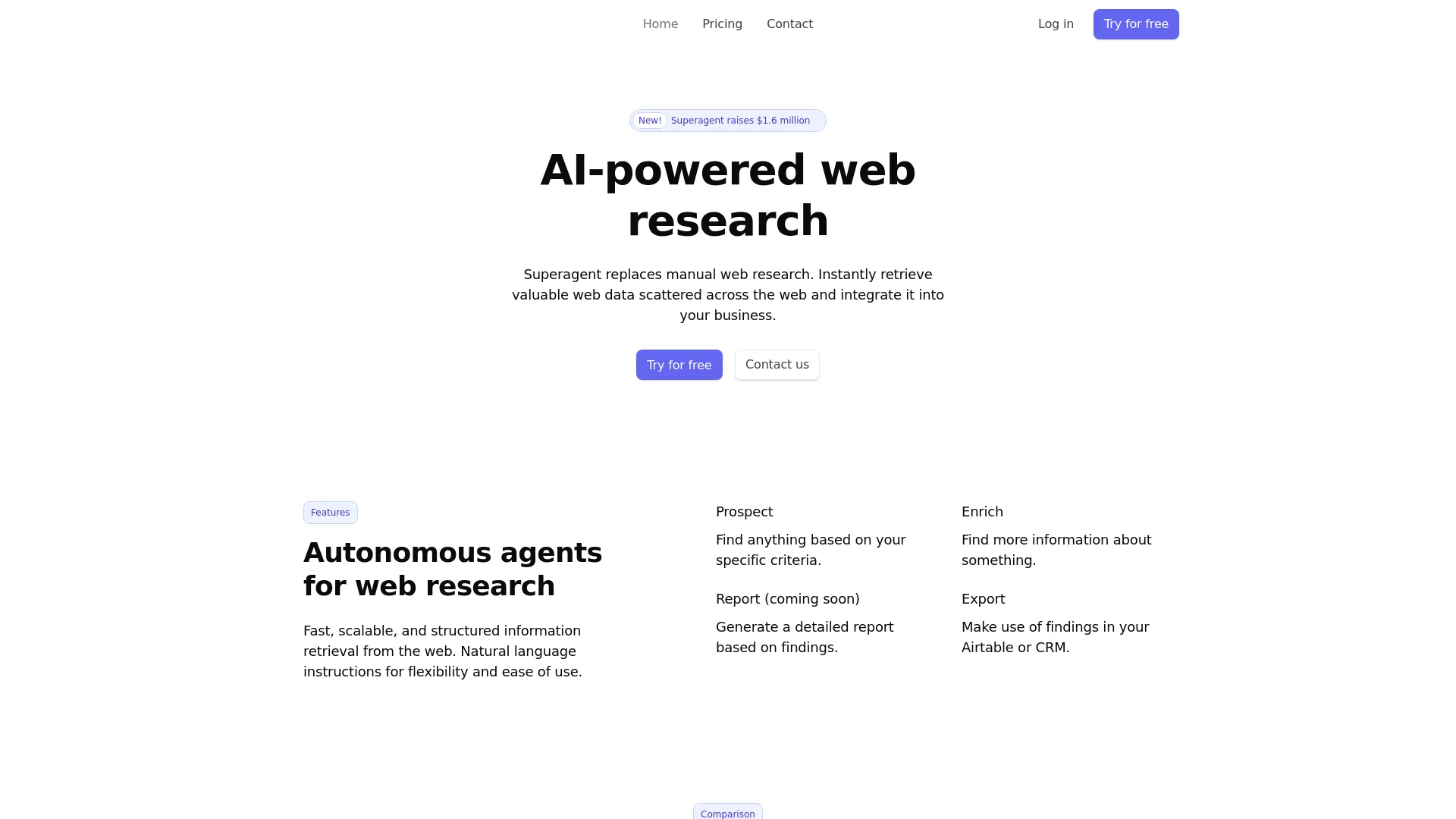
Superagent
Revolutionize web research with AI-driven browsing and Airtable integration.
Key Takeaways
- What it is
- Revolutionize web research with AI-driven browsing and Airtable integration.
- Pricing
- Freemium
- Best for
- AI-driven Web Browsing
- Integration with Airtable
- Robust API
- Rating
- 4.6/5
What is Superagent?
Superagent is an advanced AI tool designed to transform web research by using large language models (LLMs) to autonomously browse the internet and manage information. It integrates seamlessly with platforms like Airtable and provides a robust API for custom automation. Superagent is ideal for users who need to efficiently gather, organize, and analyze large volumes of data.
Superagent is distinguished by its direct integration with Airtable, which offers a unique advantage for users already utilizing this platform. Its AI-driven approach to automating and managing web research tasks provides a significant edge in efficiency and accuracy.
Superagent excels in automating and optimizing web research with its AI-driven technology and integration capabilities. It offers a valuable tool for users needing to manage and analyze large amounts of data efficiently, making it a strong asset for both individual and enterprise-level research tasks.
Who is Using Superagent?
Market Researchers
For detailed market trend analyses and competitor research.
Academic Researchers
To gather extensive academic and scientific data.
Content Creators
For content curation and fact verification.
Data Analysts
To pull and organize large datasets for analysis.
Uncommon Use Cases
Non-profits gathering data on grant opportunities; startups researching potential investors.
Key Features
Rating Breakdown
Pricing Plans
Free Tier
Free
- Basic access to test Superagent's capabilities
Pro Tier
- More advanced features available at a competitive rate
Which Superagent plan should you pick?
Start with Free for open-source or initial private-repository use, then upgrade to Starter, Growth, or Scale as monthly security volume increases.
Free
Good for teams getting started on private repositories who need 100 private credits per month.
Starter
Good for teams securing their first private repositories who need 500 credits per month.
Growth
Good for teams running security throughout development who need 2,000 credits per month.
Scale
Good for high-volume security programs that need at least 6,000 credits per month.
Superagent Use Cases
Scan pull requests
Connect a GitHub repository so Superagent scans pull requests, dependency changes, and contributor trust.
Outcome: Security findings and checks appear directly on pull requests.
Red-team an AI application
Create an adversarial report against a repository, web app, agent, or installable package.
Outcome: Findings include severity, reproduction steps, and the payload that worked.
Protect agent context
Score files, URLs, email, packages, skills, and MCP repositories before an agent consumes them.
Outcome: Agents receive safety verdicts and threat details for external context.
Enforce runtime rules
Monitor coding-agent activity and define endpoint-local rules for commands, tool calls, and sequences.
Outcome: Risky actions can be detected or blocked when supported by the agent hook.
Triage security findings
Review findings in a centralized queue, run automated triage, and inspect proposed patches.
Outcome: Confirmed issues can be resolved or turned into fix pull requests.
Workflow Ideas with Superagent
Secure every pull request
- 1Install the Superagent Security GitHub App on selected repositories
- 2Run PR, dependency, and contributor-trust checks on repository activity
- 3Review findings and proposed fixes in Superagent
Run scheduled red-team assessments
- 1Create a repository, web-app, agent, or package report
- 2Configure execution on a release, tag, or schedule
- 3Review completed findings and triage confirmed issues
Guard external agent context
- 1Submit a web page, email, file, package, skill, or MCP repository
- 2Wait for identity, behavior, and content scoring
- 3Allow or investigate the context based on its verdict and threats
How Superagent fits into your stack
Airtable Compatibility
Seamlessly integrates with Airtable for efficient data management.
API Access
Comprehensive API for custom solutions and automation.
Cloud-Based
Operates in the cloud, ensuring accessibility and scalability.
Multi-Platform Support
Compatible with various operating systems and devices.
Pros
- +Enhanced Research Efficiency: Automates data collection, significantly speeding up the research process.
- +High Accuracy: Employs advanced AI to ensure data is accurate and relevant.
- +Scalability: Suitable for various scales of research, from individual projects to large enterprise tasks.
- +Cost-Effective: Reduces manual research efforts, lowering labor costs and time.
Cons
- −Learning Curve: Users may need time to become proficient with Airtable integration and API use.
- −Dependency on Internet Connectivity: Requires a stable internet connection to function effectively.
- −Limited Offline Functionality: Does not offer significant offline capabilities.
Limitations & when to consider alternatives
Known limitations
- Credits are usage-based. PR scans, red-team reports, and context checks consume credits, while some products are included.
- Credits expire monthly. Monthly credit allocations expire at the end of each allocation period and do not roll over.
- Runtime blocking depends on agent hooks. Post-action events and sources without a supported synchronous pre-action hook remain detection-only.
- MCP scans are repository-only. MCP scans inspect public GitHub repository contents but do not connect to live MCP endpoints or execute servers.
- Red-team reports require target access. Repository reports require the GitHub App, web-app reports require a public HTTP or HTTPS URL, and package reports require installation instructions.
How to Use Superagent
- 1
Access detailed tutorials on the Superagent website, covering everything from basic setup to advanced features.
Who is Superagent For?
AI-native developers
Superagent is designed to secure AI applications, agents, repositories, and runtime activity.
Teams securing private repositories
Private-repository plans provide credits for PR scans, red-team reports, and context checks.
Open-source maintainers
Public repositories receive unlimited free usage across the Superagent suite.
Security teams
Security teams can centralize findings, run adversarial reports, manage guardrails, and monitor contributor trust.
Teams using coding agents
Superagent integrates with coding agents through its skill, MCP server, API, and webhooks.
Frequently Asked Questions
What is Superagent?
Superagent provides security for AI-native developers, including pull-request scanning, red teaming, runtime guardrails, and context guardrails.
How do I get started?
Create an account, connect GitHub, and connect Superagent to a coding agent through its skill or MCP server.
Does Superagent offer a free plan?
Yes. Public repositories receive unlimited free usage, and private repositories have a $0 plan with 100 private credits per month.
Which coding agents can Superagent connect to?
The documented skill supports Cursor, Claude Code, Codex CLI, and other MCP clients.
What can Context Guardrails scan?
It can score web pages, email, files, agent skills, GitHub-hosted MCP repositories, and registry packages.
Can Superagent automate security workflows?
Yes. Reports can run on schedules or GitHub events, and webhooks can send report, finding, contributor-trust, and agent-monitoring events to external systems.
Community reviews
Be the first to share your experience.
Sign in to leave a review for Superagent.
Superagent Alternatives
Looking for alternatives to Superagent? Here are similar tools in the same category: