
Yarnit
Turn briefs into campaigns, product pages, and reports.
Key Takeaways
- What it is
- Turn briefs into campaigns, product pages, and reports.
- Pricing
- $69 per user per month · $159 per user per month (starting price)
- Best for
- Agentic marketing copilot (Ask Yarnit)
- Campaign Manager & AI SDR Agent
- Contextual intelligence & brand hub
- Rating
- 4.5/5
What is Yarnit?
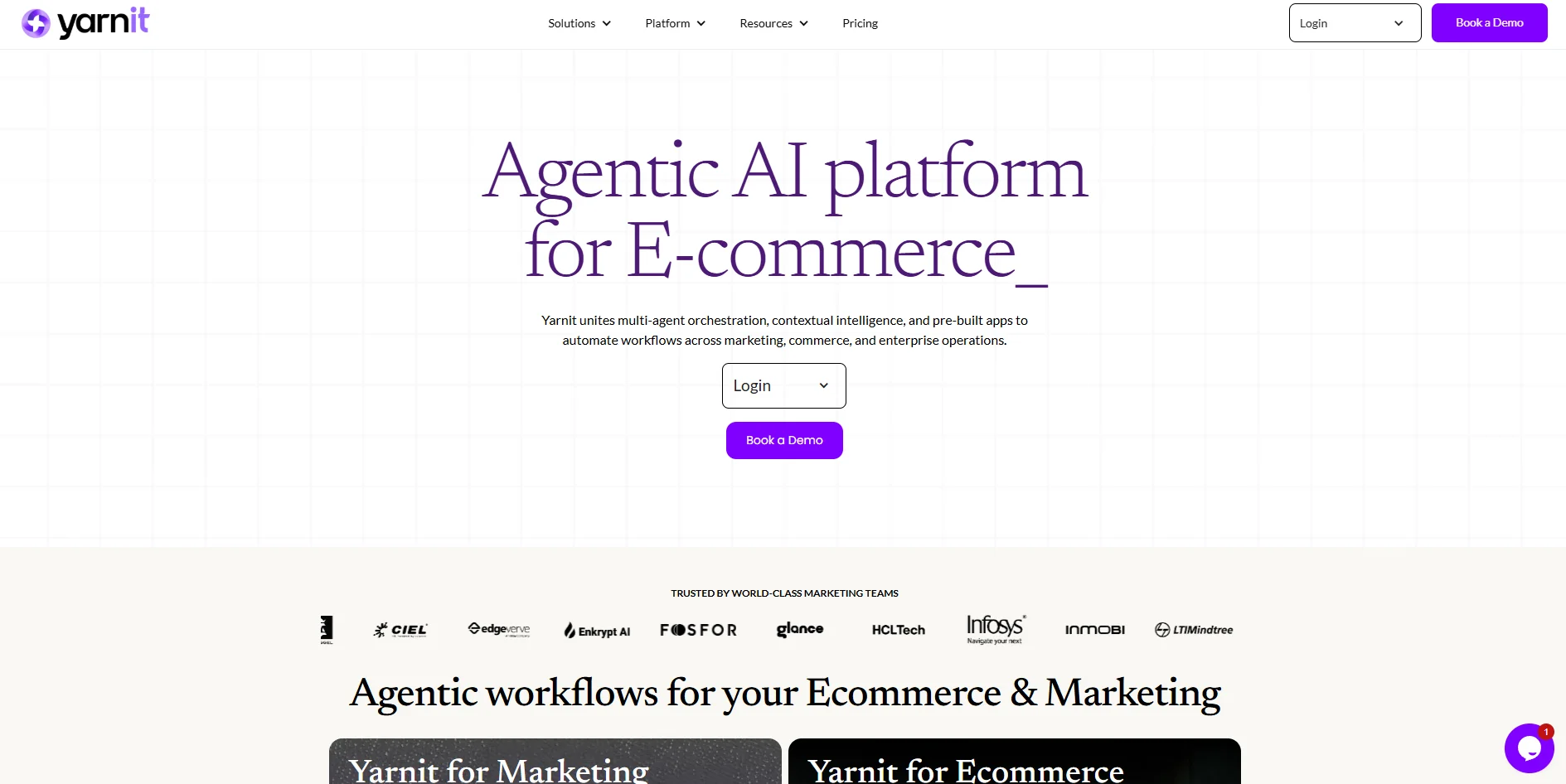
Yarnit is a Gen AI marketing and ecommerce platform that behaves like a full-stack marketing team in one app. It blends generative content, multi-agent automation, and contextual intelligence so organizations can turn briefs into channel-ready copy, creatives, product pages, and reports in minutes. Instead of a single chatbot, Yarnit uses coordinated AI agents that handle SEO, market research, campaign planning, sales development, and analytics while staying aligned with each brand’s voice and guidelines.
Yarnit stands out by combining true multi-agent orchestration with a context-rich knowledge system tied to each brand. Instead of expecting users to stitch together separate tools for SEO, copy, design, and analytics, Yarnit coordinates dozens of specialized agents behind the scenes and feeds them structured brand and market knowledge. That mix lets teams move from “blank page” to campaign, PDP, or newsletter in a single environment while still respecting tone, compliance rules, and channel nuances. Its focus on ecommerce workflows, plus support for industries like healthcare and financial services, gives it a broader operational footprint than many lightweight marketing copilots.
Yarnit delivers a sophisticated AI stack for organizations that want campaign-ready content, ecommerce assets, and research in minutes rather than days, without sacrificing brand control. Its agent-based system, contextual intelligence, and industry-tuned workflows make it especially compelling for ecommerce, B2B, and regulated sectors that need both speed and accuracy. For teams ready to modernize how they produce and manage marketing content, Yarnit offers a very capable alternative to building an in-house AI stack from scratch.
Who is Using Yarnit?
Ecommerce & Retail Brands
Using the platform for SEO-rich PDPs, seasonal catalog refreshes, and on-brand lifestyle creatives.
B2B Marketing Teams & Agencies
Running content marketing, performance campaigns, ABM programs, and sales development workflows.
Media & Publishing Organizations
Producing articles, newsletters, and audience growth campaigns informed by real-time research and analytics.
Healthcare, Pharma & Financial Services Marketers
Accelerating literature reviews, compliant content production, and regulated campaign workflows.
Uncommon Use Cases
Product and QA teams in automotive and manufacturing using Yarnit to generate test cases far faster; consulting and professional services firms automating RFP responses and scaled ABM outreach.
Key Features
Rating Breakdown
Pricing Plans
Standard
$69 per user per month
- Add up to 5 seats
- Unlimited text generation, 50 projects per month, 3 active campaigns, 20 Ask Yarnit sessions per day, 100 studio credits, 1 brand setup, up to 10 brand knowledge assets, and self-serve + guided onboarding
Business
$159 per user per month (starting price)
- Minimum 5 seats
- Unlimited text generation, 200 projects per month, 10 active campaigns, 50 Ask Yarnit sessions per day, 400 studio credits, 10 brand setups, up to 100 brand knowledge assets, personalized onboarding with brand setup assistance, usage insights, custom reports, optional third-party integrations, and SSO
Which Yarnit plan should you pick?
Start with Launch for an early-stage store, move to Growth as SKU volume and connected-store needs increase, and choose Enterprises for larger catalogs and multiple stores.
Launch
Good for early-stage D2C brands that need one connected store, up to 500 SKUs, 750 credits, and 200 GB of project storage.
Growth
Good for growing retailers that need up to 2,500 SKUs, more credits, additional stores, and 1 TB of storage.
Enterprises
Good for enterprise brands and aggregators that need multiple connected stores, up to 8,000 SKUs, 10,000 credits, and unlimited storage.
Yarnit Use Cases
SEO Content Campaigns
Plan pillar pages, supporting blog posts, meta descriptions, and internal-linking strategies.
Outcome: Search-optimized content campaigns.
Social Media Campaigns
Create themed post series, platform-specific content, hashtag campaigns, and carousels.
Outcome: Coordinated social campaigns across channels.
Product Launches
Generate announcement blogs, demo-video scripts, feature posts, and launch assets.
Outcome: A complete set of product-launch materials.
Lead Generation
Create ebooks, nurture email sequences, webinar content, and supporting social promotion.
Outcome: A multi-format lead-generation campaign.
Ecommerce Catalog Optimization
Analyze product listings, identify gaps, and generate improved copy, metadata, visuals, and recommendations.
Outcome: More complete, search-ready product pages.
Workflow Ideas with Yarnit
Build a campaign from a brief
- 1Define campaign objectives, KPIs, audience, channels, and timeline.
- 2Select content types and configure the campaign plan.
- 3Review and refine the generated briefs.
- 4Generate the campaign assets and track approvals.
Create an on-brand content system
- 1Import brand guidelines, tone, assets, and past campaigns.
- 2Configure SEO Hub, Writer, Creative Studio, or Campaign Manager.
- 3Set approvals, publishing channels, frequency, and goals.
- 4Publish content and let agents optimize from performance data.
Optimize an ecommerce catalog
- 1Connect Shopify or a custom ecommerce platform.
- 2Configure PDP, creative, and campaign applications.
- 3Set a publishing cadence for catalog and creative updates.
- 4Push optimized content to ecommerce channels.
How Yarnit fits into your stack
Browser
Yarnit is delivered as a web-based marketing workspace through the Yarnit Hub, where users access AI apps, Ask Yarnit, campaigns, and content tools.
Docs and writing
The platform supports AI-assisted writing, SEO content, blogs, social posts, emails, landing pages, ads, ebooks, and whitepapers.
Knowledge and files
Knowledge Hub ingests webpages and uploaded business files, extracts structured knowledge, and supplies context during content creation.
Automation and APIs
Campaign Manager orchestrates research, planning, generation, approvals, scheduling, and optimization; Yarnit also advertises SaaS, API, and on-premise deployment options.
Pros
- +Marketing-first design: Built specifically for marketing, ecommerce, and go-to-market teams rather than being a generic text generator.
- +Huge time savings: Customer stories point to content creation cycles shrinking from roughly an hour to a few minutes, with better ad approval rates and traffic lifts.
- +Strong ecommerce depth: Direct support for PDPs, seasonal catalog updates, and lifestyle creatives makes it attractive for retailers and consumer brands.
- +Brand consistency at scale: Central brand voice, personality, and visual guideline controls help large teams keep messaging aligned across channels.
- +Enterprise readiness: Security posture, deployment options, and custom workflow support suit regulated industries and larger organizations.
Cons
- −Pricing transparency: Public, line-item pricing is limited, so many teams will need a demo or sales call to understand total cost.
- −Learning curve for full power: Getting the most from multi-agent workflows, brand hubs, and custom workflows can take time and process change.
- −Best suited to serious teams: Solo creators or very small teams with light needs may find the enterprise focus more than they require.
Limitations & when to consider alternatives
Known limitations
- Free plan has limited features. The free account is usable, but premium features require an upgrade.
- Campaign size is limited. Campaign Manager supports up to 50 content pieces in a single campaign.
- Large-screen web access. Yarnit is optimized for large-screen devices such as laptops and desktops.
- Not PCI or HIPAA compliant. Yarnit states that customers should not submit cardholder or protected health information.
Look elsewhere when
- You need a native mobile app.
- You need a downloadable desktop application.
- You need documented developer API endpoints and API keys.
- You need PCI or HIPAA-compliant handling of sensitive data.
How to Use Yarnit
- 1
Create an account
Sign up through Yarnit.app with your name, email address, institution, and password.
- 2
Connect brand context
Import brand guidelines, tone, assets, and past campaigns so outputs reflect your organization.
- 3
Choose an AI application
Select tools such as Ask Yarnit, SEO Hub, Writer, Creative Studio, or Campaign Manager.
- 4
Configure guardrails and cadence
Set approvals, channels, frequency, and campaign goals before publishing.
- 5
Generate and review content
Create campaign assets, review drafts, add comments, and manage approvals from the campaign dashboard.
- 6
Publish and optimize
Publish across supported channels and use performance data to improve future outputs.
Who is Yarnit For?
Content Marketers
Yarnit provides AI-assisted writing, content repurposing, SEO content, and campaign asset generation.
Digital Marketers
Yarnit supports performance marketing, compliant ad copy, keyword research, campaign planning, and analytics.
Social Media Marketers
Yarnit helps teams ideate, create, schedule, publish, and analyze social media content.
Product Marketers
Yarnit creates product narratives, launch materials, product descriptions, and multi-channel campaign content.
Ecommerce and Retail Teams
Yarnit optimizes product catalogs, PDPs, product visuals, SEO, and publishing across ecommerce channels.
Frequently Asked Questions
Can I use Yarnit on multiple devices?
Yes. Yarnit is a web app for large-screen devices and works through Chrome, Safari, and Edge.
Is creating a Yarnit account free?
Yes. Account creation is free, although the free plan has limited features and premium plans offer a seven-day free upgrade.
What content can Yarnit create?
Yarnit can create blog posts, social media posts, emails, product descriptions, presentations, announcements, advertisements, and more.
How does Campaign Manager collaboration work?
Team members can review content, track generation status, comment, and manage approvals from a shared dashboard.
What information does Yarnit use for marketing outputs?
Yarnit can use brand guidelines, tone, assets, past campaigns, market data, and campaign history.
What security protections does Yarnit provide?
Yarnit states that customer data is encrypted at rest and in transit using AES-256 and TLS v1.2, with SSO, MFA, and role-based access control.
Community reviews
Be the first to share your experience.
Sign in to leave a review for Yarnit.
Yarnit Alternatives
Looking for alternatives to Yarnit? Here are similar tools in the same category:
Learn to Master Yarnit
With Skill Leap courses
Get in-depth training on Yarnit and 50+ other AI tools with our expert-led video courses.
Start 7-Day Free Trial